


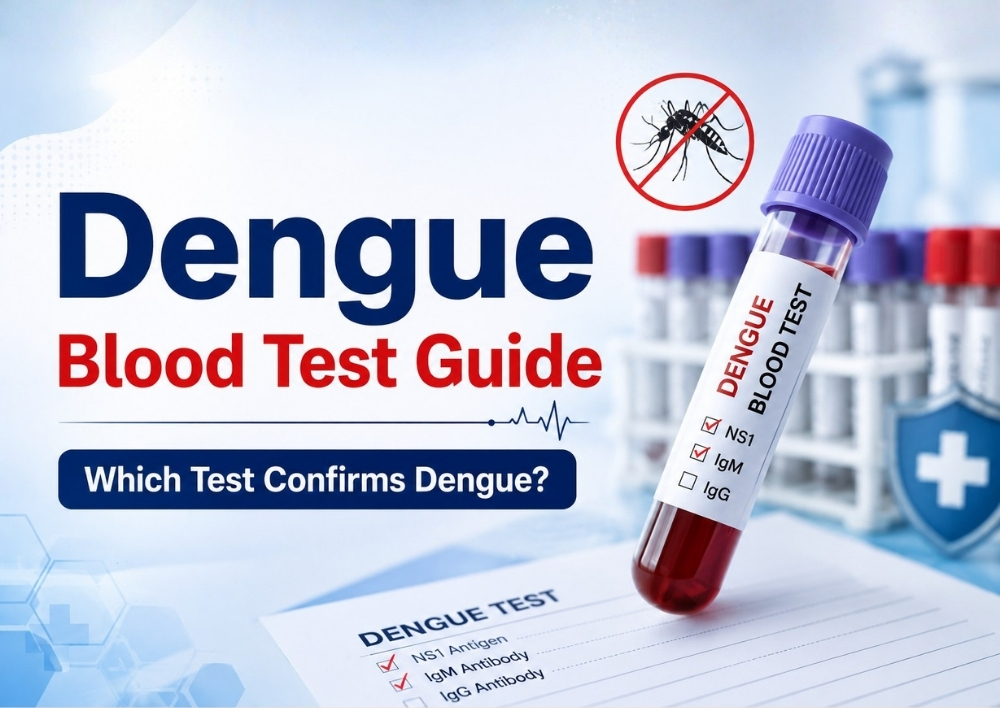
Dengue Test Guide: Which Blood Test Confirms Dengue and When Should You Get Tested?

- What Is a Dengue Blood Test?
- Which Blood Test Confirms Dengue?
- Which Dengue Blood Test to Take?
- When Should You Go for a Dengue Blood Test?
- What Other Blood Tests Are Done During Dengue?
- When Should You See a Doctor Immediately?
- Get the Right Dengue Test at the Right Time
- Comprehensive Dengue Testing and Healthcare Under One Roof
Summary
A sudden high fever with severe body aches, headache, nausea, or weakness can leave you wondering: Is it just a viral fever, or could it be dengue? Since dengue fever symptoms can be similar to other infections, a blood test is often needed to confirm the cause. But with different dengue tests available, knowing which test to take and when to get tested is equally important.
The timing of blood tests for dengue matters because different tests detect different markers of the infection at different stages. An NS1 antigen test or RT-PCR may be useful during the early days of fever, while an IgM antibody test becomes more useful as the illness progresses. A CBC may also be recommended to monitor platelet count and other blood parameters, but it cannot confirm dengue by itself.
If you are wondering which dengue virus test you require and when the appropriate time is for the test, this blog will definitely guide you through the process. Here, you will learn about the various blood tests done for dengue, the ideal time for each dengue test, how the results of the test are understood, and also CBC and platelet tests.
What Is a Dengue Blood Test?
First of all, we will understand what a dengue virus test is and why it is recommended.
A dengue blood test is a laboratory test used to detect evidence of dengue virus infection in the body. As the various markers of dengue infection emerge at different points in time, the test prescribed by your doctor might vary depending on the number of days since the first day of your fever.
Depending on the point in time during dengue infection, the test for dengue can include
-
NS1 antigen: A protein marker of dengue infection that helps detect the infection during the early phase of infection.
-
Dengue viral RNA: A genetic component of the virus that can be detected using molecular diagnostic tests such as RT-PCR or NAAT
-
IgM antibodies: Immune system proteins produced as a reaction to the dengue infection that typically become more relevant a few days after the appearance of symptoms.
-
IgG antibodies: A marker of a past or a recent dengue infection that can be relevant in certain cases.
According to Dr. Swati Kapoor, Internal Medicine Doctor in Gurgaon at Miracles Healthcare, "The right test for dengue infection at the right time will assist in diagnosing the disease and appropriate monitoring of the patient.
It is important to realize that no one test for dengue is equally effective on all days of the infection. It all depends on the duration of symptoms, the clinical situation, prior dengue infection, and the doctor's opinion. That is why it is necessary to know the date of your fever when you take the dengue test."
Which Blood Test Confirms Dengue?
Several blood tests can help detect dengue infection, but the usefulness of each test depends on when the blood sample for dengue test is collected. Some dengue serology tests are the best during the early phase of illness, while antibody tests become more helpful as the infection progresses.
|
Dengue Test |
What Does It Detect? |
When Is It Useful? |
What Does a Positive Result Indicate? |
|
NS1 Antigen Test |
NS1 protein associated with the dengue virus |
Generally most useful during the first 1–5 days of illness |
Provides evidence of dengue infection, particularly during the early phase |
|
RT-PCR / Molecular Test |
Dengue viral RNA |
Mainly useful during the early/acute phase of infection |
Detects the presence of dengue viral genetic material |
|
Dengue IgM Test |
IgM antibodies produced by the immune system |
Usually becomes more useful around day 5 onward |
Suggests a recent dengue infection when interpreted with symptoms and other findings |
|
Dengue IgG Test |
IgG antibodies against dengue |
Appears later and may remain detectable for a longer period |
May indicate previous or recent exposure; a positive result alone does not necessarily confirm an active infection |
Which Dengue Blood Test to Take?
Your choice of dengue test will depend on how many days into the illness you are. Antigen or molecular tests can be considered during the early phase of fever, whereas an IgM test may be recommended a few days into the infection period as antibodies begin to develop.
Moreover, your physician will be able to recommend the appropriate tests depending on the dengue symptoms, medical history, duration of fever, and the results of any initial tests.
Negative test results do not always mean that a patient does not have dengue, particularly when testing is performed very early in the infection. If symptoms continue or clinical suspicion remains high, your doctor may recommend repeat or additional testing.
Dr. Swati Kapoor says,“The timing of dengue testing is important, and a negative early test may need to be followed by repeat testing when symptoms and clinical suspicion continue.”
When Should You Go for a Dengue Blood Test?
It is recommended to conduct the dengue lab test after a certain period of time depending on when the signs of the disease appeared.
|
Day of illness |
Tests doctors may consider |
|
Day 1–5 |
NS1 antigen and/or molecular testing such as RT-PCR/NAAT |
|
Around Day 5 onward |
Dengue IgM, with NS1 or molecular testing depending on the clinical situation |
|
After the first week |
IgM testing and other tests based on medical assessment |
|
Persistent suspicion despite a negative result |
Repeat or additional testing may be recommended |
These time periods are guidelines, but you should consult a doctor who will prescribe the tests depending on your personal case. As per the WHO algorithm for diagnosing involves NS1 and IgM testing and NAAT if necessary depending on the number of days since symptoms started.
What Other Blood Tests Are Done During Dengue?
Dengue diagnosis is not based only on a dengue-specific test. Doctors may also recommend a complete blood count (CBC) to monitor the patient's condition.
A CBC can provide information about
-
Platelet count
-
White blood cell count
-
Haemoglobin
-
Haematocrit
Platelet levels can change during dengue, but a low platelet count by itself does not confirm dengue. Similarly, a normal platelet count in the early stage does not necessarily exclude dengue.
Depending on clinical symptoms, severity of the condition, hydration, and the level of infection, the physician can request further CBC tests.
Furthermore, additional tests can be recommended in order to rule out other causes of fever, such as malaria and chikungunya, as all these diseases can show similar symptoms.
When Should You See a Doctor Immediately?
If there are any warning signs indicating that the patient suffering from dengue is experiencing any of the following symptoms, then immediate medical assistance must be sought:
Severe abdominal pain
-
Continuous vomiting
-
Bleeding from the gums or nose
-
Blood in vomit or stool
-
Weakness, agitation, and excessive sleepiness
-
Breathing difficulty
A sudden increase in the intensity of symptoms especially during the period when the fever starts settling down. Severe dengue may lead to plasma leakage, hemorrhage, and organ dysfunction.
Get the Right Dengue Test at the Right Time
Timely testing can play an important role in identifying dengue and monitoring the condition, especially when symptoms such as persistent fever, severe body aches, headache, nausea, vomiting, or weakness appear. Understanding which dengue test is appropriate and when it should be performed can help support early diagnosis and proper medical management.
If you have symptoms suggestive of dengue or need a reliable dengue blood test, consult an internal medicine doctor or book a dengue test near you at Miracles Healthcare, Gurgaon.
Comprehensive Dengue Testing and Healthcare Under One Roof
Miracles Healthcare is a leading multispeciality hospital and blood test lab in Gurgaon, providing comprehensive diagnostic services, specialist consultations, and medical care under one roof. Our advanced laboratory offers 2,000+ pathology and diagnostic tests, helping patients access the investigations they need for dengue and other infections.
-
Advanced Laboratory: Equipped with advanced diagnostic technologies from reputed healthcare brands to support accurate and reliable test results.
-
2,000+ Diagnostic Tests: Access a comprehensive range of diagnostic tests, including dengue tests, CBC, and other pathology investigations.
-
Dengue Testing: Access dengue-specific investigations such as NS1 antigen, IgM, IgG, and other tests as recommended by your doctor based on the stage of illness.
-
Home Sample Collection: Get blood samples collected conveniently from your home, particularly helpful when fever, weakness, or body aches make travelling difficult.
-
Quick Test Results: Get routine test reports within approximately 6 hours, depending on the test.
-
24×7 Laboratory Facility: Round-the-clock laboratory services are available for patients requiring urgent diagnostic support.
-
Sunday Reporting: Reports for eligible tests performed on Sundays are available on the same day.
-
Easy Reports: Receive reports conveniently through WhatsApp and access them anytime through the patient portal.
-
Expert Team: Skilled Pathologists and Microbiologists ensure quality laboratory testing and accurate reporting.
-
Multispeciality Support: Access Internal Medicine and other specialists for clinical evaluation, diagnosis, monitoring, and treatment guidance.
-
Convenient Locations: With healthcare facilities across Sector 14, Sector 56, and Sector 82, Gurgaon, patients can access diagnostic testing and specialist consultation at a convenient location.
-
Miracles Mediclinic, Sector 14, Gurgaon: Convenient for patients from Old Gurgaon, Civil Lines, Patel Nagar, Rajiv Chowk, and Sadar Bazaar who need dengue testing, CBC, and medical consultation.
-
Miracles Mediclinic, Sector 56, Gurgaon: Easily accessible for patients from Golf Course Road, Sushant Lok, DLF Phase 1, South City, and Nirvana Country, offering diagnostic testing and specialist consultation.
-
Miracles Apollo Cradle/Spectra, Sector 82, Gurgaon: Conveniently located for patients from New Gurgaon, Sector 83, Sector 85, Sector 90, Sector 93, Vatika India Next, and Dwarka Expressway.
-
Experiencing persistent fever, body aches, headache, nausea, or other symptoms of dengue? Book your dengue blood test or home sample collection at Miracles Healthcare today and get timely testing and expert medical guidance for appropriate diagnosis and care.
Written and Verified by:

Frequently Asked Questions
Dengue can be identified in a blood test by NS1 antigen or molecular techniques during the early stages of illness, and IgM antibodies will be detectable from day 5 onwards.
The best test depends on the day of illness. NS1 or RT-PCR may be useful during days 1–5, while IgM testing is generally more useful from around day 5 onward.
No. No, 80,000/µL of platelet count is lower than the normal value and needs evaluation. Only platelet count cannot help diagnose dengue.
Confirmation of dengue can be done with the help of laboratory tests like NS1, RT-PCR/NAAT, IgM tests, etc., based on the stage of the illness and clinical symptoms.
Check whether the dengue-specific test is reported as “Positive/Reactive” or “Detected.” The interpretation depends on the test performed and its reference range, so discuss the report with your doctor.






Was the information useful?
0 0