



How Long Is a Hysterectomy Surgery? Duration, Types & What to Expect

- What Is a Hysterectomy?
- Types of Hysterectomy and How Long Each Takes
- How Long Is a Hysterectomy Surgery by Approach?
- Key Factors That Affect How Long a Hysterectomy Surgery Takes
- What Happens Before the Surgery Begins?
- Hysterectomy Recovery: What to Expect After Surgery
- Why Minimally Invasive Hysterectomy Is the Preferred Choice
- When Is a Hysterectomy Necessary?
- Hysterectomy at Miracles Healthcare, Gurgaon
- Book Your Consultation at Miracles Healthcare
Summary
If you or someone you know has been advised a hysterectomy, one of the first and most practical questions that comes to mind is - how long is a hysterectomy surgery? It is a completely natural concern. Knowing the expected duration helps you plan your time off work, arrange family support, and mentally prepare for the procedure and recovery ahead. The answer, however, is not one-size-fits-all. The surgical time for a hysterectomy can range from just about an hour to several hours, depending on the type of hysterectomy performed, the surgical approach chosen, and the individual complexity of the patient's condition. This guide breaks down everything you need to know - from procedure duration by type to the factors that influence operating time and what a complete recovery looks like.
What Is a Hysterectomy?
A hysterectomy is a surgical procedure to remove the uterus and, depending on the indication, may also involve removal of the cervix, ovaries, and fallopian tubes. It is recommended for conditions that do not respond adequately to medication or conservative management - including uterine fibroids, endometriosis, abnormal uterine bleeding, uterine prolapse, and certain gynaecological cancers.
After a hysterectomy, menstruation stops permanently, and pregnancy is no longer possible. It is a major decision, and understanding what the procedure involves - including how long a hysterectomy surgery takes - is an essential part of being fully prepared.
The right gynaecologist will walk you through every aspect of the surgery, including the type of hysterectomy recommended for your condition, the expected duration, and the recovery plan. At Miracles Healthcare, the best gynecologist surgeons in Delhi NCR ensure every patient receives this level of personalised guidance before proceeding.
Types of Hysterectomy and How Long Each Takes
The surgical duration of a hysterectomy varies significantly based on the type of procedure performed. Here is a clear breakdown:
1. Total Hysterectomy
The uterus and cervix are removed, while the ovaries and fallopian tubes are retained. Since the ovaries remain intact, menopause is not immediately triggered. This is the most commonly recommended type of hysterectomy.
-
Surgical time: 1 to 2 hours (laparoscopic or vaginal approach)
2. Subtotal (Supracervical) Hysterectomy
Only the upper body of the uterus is removed; the cervix is left in place. This approach may be preferred for specific clinical indications, though cervical screening must continue post-surgery.
-
Surgical time: 1 to 1.5 hours
3. Total Hysterectomy with Bilateral Salpingo-Oophorectomy
The uterus, cervix, both fallopian tubes, and both ovaries are removed. This induces surgical menopause immediately and is typically indicated when there is a risk of ovarian or fallopian tube pathology, including cancer.
-
Surgical time: 1.5 to 3 hours, depending on the approach
4. Radical Hysterectomy
A more extensive procedure that removes the uterus, cervix, upper portion of the vagina, surrounding tissue, and lymph nodes. This is typically performed in cases of gynaecological cancer.
-
Surgical time: 2 to 4 hours or longer, depending on disease extent
How Long Is a Hysterectomy Surgery by Approach?
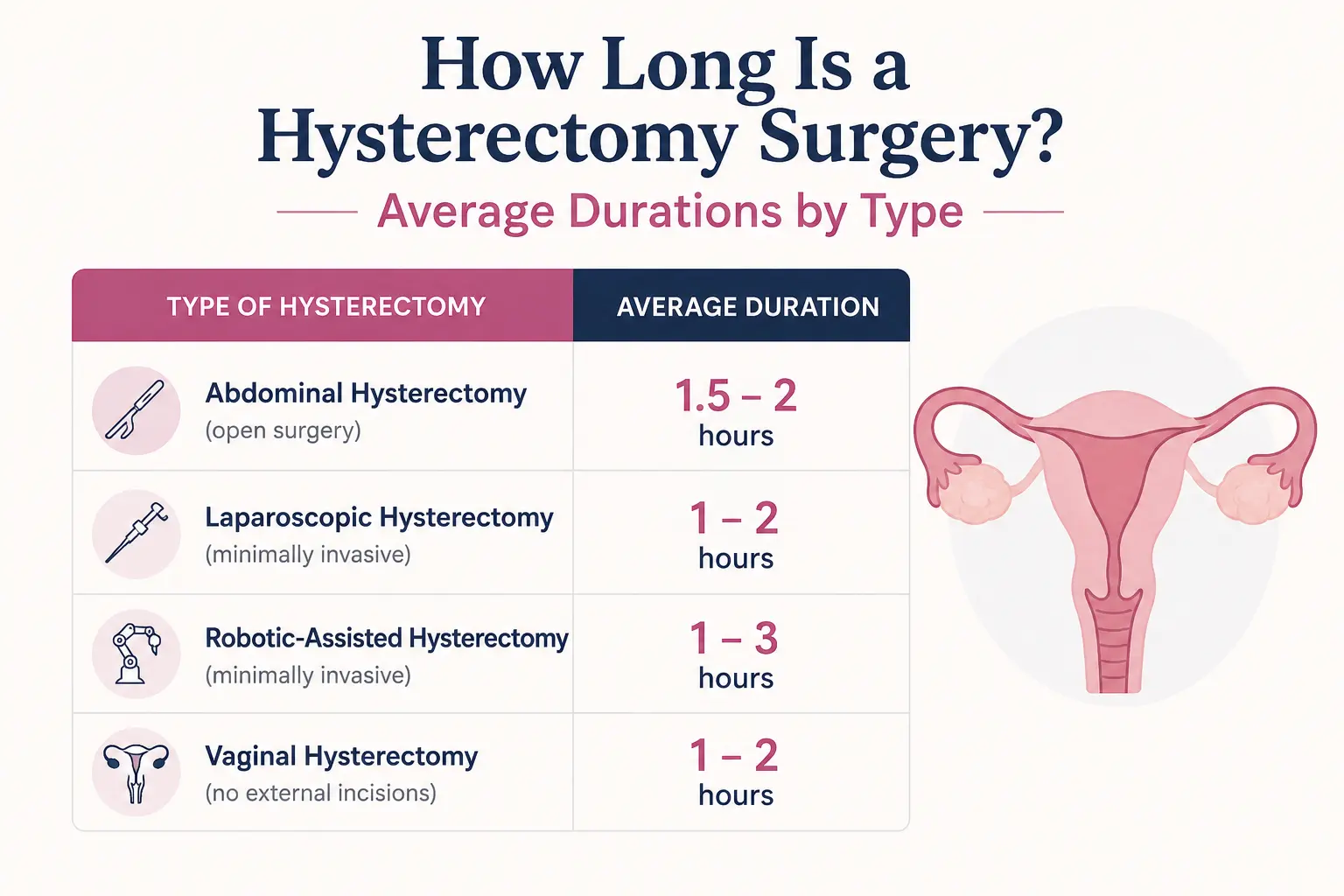
Beyond the type, the surgical route - how the surgeon accesses the uterus - has the most direct bearing on how long a hysterectomy surgery takes.
Laparoscopic (Keyhole) Hysterectomy
A laparoscope - a thin tube with a camera - is inserted through small abdominal incisions, allowing the surgeon to remove the uterus with precision and minimal disruption to surrounding tissue. This is the preferred approach at Miracles Healthcare, wherever clinically appropriate.
-
Duration: 1 to 2 hours
-
Anaesthesia: General
-
Hospital stay: 1 to 2 days
-
Recovery: Return to light activity within 5 to 7 days; full recovery in 2 to 4 weeks
Laparoscopic hysterectomy results in smaller incisions, significantly less blood loss, a lower risk of surgical site infection, and a much faster return to normal life compared to open surgery.
Vaginal Hysterectomy
The uterus and cervix are removed through an incision made at the top of the vagina. No abdominal cuts are required. This approach is generally preferred for uterine prolapse and when the uterus is of normal or near-normal size.
-
Duration: Approximately 1 to 1.5 hours
-
Anaesthesia: General, local, or spinal
-
Hospital stay: 1 to 3 days
-
Recovery: 3 to 4 weeks
Abdominal (Open) Hysterectomy
A horizontal or vertical incision is made in the lower abdomen to access and remove the uterus. This approach is recommended when the uterus is significantly enlarged due to large fibroids or tumours, or when other approaches are not feasible.
-
Duration: 1 to 3 hours (can extend beyond 3 hours in complex cases)
-
Anaesthesia: General
-
Hospital stay: 3 to 5 days
-
Recovery: 6 to 8 weeks
Although abdominal hysterectomy is the most invasive approach, it remains the appropriate choice in specific clinical situations requiring wider surgical access.
Key Factors That Affect How Long a Hysterectomy Surgery Takes
Even within the same surgical approach, no two hysterectomies are identical. Several patient-specific and procedural factors directly influence the overall operating time:
-
Size of the uterus: A significantly enlarged uterus - commonly caused by large fibroids - requires additional surgical time for safe removal
-
Presence of fibroids: Multiple or deeply embedded fibroids complicate dissection and increase duration
-
Endometriosis and adhesions: Scar tissue binding the uterus to surrounding organs must be carefully separated, adding considerable time to the procedure
-
Ovarian removal: If the ovaries and fallopian tubes are also removed, the procedure takes longer
-
Prior abdominal surgeries: Adhesions from previous caesarean sections or other procedures increase surgical complexity
-
Body weight and anatomy: Higher BMI and anatomical variation can make laparoscopic access more challenging, sometimes increasing operating time
At Miracles Apollo Cradle, Sector 14 and Miracles Apollo Cradle/Spectra, Sector 82, dedicated gynaecological operating theatres, advanced laparoscopic equipment, and experienced surgical teams work together to ensure that procedures are performed with maximum precision and minimum operating time.
What Happens Before the Surgery Begins?
The actual surgical duration of a hysterectomy does not account for everything that happens on the day of the procedure. Patients should plan for a full-day hospital commitment, even if the surgery itself is completed in under two hours.
Pre-operative preparation typically includes:
-
Admission 2 to 3 hours before the scheduled operating time
-
Anaesthesia assessment and consent
-
Blood tests, ECG, and pre-operative imaging (if not completed earlier)
-
Intravenous line placement, compression stockings, and bladder catheterisation
-
Administration of anaesthesia and positioning in the operating theatre
Post-operative recovery in hospital includes:
-
Time in the recovery room (post-anaesthesia care unit) - typically 1 to 2 hours
-
Return to the ward for monitoring of vitals, pain, and early mobilisation
-
Removal of the catheter and commencement of fluids/diet
Patients undergoing laparoscopic or vaginal hysterectomy are generally discharged the same day or within 24 to 48 hours. Abdominal hysterectomy requires a longer inpatient stay of 3 to 5 days.
Hysterectomy Recovery: What to Expect After Surgery
Understanding recovery timelines is as important as knowing how long a hysterectomy surgery takes. Recovery varies by approach:
Laparoscopic / Vaginal Hysterectomy:
-
Light activity resumes in 5 to 7 days
-
Driving can typically resume after 2 weeks
-
Full recovery and return to work: 3 to 4 weeks
-
Strenuous exercise and heavy lifting: avoid for 6 weeks
Abdominal Hysterectomy:
-
Hospital stay: 3 to 5 days
-
Return to light activity: 4 to 6 weeks
-
Full recovery: 6 to 8 weeks
General post-operative guidance:
-
Avoid lifting anything heavier than 2 to 3 kilograms for at least 6 weeks
-
Pelvic rest (no sexual intercourse) for a minimum of 6 to 8 weeks
-
Keep the incision area clean and dry; report any signs of redness, discharge, or fever
-
Attend all scheduled follow-up appointments for wound review and recovery monitoring
-
Pelvic floor physiotherapy may be recommended as part of rehabilitation
Miracles Healthcare's integrated care model ensures that physiotherapy and post-surgical support are available in-house, making recovery more structured and supervised for every patient.
Why Minimally Invasive Hysterectomy Is the Preferred Choice
The surgical team at Miracles Healthcare - one of the most trusted multi-specialty hospitals in Gurgaon - consistently prioritises laparoscopic and vaginal approaches for hysterectomy over open abdominal surgery, wherever the patient's clinical condition allows.
The benefits of minimally invasive hysterectomy are well-established:
-
Significantly smaller incisions - typically 0.5 to 1 cm compared to a 10 to 15 cm abdominal cut
-
Substantially less intraoperative blood loss
-
Lower risk of post-operative infection - Miracles Healthcare maintains a surgical site infection rate of less than 0.001% across 26,000+ surgeries
-
Reduced post-operative pain and faster return to daily activity
-
Shorter hospital stay - often just 1 to 2 days
-
Better cosmetic outcome with minimal visible scarring
Across 15,000+ gynaecological surgeries performed at Miracles Healthcare, the emphasis on minimally invasive techniques has delivered consistently superior outcomes for patients from Gurgaon and across Delhi NCR.
When Is a Hysterectomy Necessary?
Hysterectomy is recommended when:
-
Uterine fibroids are large, multiple, or cause severe bleeding and pain that medication has failed to control
-
Endometriosis is advanced and significantly impairs the quality of life or fertility
-
Abnormal uterine bleeding is persistent and unresponsive to hormonal or other treatments
-
Uterine prolapse is causing urinary incontinence, bowel dysfunction, or pelvic discomfort
-
Gynaecological cancers - cervical, ovarian, or uterine - require surgical removal
-
Adenomyosis causes severe dysmenorrhoea and heavy menstrual bleeding
A hysterectomy is a permanent solution. Specialists at Miracles Healthcare discuss all alternative treatments before recommending surgery, ensuring the decision is taken with the patient's full understanding and informed consent.
Hysterectomy at Miracles Healthcare, Gurgaon
Patients requiring hysterectomy surgery can access expert care at the following Miracles Healthcare locations:
Miracles Apollo Cradle, Sector 14, Gurgaon, SCO 1, 2 & 3, Delhi Road, Sector 14, Gurugram - 0124-4797600 View Location Services: Gynaecological surgeries including hysterectomy, laparoscopy, myomectomy | Level III NICU | 24x7 emergency | Baby delivery
Miracles Apollo Cradle/Spectra, Sector 82, Gurgaon Plot No. 45, Vatika India Next, Sector 82, Gurugram - 0124-352-8282 View Location Services: Gynaecological surgeries | Maternity care | CT scan | Comprehensive diagnostics | 24x7 emergency
Miracles Mediclinic, Sector 56, Gurgaon SCO-68-69, More Market, Block B, Sector 56, Gurugram - 906-906-8800 View Location Services: Gynaecology OPD | MRI scan | NABL-certified diagnostics | Pre-surgical workup
Miracles Mediclinic, Sector 14, Gurgaon SCO 1, 2 & 3, Sector 14, Gurugram - 0124-4797600 View Location Services: Gynaecology consultations | Pathology | Health check-up packages | Pre-operative diagnostics.
Book Your Consultation at Miracles Healthcare
If you have been advised of a hysterectomy or are experiencing symptoms that may require surgical evaluation, do not delay seeking expert opinion. The gynaecology and obstetrics team at Miracles Healthcare brings together deep surgical expertise, minimally invasive techniques, near-zero infection rates, and a genuinely patient-centred approach.
With 15,000+ gynaecological surgeries completed, a surgical site infection rate of less than 0.001%, NABH-accredited facilities, and a Google rating of 4.9 across 12,000+ reviews, Miracles Healthcare is one of the most trusted multi-specialty hospitals in Gurgaon for women's surgical care.
Call: 0124-4797600
WhatsApp: 98209-65000
Miracles Apollo Cradle, Sector 14
• SCO 1, 2 & 3, Delhi Road, Sector 14, Gurugram
Miracles Apollo Cradle/Spectra, Sector 82
• Plot No. 45, Vatika India Next, Sector 82, Gurugram
Written and Verified by:

Frequently Asked Questions
The duration depends on the approach and complexity. Laparoscopic and vaginal hysterectomies typically take 1 to 2 hours. Abdominal hysterectomies generally take 1 to 3 hours, and radical hysterectomies - performed for gynaecological cancers - may take 3 to 4 hours or more. Your surgeon will give you a more precise estimate based on your specific condition.
Laparoscopic hysterectomy takes a comparable or sometimes slightly longer time in the operating theatre than open abdominal surgery. However, it results in significantly faster recovery, shorter hospital stays, less pain, and a much lower infection risk - making it the preferred approach at Miracles Healthcare wherever clinically suitable.
It depends on the surgical approach. Laparoscopic or vaginal hysterectomy patients are often discharged within 1 to 2 days. Abdominal hysterectomy typically requires a 3 to 5-day hospital stay. Your consultant will plan your discharge based on your recovery progress.
Most patients who undergo laparoscopic or vaginal hysterectomy return to light activity within 5 to 7 days and resume normal routines within 3 to 4 weeks. Abdominal hysterectomy recovery takes 6 to 8 weeks. Strenuous exercise and heavy lifting should be avoided for at least 6 weeks regardless of the approach.
Yes. In a total hysterectomy, only the uterus and cervix are removed, while the ovaries are preserved. This avoids immediate surgical menopause. In cases where ovarian removal is indicated - such as a strong family history of ovarian cancer, or where the ovaries are themselves diseased - a bilateral salpingo-oophorectomy is performed alongside.
Yes. Miracles Healthcare has tie-ups with all leading insurance companies and supports both cashless and reimbursement claims. Covered procedures include laparoscopic hysterectomy, abdominal hysterectomy, myomectomy, and ovarian cyst removal. Call 0124-4797600 to confirm your coverage before scheduling.
You can book a consultation by calling 0124-4797600, WhatsApp at 98209-65000, or through online appointment booking on the Miracles Healthcare website. Consultations are available at Miracles Apollo Cradle (Sector 14), Miracles Apollo Cradle/Spectra (Sector 82), Miracles Mediclinic (Sector 56), and Miracles Mediclinic (Sector 14).







Was the information useful?
0 0