



What Is Double Marker Test in Pregnancy? Purpose, Procedure & Normal Values
Summary
Pregnancy is a journey of joy, anticipation, and important medical decisions. Among the several prenatal screenings recommended during the first trimester, the double marker test in pregnancy is one of the most significant. Despite being routinely advised, many expectant parents are unsure of what this test actually involves, when it should be done, and how the results should be interpreted. This guide explains everything you need to know - in clear, simple language.
What Is the Double Marker Test in Pregnancy?
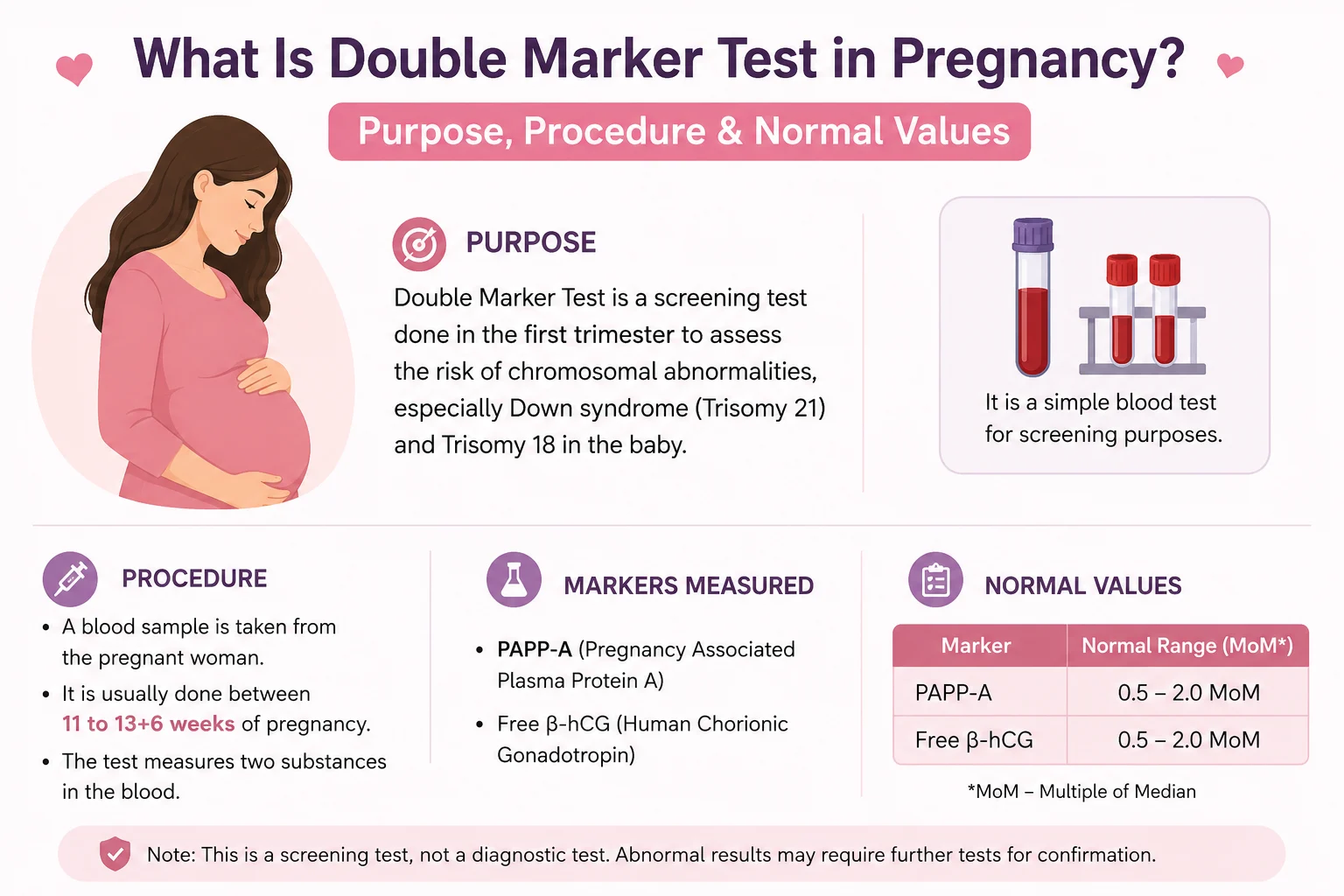
The double marker test - also referred to as the dual marker test - is a prenatal blood screening conducted during the first trimester of pregnancy. It measures the levels of two specific hormones or proteins in the mother's blood to assess the likelihood of certain chromosomal abnormalities in the developing baby.
The two markers evaluated in this test are:
-
Free Beta-hCG (Human Chorionic Gonadotropin): A hormone produced by the placenta shortly after conception. Abnormally high or low levels can indicate chromosomal irregularities.
-
PAPP-A (Pregnancy-Associated Plasma Protein-A): A protein linked to placental development. Reduced levels of PAPP-A are associated with a higher risk of chromosomal conditions.
When combined with the mother's age, gestational age, and findings from the Nuchal Translucency (NT) ultrasound scan, these two markers help paint a clearer picture of the baby's chromosomal health.
Expecting mothers in Gurgaon can access this test conveniently at Miracles Mediclinic, Sector 14 and Miracles Mediclinic, Sector 56 - both equipped with NABL-accredited diagnostic laboratories for accurate and reliable results.
Why Is the Double Marker Test Important?
The primary purpose of the double marker test in pregnancy is to screen for three major chromosomal abnormalities:
-
Down Syndrome (Trisomy 21): Caused by an extra copy of chromosome 21, leading to developmental and intellectual delays
-
Edward Syndrome (Trisomy 18): A severe condition involving an extra chromosome 18
-
Patau Syndrome (Trisomy 13): A rare but serious condition resulting from an extra chromosome 13
These conditions arise when the baby has more chromosomes than the usual 46 (22 pairs + XX or XY). While the double marker test cannot confirm whether a baby has any of these conditions, it estimates the level of risk with meaningful accuracy - especially when performed alongside the NT scan.
Early screening is valuable because it:
-
Gives parents and doctors time to plan further diagnostic tests if needed
-
Reduces unnecessary anxiety when results indicate low risk
-
Supports informed decision-making about the pregnancy
-
Helps healthcare teams provide personalised care based on risk levels
When Should You Get the Double Marker Test Done?
Timing is crucial for this screening. The double marker test is recommended between 11 and 14 weeks of pregnancy, with the optimal window being the 11th to 13th week. Having it done within this period ensures the hormonal markers are at their most detectable and the NT scan results are most meaningful.
The test report is typically available within 3 to 7 working days of sample collection.
Women who are particularly advised to undergo this screening include:
-
Those aged 35 years or above (advanced maternal age)
-
Those with a family history of chromosomal disorders
-
Those who have had a previous pregnancy affected by chromosomal abnormality
-
Those with twin or multiple pregnancies
-
Those with abnormal findings on early ultrasound scans
That said, many gynaecologists recommend the test for all pregnant women as a routine first-trimester precaution, regardless of age or risk factors.
How Is the Double Marker Test Performed?
The procedure is straightforward and non-invasive. It involves no risk whatsoever to the baby.
-
A small blood sample is drawn from the mother's vein - just like a routine blood test
-
The sample is analysed in an accredited laboratory for Free Beta-hCG and PAPP-A levels
-
These results are combined with the mother's age, weight, gestational age, and NT scan measurements
-
A risk score is calculated and reported
The entire blood draw takes just a few minutes. No fasting is required. Reports are delivered digitally and - at Miracles Healthcare - automatically sent via WhatsApp for convenience.
Double Marker Test Normal Values
Understanding what constitutes a normal result helps reduce anxiety around the test. The reference ranges are:
-
Free Beta-hCG: 25,700 to 288,000 mIU/ml (for all age groups)
-
PAPP-A: 1 MoM (Multiples of Median) - for all age groups
These values are interpreted in the context of gestational age and maternal factors. Results are reported in one of three risk categories:
-
Screen Negative / Low Risk: Risk ratio of 1:1000 or greater. This indicates a low probability of chromosomal abnormality. Most pregnancies fall in this category.
-
Moderate Risk: Risk ratio between 1:251 and 1:1000. Further discussion with your gynaecologist is advised.
-
Screen Positive / High Risk: Risk ratio between 1:10 and 1:250. This does not confirm a chromosomal condition but indicates that additional diagnostic testing is recommended, such as Non-Invasive Prenatal Testing (NIPT), amniocentesis, or chorionic villus sampling (CVS).
It is important to understand that a high-risk result is not a diagnosis - it is a prompt for further investigation. Many pregnancies with screen-positive results go on to be entirely healthy.
Double Marker Test and NT Scan: Why Both Are Needed Together
The double marker test is most effective when performed alongside the Nuchal Translucency (NT) scan - an ultrasound that measures the fluid-filled space at the back of the baby's neck. An increased NT measurement, combined with abnormal marker levels, raises the overall risk prediction significantly.
When the NT scan is combined with the dual marker blood test, the accuracy of chromosomal abnormality detection rises to 80–85%, compared to around 50% with the blood test alone. This combined first-trimester screening is considered the most reliable non-invasive approach to early chromosomal risk assessment.
Both the blood test and NT scan can be conveniently done at Miracles Mediclinic, Sector 56, Gurgaon, which is equipped with advanced radiology including 4D ultrasound, and at Miracles Apollo Cradle/Spectra, Sector 82, Gurgaon - offering comprehensive diagnostics, imaging, and specialist consultations under one roof.
What Happens After a High-Risk Result?
A high-risk result on the double marker test is not a cause for immediate alarm, but it does signal the need for further evaluation. Your gynaecologist or obstetrician may recommend one or more of the following:
-
NIPT (Non-Invasive Prenatal Testing): A highly accurate blood test that analyses foetal DNA circulating in the mother's blood. It has a detection rate above 99% for Down syndrome.
-
Amniocentesis: A procedure where a small amount of amniotic fluid is collected for chromosomal analysis. This is diagnostic, not just screening.
-
Chorionic Villus Sampling (CVS): A procedure to obtain a small sample of placental tissue for genetic testing.
Experienced gynaecologists and obstetricians at Miracles Apollo Cradle, Sector 14, Gurgaon provide comprehensive high-risk pregnancy care and personalised guidance for every stage of this journey. The team includes 24x7 resident gynaecologists and a full neonatology unit with Level III NICU support.
Cost of the Double Marker Test in India
The double marker test price in India typically ranges between ₹2,000 and ₹3,000, depending on the city, laboratory, and whether an NT scan is included as part of a combined screening package. At Miracles Healthcare, the test is conducted in NABL-accredited laboratories with results delivered within the shortest turnaround time in Gurgaon.
Patients can visit any of our diagnostic locations for testing:
Miracles Mediclinic, Sector 14, Gurgaon SCO-1, 2 & 3, Sector 14, Gurugram, Haryana 122007. Call: 0124-4797600 Services: Consultations, Lab Tests, Diagnostics, Health Checks
Miracles Mediclinic, Sector 56, Gurgaon SCO-68-69, More Market, Block B, Sector 56, Gurugram, Haryana 122011. Call: 906-906-8800 Services: Consultations, Lab Tests, Diagnostics, Health Checks, MRI/CT Scans
Miracles Apollo Cradle, Sector 14, Gurgaon SCO 1, 2 & 3, Delhi Rd, Sector 14, Gurugram, Haryana 122007. Call: 0124-4797600 Services: Baby Delivery, High-Risk Pregnancy, Level III NICU, Gynaecology, Surgeries
Miracles Apollo Cradle/Spectra, Sector 82, Gurgaon Plot No. 45, Vatika India Next, Sector 82, Gurugram, Haryana 122012. Call: 0124-352-8282 Services: Baby Delivery, High-Risk Pregnancy, Level III NICU, Surgeries, Consultations, Diagnostics, MRI/CT Scans
Miracles Fertility & IVF Clinic, Sector 14, Gurgaon SCO 1, 2, 3, Old Delhi Gurugram Rd, Sector 14, Gurugram, Haryana 122001. Call: 0124-4797600 Services: IVF, IUI, ICSI, Fertility Screening, Donor Egg Cycle, Semen Test, Egg & Semen Preservation
Why Choose Miracles Healthcare for Your Prenatal Diagnostics?
Miracles Healthcare is Gurgaon's trusted multi-specialty hospital network, serving families since 2002 across five facilities in Sectors 14, 56, and 82.
What makes it the right choice for prenatal screening:
-
NABH & NABL accredited: Across all locations - ensuring precise, reliable test results
-
150+ experienced specialists: Covering 20+ disciplines including gynaecology, fetal medicine, neonatology, and fertility
-
All under one roof: Consultations, diagnostics, radiology, and specialist care available at the same centre
-
Comprehensive women's care: From first-trimester screening through high-risk pregnancy management and delivery
-
Dedicated fertility services: At Miracles Fertility & IVF Clinic, Sector 14 - offering IVF, IUI, ICSI, egg/sperm freezing, and more
-
Rated 4.9 on Google: Reflecting consistent patient satisfaction across the network
Miracles Healthcare is built on a simple belief: "Small enough to care, large enough to heal" - making it one of Gurgaon's most comprehensive and trusted choices for prenatal diagnostics and maternity care.
Book Your Prenatal Screening Today
The double marker test in pregnancy is a small but powerful step towards informed, confident parenthood. At Miracles Healthcare - your trusted multi-speciality hospital in Gurgaon - we ensure every prenatal test is conducted with precision, delivered promptly, and explained with care.
Call: 0124-4797600
WhatsApp: 98209-65000
Website: www.miracleshealth.com
Written and Verified by:

Frequently Asked Questions
The double marker test is a first-trimester prenatal blood screening that measures two hormones - Free Beta-hCG and PAPP-A - in the mother's blood to estimate the risk of chromosomal abnormalities such as Down syndrome, Edward syndrome, and Patau syndrome. It is a predictive screening, not a diagnostic test.
It is not legally mandatory, but it is strongly recommended - particularly for women over 35, those with a family history of chromosomal conditions, or those with twins. Many gynaecologists advise it for all pregnant women as a routine first-trimester precaution.
The ideal time is between 11 and 14 weeks of pregnancy, with the 11th to 13th week being optimal. Doing it within this window ensures the most accurate and meaningful results.
A high-risk or screen-positive result does not confirm that the baby has a chromosomal abnormality. It means the likelihood is higher than average, and further diagnostic testing - such as NIPT, amniocentesis, or CVS - is recommended to arrive at a definitive answer.
Yes, completely. The test involves only a routine blood draw from the mother and poses no risk to the baby at any stage. It is a non-invasive procedure.
Normal values are Free Beta-hCG: 25,700–288,000 mIU/ml and PAPP-A: 1 MoM. A risk ratio of 1:1000 or greater is classified as screen negative (low risk). Results are always interpreted alongside ultrasound data and maternal age.
You can get the double marker test done at Miracles Mediclinic, Sector 14 or Miracles Mediclinic, Sector 56, Gurgaon - both equipped with NABL-accredited labs and staffed by experienced pathologists. Call 0124-4797600 or WhatsApp 98209-65000 to book your appointment.






Was the information useful?
0 0