


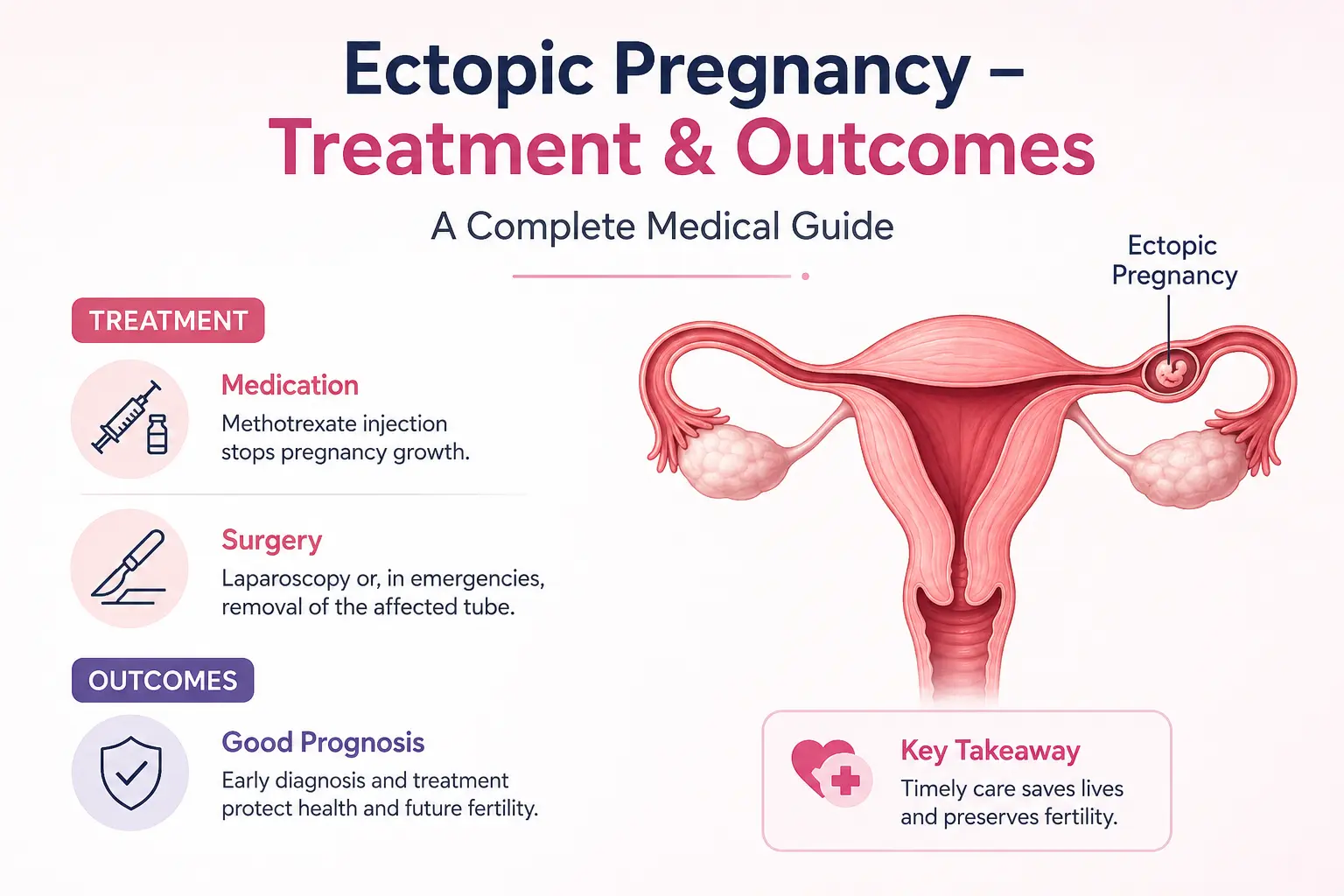
Ectopic Pregnancy – Treatment & Outcomes: A Complete Medical Guide

- What Is an Ectopic Pregnancy?
- How Common Is Ectopic Pregnancy?
- Common Symptoms of Ectopic Pregnancy
- What Causes Ectopic Pregnancy?
- How Is Ectopic Pregnancy Diagnosed?
- Treatment of Ectopic Pregnancy
- Recovery After Ectopic Pregnancy Treatment
- Can You Get Pregnant After an Ectopic Pregnancy?
- Outcomes & Long-Term Effects
- How to Reduce the Risk of Future Ectopic Pregnancy
- When to See a Doctor Immediately
- Why Choose Miracles Healthcare for Ectopic Pregnancy Care?
- Book a Consultation with Our Gynaecology Experts
Summary
An ectopic pregnancy is a serious medical condition where a fertilised egg implants outside the uterus, most commonly in the fallopian tube. Without timely treatment, it can lead to life-threatening complications. Understanding the treatment options and outcomes of ectopic pregnancy is essential for every woman planning or going through pregnancy.
The treatment of ectopic pregnancy depends on how early it is detected. Options include medication (Methotrexate injection) for early cases, laparoscopic surgery to remove the ectopic tissue, or emergency surgery if the fallopian tube has ruptured. With prompt care, most women recover well and can conceive again in the future.
When it comes to women's health and emergency obstetric care in Gurgaon, Miracles Healthcare brings together experienced gynaecologists, advanced diagnostic tools, and round-the-clock surgical support under one roof. Our team has managed numerous complex pregnancy cases, helping women receive timely diagnoses and appropriate treatment without delay.
What Is an Ectopic Pregnancy?
In a normal pregnancy, a fertilised egg travels through the fallopian tube and implants in the uterus. In an ectopic pregnancy, the egg implants outside the uterus, usually in the fallopian tube (called a tubal pregnancy). In rare cases, it may attach to the ovary, cervix, or abdominal cavity.
Since these areas cannot support a growing pregnancy, the condition cannot continue safely and requires immediate medical attention.
How Common Is Ectopic Pregnancy?
Ectopic pregnancies occur in approximately 1 to 2 out of every 100 pregnancies. While the numbers may seem small, the risk to the mother is significant if not diagnosed early.
Common Symptoms of Ectopic Pregnancy
Early symptoms can resemble a normal pregnancy, but the following warning signs should never be ignored:
-
Sharp or one-sided lower abdominal pain
-
Vaginal bleeding or spotting (different from a normal period)
-
Shoulder tip pain (a sign of internal bleeding)
-
Dizziness, weakness, or fainting
-
Nausea and vomiting
-
Pain during urination or bowel movements
-
Low blood pressure
If you experience these symptoms in early pregnancy, seek medical care immediately.
What Causes Ectopic Pregnancy?
Several factors can increase the risk of an ectopic pregnancy:
-
Previous ectopic pregnancy
-
Pelvic Inflammatory Disease (PID)
-
Sexually transmitted infections like chlamydia or gonorrhoea
-
Endometriosis
-
Previous tubal or pelvic surgery
-
Smoking
-
IVF or fertility treatments
-
Use of intrauterine devices (IUDs) in rare cases
-
Age above 35
-
Damaged or blocked fallopian tubes
Understanding these risk factors helps in early detection and prevention.
How Is Ectopic Pregnancy Diagnosed?
Early diagnosis is the key to safe treatment. Doctors typically use:
1. Blood Test (Beta hCG)
Lower-than-expected or slowly rising hCG levels often indicate an ectopic pregnancy.
2. Transvaginal Ultrasound
This scan helps identify whether the pregnancy is inside or outside the uterus.
3. Pelvic Examination
To check for tenderness, swelling, or mass formation.
4. Laparoscopy (in advanced cases)
A small surgical procedure is used both for diagnosis and immediate treatment if needed.
Treatment of Ectopic Pregnancy
Treatment depends on how early the condition is detected, the size of the pregnancy, hCG levels, and whether the fallopian tube has ruptured. The main treatment options are:
1. Medical Management with Methotrexate
For early, unruptured ectopic pregnancies, doctors may prescribe Methotrexate injection, which stops the growth of the pregnancy tissue, allowing the body to absorb it naturally.
This option is suitable when:
-
The pregnancy is detected early
-
The fallopian tube has not ruptured
-
hCG levels are low
-
The patient is stable and has no severe pain
-
There is no foetal heartbeat
After the injection, hCG levels are monitored regularly until they return to zero. Most women recover within 4–6 weeks.
2. Laparoscopic Surgery (Minimally Invasive)
If the pregnancy is larger or the medication is not suitable, laparoscopy is the preferred surgical approach. Two main procedures may be performed:
-
Salpingostomy: A small incision is made in the fallopian tube to remove the pregnancy, preserving the tube.
-
Salpingectomy: The entire affected fallopian tube is removed if it's badly damaged.
Benefits of laparoscopic surgery:
-
Small incisions, minimal scarring
-
Less blood loss
-
Shorter hospital stay (usually 1–2 days)
-
Faster recovery
-
Lower risk of infection
3. Emergency Surgery (Open or Laparoscopic)
If the fallopian tube has ruptured, it becomes a medical emergency due to internal bleeding. Immediate surgery is required to stop the bleeding and remove the damaged tissue. In such cases, the affected fallopian tube is usually removed to save the woman's life.
Recovery After Ectopic Pregnancy Treatment
Recovery time depends on the treatment received.
After Methotrexate Injection
-
Mild abdominal cramping and bleeding for a few weeks
-
Regular blood tests to track hCG decline
-
Avoid alcohol, folic acid, and intercourse during recovery
-
Resume normal activity in 2–4 weeks
After Laparoscopic Surgery
-
Hospital stay of 1–2 days
-
Mild pain or discomfort for a week
-
Avoid lifting heavy objects for 3–4 weeks
-
Resume normal routine within 2–3 weeks
After Open Surgery (in severe cases)
-
Hospital stay of 3–5 days
-
Recovery may take 4–6 weeks
-
Follow up with your gynaecologist regularly
Emotional recovery is equally important. Many women experience grief, anxiety, or fear of future pregnancy, and counselling support can be very helpful.
Can You Get Pregnant After an Ectopic Pregnancy?
Yes, most women can conceive naturally after an ectopic pregnancy, especially if one fallopian tube remains healthy. Statistics show that around 60–70% of women conceive successfully within 18 months of treatment.
However, the chances of another ectopic pregnancy slightly increase, so future pregnancies must be monitored closely from the very beginning, especially in the first trimester.
Outcomes & Long-Term Effects
With timely diagnosis and treatment, the outcomes of ectopic pregnancy are largely positive. Here's what to expect:
|
Outcome |
Likelihood |
|
Full physical recovery |
High |
|
Future natural pregnancy |
60–70% |
|
Recurrence of ectopic pregnancy |
10–15% |
|
Need for IVF |
In some cases of tubal damage |
|
Emotional recovery |
Varies; counselling helps |
The earlier the condition is detected, the better the outcome for both physical and reproductive health.
How to Reduce the Risk of Future Ectopic Pregnancy
While not all ectopic pregnancies can be prevented, you can lower your risk by:
-
Avoiding smoking
-
Getting tested and treated for STIs
-
Managing PID and endometriosis promptly
-
Seeking early prenatal care
-
Discussing pregnancy planning with a gynaecologist if you've had an ectopic pregnancy before
-
Considering IVF with close monitoring if natural conception poses a higher risk
When to See a Doctor Immediately
Visit a gynaecologist or emergency department right away if you experience:
-
Suddenly, severe abdominal or pelvic pain
-
Heavy vaginal bleeding
-
Dizziness, fainting, or shoulder tip pain
-
Rapid heartbeat or low blood pressure
-
Positive pregnancy test with abnormal symptoms
Quick action can prevent life-threatening complications. Find a doctor today as per your needs.
Why Choose Miracles Healthcare for Ectopic Pregnancy Care?
Miracles Healthcare is your neighbourhood family hospital in Gurgaon, equipped to manage routine pregnancies, high-risk cases, and emergency gynaecological conditions like ectopic pregnancy with precision and compassion.
What makes us stand out:
-
Experienced gynaecologists and obstetricians specialising in high-risk pregnancies
-
24x7 emergency and surgical support
-
Advanced laparoscopic surgery capabilities
-
In-house pathology and radiology with same-day reports
-
NABH-accredited hospital for clinical safety
-
Female radiologists for sensitive scans
-
Single window patient assistance through dedicated PROs
-
Tie-ups with all leading insurance providers
-
Google rating of 4.9 across thousands of patient reviews.
Book a Consultation with Our Gynaecology Experts
If you or a loved one is experiencing symptoms of ectopic pregnancy or needs expert pregnancy guidance, don't delay. Reach out to the women's health specialists at Miracles Healthcare.
Our Locations in Gurgaon:
Miracles Mediclinic SCO 1, 2, 3, Sector 14, Old Delhi–Gurgaon Road, Gurgaon
Call: 0124-4797600
Miracles Fertility & IVF Clinic, SCO 1, 2, 3, Sector 14, Old Delhi–Gurgaon Road, Gurgaon
Call: 0124-4797600
Miracles Mediclinic, SCO 55-56, More Market, Sector 56, Gurgaon
Call: 906-906-8800
Miracles Apollo Cradle / Spectra, Vatika India Next, Sector 82, Gurgaon
Call: 0124-352-8282
Written and Verified by:

Frequently Asked Questions
Early ectopic pregnancies are usually treated with a Methotrexate injection, while larger or ruptured cases require laparoscopic or emergency surgery.
Yes, in early cases with low hCG levels and no rupture, Methotrexate injection can dissolve the pregnancy tissue without surgery.
Recovery from laparoscopic surgery usually takes 2–3 weeks, while open surgery may take 4–6 weeks.
Yes, around 60–70% of women conceive successfully after an ectopic pregnancy, especially if one fallopian tube remains healthy.
If untreated, a ruptured ectopic pregnancy can cause severe internal bleeding and become life-threatening. Early diagnosis prevents complications.
A combination of blood tests (Beta hCG), transvaginal ultrasound, and clinical examination helps in early detection.
You can visit Miracles Healthcare in Sector 14, Gurgaon, for expert gynaecology care, laparoscopic surgery, and 24/7 emergency support.





Was the information useful?
0 0