


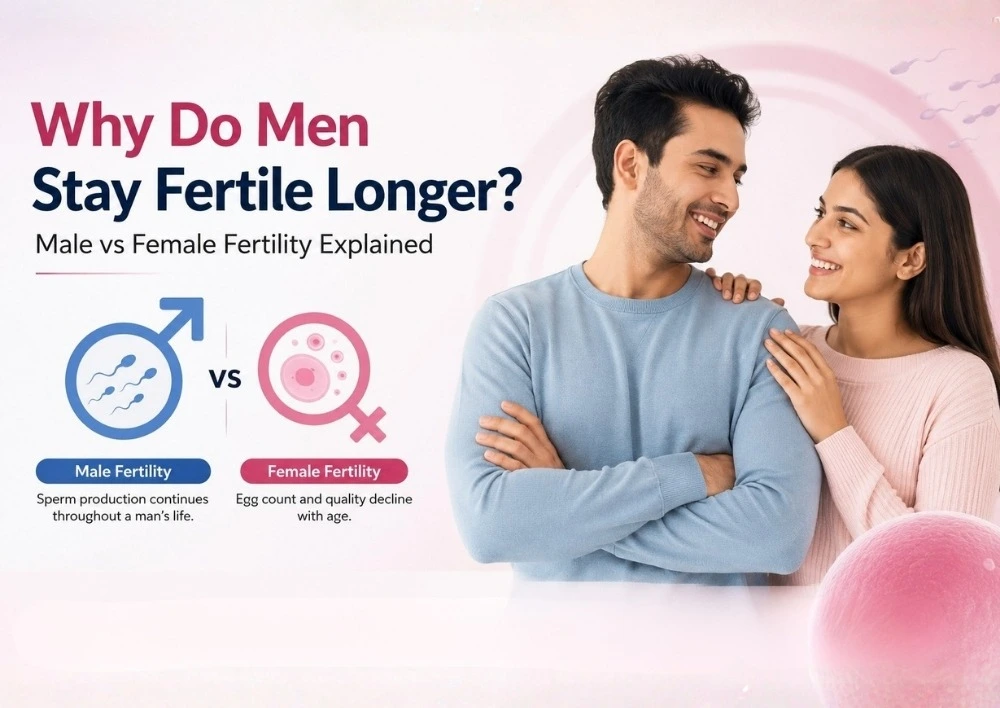
Why Do Men Stay Fertile Longer Than Women?


- The Biology Behind Male and Female Fertility
- Biological Clock: Male vs Female
- Why Does Female Fertility Decline Faster?
- Does Male Fertility Stay the Same Forever?
- Male Fertility Age Chart
- Why Don't Men Experience Menopause?
- Lifestyle Factors That Affect Male Fertility
- Lifestyle Factors That Affect Female Fertility
- Advanced Fertility Care by Expert Fertility Specialists
- Planning a Pregnancy? Know Your Fertility Before It is Too Late
Summary
The Biology Behind Male and Female Fertility
When it comes to fertility, one of the most common questions couples ask is: "Why do men remain fertile for much longer than women?" While women experience a natural decline in fertility with age and eventually reach menopause, many men are capable of fathering children well into their 60s, 70s, and even beyond.
Does this imply that male fertility does not drop? No, that is not true.
Although it is right that the lifespan of male fertility is longer than female fertility, there are also certain biological factors that affect them.
By knowing the biological facts about male reproductive health, a couple can be better informed regarding their plans to have a baby.
Biological Clock: Male vs Female
Fertility is determined by the proper functioning of reproductive organs, hormonal balance, and production of healthy eggs or sperms. It is true that aging affects both men and women differently; however, the speed at which this aging takes place is different. “Even though men have the potential to be fertile for a long period of time compared to women, fertility decreases with age in both sexes,” says Dr. Anviti Saraf, best fertility specialist in Gurgaon, Miracles Healthcare. The main cause is natural differences between reproductive systems of male and female bodies.
|
Aspect |
Female |
Male |
|
Reproductive Cells |
Born with all the eggs they will ever have. |
Continuously produce new sperm throughout life. |
|
At Birth |
Around 1–2 million eggs remain at birth (after having 6–7 million during fetal development). |
Sperm production has not yet started. |
|
At Puberty |
Approximately 300,000–500,000 eggs remain. |
Sperm production begins at puberty. |
|
Production of New Gametes |
No new eggs are produced after birth. |
New sperm are produced every day from spermatogonial stem cells. |
|
Number Released |
Only 300–400 eggs are ovulated during a woman's reproductive lifetime. |
Millions of sperm are produced daily, with over 1,000 sperm produced every second in a healthy man. |
|
Cell Lifespan |
Egg quantity and quality decline continuously with age due to a natural process called atresia. |
New sperm take approximately 64–74 days to mature before ejaculation. |
|
Age-Related Fertility Changes |
Fertility starts declining in the early 30s and drops more rapidly after 35 years. |
Fertility declines gradually with age, mainly due to changes in sperm quality rather than production. |
|
End of Natural Fertility |
Natural fertility ends with menopause, usually between 45–55 years. |
There is no equivalent to menopause; sperm production usually continues throughout life, although quality declines. |
|
Primary Reason for Longer Fertility |
Limited ovarian reserve and declining egg quality. |
Continuous sperm production allows men to remain fertile for much longer than women. |
Why Does Female Fertility Decline Faster?
The decline in female fertility is affected by many biological factors.
1. Decreased Eggs Count
With each menstrual cycle, there is a reduction in egg count. With advancing age, women have fewer eggs.
-
By age 35, fertility starts declining faster.
-
By age 40 years, the ovarian reserve has significantly diminished.
According to Dr. Anviti, "The ovarian reserve of a woman decreases naturally with age, and once a woman turns 35, the quantity and quality of eggs start to decline rapidly."
2. Declining Eggs Quality
While aging leads to a reduced number of eggs, there is also a problem in the quality of eggs.
Older eggs are more likely to have:
-
Abnormal chromosomes
-
Damaged DNA
-
Reduced capacity for fertilization
3. Hormonal Changes
The response of the ovaries to the following hormones starts to slow down:
-
Follicle Stimulating Hormone (FSH)
-
Luteinizing Hormone (LH)
Ovulation becomes less regular, making conception more difficult.
4. Menopause
Finally, women enter into the stage of menopause at the age of around 45 to 55 years, where:
-
Ovulation ends.
-
Periodic menstruation ends.
-
It becomes impossible to conceive naturally.
Menopause marks the end of fertility.
According to Dr. Anviti Saraf, "Menopause is a natural phenomenon in a woman's life marking an end to the period of her reproduction cycle and hence fertility planning becomes imperative for women desirous of conceiving at a later age."
Does Male Fertility Stay the Same Forever?
No, exactly. While men fertility has no age limit, they continue to remain fertile longer because male fertility decreases with age, but at a much slower rate.
Many changes happen with aging
-
Low Sperm Count: Men of an older age group might have low sperm count compared to young men.
-
Poor Sperm Motility: It is possible that sperm will swim at a lower speed, thus limiting their capability of fertilizing the egg.
-
Sperm Morphology Problems: Low percentages of morphologically normal sperm will be seen.
-
High Levels of Sperm DNA Fragmentation: DNA of sperm can be damaged more with aging, contributing to:
-
Low rates of pregnancy
-
Miscarriages
-
Poor Embryo Quality
-
Male Fertility Age Chart
|
Age |
What Happens to Fertility? |
|
20–29 years |
Peak fertility. High sperm count, motility, and morphology with minimal DNA fragmentation. |
|
30–34 years |
Fertility remains high. Mild decline in sperm quality may begin, but most men conceive without difficulty. |
|
35–39 years |
Slow reduction in sperm motility and morphology. Time to conception may increase slightly. |
|
40–44 years |
Noticeable decline in sperm quality and increased DNA fragmentation. Fertility decreases, and miscarriage risk begins to rise. |
|
45–49 years |
Lower sperm count and motility. Pregnancy may take longer, and the risk of certain genetic and neurodevelopmental conditions in offspring increases. |
|
50+ years |
Many men remain fertile, but sperm quality continues to decline. Fertility is highly dependent on overall health, lifestyle, and underlying medical conditions. |
Why Don't Men Experience Menopause?
"If women go through menopause, do men experience something similar?" This is one of the most common questions women search online, especially when comparing male and female fertility. The short answer is no, men do not experience menopause in the same way women do.
Men do not go through the process of menopause since the production of the testosterone declines slowly instead of abruptly ceases. It is called late-onset hypogonadism or andropause, though it is quite different from menopause.
In contrast to menopause:
-
Sperm production keeps going.
-
They may remain fertile.
-
Their hormone levels decrease slowly for many years.
According to Dr. Anviti, "Unlike females, males do not suddenly stop their reproductive period. While testosterone and the quality of sperm keep decreasing with age, some men continue to be fertile well into their advanced years, even if age impacts conception and pregnancy in some ways."
Lifestyle Factors That Affect Male Fertility
Even though men produce new sperm continuously, sperm quality can be significantly affected by lifestyle choices.
Factors that may reduce fertility include
-
Smoking
-
Excessive alcohol consumption
-
Obesity
-
Diabetes
-
Poor diet
-
Lack of exercise
-
Chronic stress
-
Sleep deprivation
-
Exposure to environmental toxins
-
Excessive heat exposure to the testes
-
Certain medications
-
Anabolic steroid use
Fortunately, since new sperm are constantly produced, improving lifestyle habits can often enhance sperm quality over time.
Lifestyle Factors That Affect Female Fertility
Women's fertility is also influenced by lifestyle, although age remains the most significant factor.
Some common factors are
-
Endometriosis
-
Hormonal imbalance
-
Obesity
-
Smoking
-
High consumption of alcohol
-
Unhealthy diet
-
Stress
-
Sexual diseases
Early evaluation helps detect any problems and increase the chances of successful treatment.
Advanced Fertility Care by Expert Fertility Specialists
Besides knowing the reason behind the fact that men tend to stay fertile for a longer period than women, there is more to the story of fertility. While age does matter, it is not the only factor that affects fertility and influences a couple’s chances of conception. A fertility evaluation reveals all the other factors which may affect pregnancy chances.
Miracles Healthcare is the best fertility hospital in Gurgaon where each fertility journey starts with a complete evaluation.
-
Our team consists of highly trained fertility experts, specialists of embryo development and gynecologists, who combine their expertise with state-of-the-art technology to bring you personal solutions to fertility problems.
-
Since 2013, more than 1,500 IVF cycles have been performed with a high success rate by our team that enables couples to become parents.
-
ICMR approved an in-house IVF and embryology laboratory with advanced technologies used for embryo development and embryo freezing.
-
One-stop solution to your fertility problems such as fertility assessment, ovulation induction, IUI, IVF, ICSI, fertility preservation and male/female infertility treatment.
-
Multidisciplinary approach allows gynaecologists, endocrinologists, radiologists, general physicians and others in solving your fertility issues related to PCOS, endometriosis, thyroids, diabetes, recurrent miscarriages, ovarian insufficiency and male factor infertility.
-
Comprehensive and patient-centred approach with professional guidance of our fertility experts throughout the process of fertility diagnosis and treatment.
-
Having multiple branches Gurgaon in Sector 14, Sector 56 and Sector 82, Miracles Healthcare provides you with the best possible treatment.
Planning a Pregnancy? Know Your Fertility Before It is Too Late
Whether you are planning to start a family soon or simply want to understand your reproductive health, a timely fertility assessment can provide valuable insights and help you make informed decisions. Early evaluation becomes even more important if you are over 35, have irregular menstrual cycles, have been trying to conceive without success, or have concerns about sperm health.
-
Book An Appointment Online: Book your consultation at your preferred date and time.
-
Call Our Fertility Specialists: Talk to our specialists to get information about investigations, treatments, and consultation schedules.
-
WhatsApp Us: Get instant help for appointments and fertility related questions on +91 98209 65000.
-
Virtual Consultation: Consult with a well-experienced fertility specialist sitting at your own place through virtual consultation.
-
Visit Our Fertility Centers: Get consultation from our fertility specialists in person at our centers located in Sector 14, Sector 56 & Sector 82, Gurugram.
The earlier you know about your fertility, the better your choices will be. Book a consultation with the fertility specialist near you at Miracles Healthcare.
Written and Verified by:

Dr. Anviti Saraf Exp: 11
MBBS, M.S. (Obstetrics & Gynaecology), FNB (Reproductive Medicne), DNB, MRCOG (UK)
Frequently Asked Questions
No, masturbation does not permanently reduce sperm count; the body continuously produces new sperm.
Dr. Anviti Saraf states that the following are the top three reasons for male infertility, including
-
Poor sperm quality
-
Hormonal issues
-
Varicocele and blocked reproductive tracts
Men are generally most fertile from their late teenage years to early thirties as this is when their sperm quality is highest.
Yes, a healthy 43-year-old man can conceive a baby.
The minimum age when a male can impregnate a woman is when he reaches puberty and produces mature sperms.





Was the information useful?
0 0