


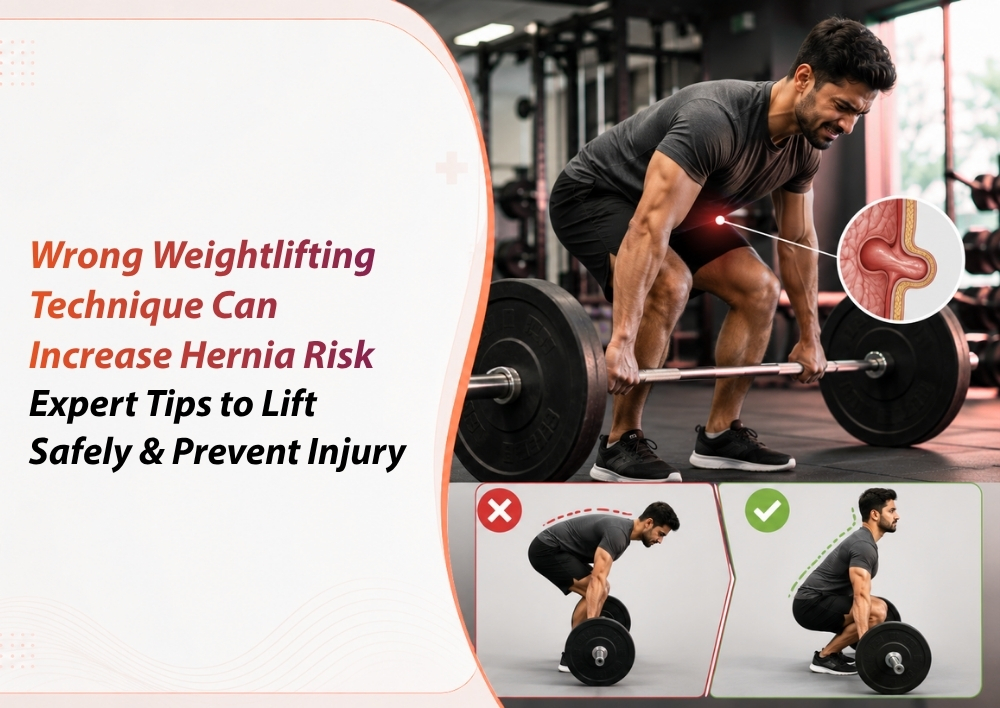
Wrong Weightlifting Technique Can Increase Hernia Risk, Warns Gurgaon's Renowned Surgeon

- Can Weightlifting Really Cause a Hernia?
- How Incorrect Weightlifting Increases Risk of Hernia?
- Is It Okay to Workout with a Hernia?
- How to Avoid a Hernia During the Gym?
- How is Hernia Diagnosed?
- Can a hernia be cured without surgery?
- Laparoscopic Hernia Surgery vs. Open Hernia Surgery
- Hernia Myth vs Fact: Common Misconceptions
- Expert Hernia Care at Miracles Healthcare, Gurgaon
- Don't Ignore the Signs. Get Expert Care Today
Summary
Weightlifting has become one of the most popular forms of exercise for improving strength, building muscle, and maintaining overall fitness. However, lifting heavy weights without proper technique can put excessive pressure on the abdominal wall, increasing the risk of developing a hernia.
According to Dr. Govind Yadav, senior laparoscopic and general surgeon in Gurgaon at Miracles Healthcare, "Incorrect weightlifting is a common but often overlooked cause of hernias, especially among gym enthusiasts, bodybuilders, manual laborers, and people who suddenly begin lifting heavy weights without proper conditioning."
While weightlifting itself is not harmful, poor lifting techniques, excessive strain, and ignoring your body's warning signs can significantly increase your risk.
In this blog, we will explore how improper weightlifting can trigger a hernia, the symptoms you should never ignore, who is most at risk, and practical tips to prevent injuries while continuing your fitness journey.
Can Weightlifting Really Cause a Hernia?
One of the biggest misconceptions among people is that lifting heavy weights directly "creates" a hernia. In reality, the connection between weightlifting and hernia is more complex. Weightlifting doesn't usually cause a gym hernia in a healthy abdominal wall. Instead, heavy lifting increases pressure inside the abdomen, which can expose or worsen an existing weakness in the abdominal muscles. Factors such as genetics, aging, previous abdominal surgery, obesity, or naturally weak connective tissues can make some individuals more susceptible, and improper lifting techniques may trigger the hernia to become noticeable.
Interestingly, research has suggested that gym-related activities are among the more commonly reported triggers in people diagnosed with hernias. In some patient studies, strenuous exercise and weight training were identified as one of the leading activities preceding the onset of symptoms, while traditional risk factors such as chronic cough, long-term constipation, as well as urinary straining were reported less frequently. Although this does not mean the gym directly causes hernias, it highlights the importance of using correct lifting techniques and avoiding excessive strain.
Gym goers usually experience
-
A sudden pull while deadlifting
-
Developing a bulge after squats
-
Groin pain after lifting heavy weights
-
Swelling after intense gym sessions
These are warning signs that should never be ignored. Early evaluation by a surgeon can help prevent complications, confirm the diagnosis, and ensure timely treatment if a hernia is present.
To help people better understand the connection between weightlifting and hernias, Miracles Healthcare recently hosted an episode of its "Har Peit Dard Gas Nahi Hota---Kahin Hernia Toh Nahi?" podcast featuring Dr. Govind Yadav. In the podcast, he explains how improper techniques, lifting beyond your capacity, and ignoring early symptoms can increase the risk of a hernia. He also shares some practical tips on safe lifting, common myths, treatment options, and when it is important to seek medical attention.
Watch the full podcast to learn directly from the expert and make informed decisions about your fitness and health.
How Incorrect Weightlifting Increases Risk of Hernia?
Incorrect lifting techniques place tremendous pressure on the abdominal wall. Some common mistakes include
1. Lifting More Than Your Body Can Handle
Trying to lift excessively heavy weights before your muscles are ready dramatically increases abdominal pressure. Progressive overload is important, but increasing weights too quickly can be risky.
2. Holding Your Breath During Heavy Lifts
Many lifters unknowingly perform the Valsalva maneuver, where they hold their breath while lifting. Although advanced athletes sometimes use this technique under supervision, improper breath-holding can sharply increase pressure inside the abdomen. Learning proper breathing techniques is essential.
3. Poor Lifting Form
Rounded backs, improper core engagement, jerky movements, and sudden twisting while lifting place unnecessary stress on the abdominal muscles. Incorrect posture transfers force to areas not designed to bear excessive strain.
Dr. Govind advises, "Never compromise your technique just to lift heavier weights. Proper posture protects not only your spine but also your abdominal muscles."
4. Skipping Warm-Up Exercises
Cold muscles are less prepared to handle heavy loads. Dynamic stretching and mobility exercises improve muscle activation and reduce injury risk.
5. Ignoring Existing Pain
Many people continue exercising despite experiencing
-
Mild groin discomfort
-
Lower abdominal pain
-
Small bulges
-
Pulling sensations
Ignoring these symptoms can allow a small hernia to become larger over time.
Is It Okay to Workout with a Hernia?
Many patients ask whether they can continue exercising or not. The answer completely depends on the severity of the hernia. Small hernias may initially cause only mild discomfort, but continuing heavy lifting usually makes the defect larger over time. You can wear a hernia belt, which may provide temporary support but does not repair the underlying weakness.
If a hernia has been diagnosed, your surgeon will advise which activities should be avoided until appropriate treatment is completed.
How to Avoid a Hernia During the Gym?
Fortunately, most weightlifting-related hernia risks can be reduced with proper precautions.
1. Learn Correct Technique: Always prioritize form over the amount of weight lifted. If you are new to strength training, seek guidance from a certified trainer.
2. Strengthen Your Core: A strong core provides better support for the abdominal wall.
Include exercises such as
-
Planks
-
Birddogs
-
Deadbugs
-
Pallof press
Controlled abdominal strengthening exercises
3. Increase Weight Slowly: Avoid sudden jumps in training intensity or attempting weights beyond your current fitness level. Giving your muscles and connective tissues enough time to adapt is essential for safe strength training.
Dr. Govind advises, "Progressive overload is the key to building strength safely. Increasing weights too quickly can place excessive pressure on the abdominal wall and increase the risk of injury, including hernias."
4. Breathe Properly: Exhale during the lifting phase and avoid unnecessary breath-holding unless specifically instructed by experienced coaches for advanced lifts.
5. Warm Up Before Every Session: Spend 10–15 minutes performing:
-
Dynamic stretches
-
Mobility drills
-
Light cardio
-
Activation exercises
6. Maintain a Healthy Body Weight: Excess body weight places continuous pressure on the abdominal wall, increasing the stress on weakened muscles and connective tissues. Maintaining a healthy BMI through regular physical activity and proper nutrition can help reduce the risk of developing a hernia.
7. Prevent Constipation: Straining during bowel movements can significantly increase pressure inside the abdomen, much like lifting heavy weights. Over time, this repeated strain may contribute to the development or worsening of a hernia. Staying well-hydrated, eating a fiber-rich diet, and maintaining regular bowel habits can help reduce unnecessary pressure on the abdominal wall.
Dr. Govind advises, "Many people don't realize that chronic constipation can put repeated stress on the abdominal muscles. Preventing constipation through a healthy diet, adequate hydration, and an active lifestyle is an important step in reducing the risk of hernias."
8. Treat Chronic Cough: A constant cough increases intra-abdominal pressure, placing continuous stress on the abdominal wall. Over time, this repeated strain can weaken existing vulnerable areas and increase the risk of developing or worsening a hernia. Treating the underlying cause of a chronic cough and seeking timely medical care can help protect your abdominal muscles and reduce hernia risk.
Read More: How Your Workout Routine Could Be Causing an Inguinal Hernia
How is Hernia Diagnosed?
A hernia is often diagnosed through a combination of your medical history, physical examination, and, when necessary, imaging tests. In many cases, a surgeon can identify a hernia during a clinical examination without requiring extensive investigations.
1. Medical History
Your surgeon will ask about
-
When you noticed the swelling or bulge for the first time
-
Whether the bulge becomes more prominent while standing, coughing, or lifting heavy objects
-
Any pain or discomfort during exercise and daily activities
-
Previous abdominal surgeries
-
Risk factors such as chronic cough, constipation, obesity, or heavy weightlifting
2. Physical Examination
The most important step in diagnosing a hernia is a careful physical examination.
Your surgeon may ask you to:
-
Stand upright
-
Cough or strain gently
-
Lie down while the swelling is examined.
These techniques help determine whether the swelling is caused by a hernia and whether it can be gently pushed back into the abdomen (a reducible hernia).
3. The Three-Finger (3-Finger) Test
For patients with a suspected inguinal hernia, surgeons may perform a clinical examination commonly referred to as the three-finger (3-finger) test.
During this examination, the surgeon gently places three fingers over specific areas of the groin while asking the patient to cough. The location where the cough impulse is felt can provide valuable clues about the type of groin hernia, such as whether it is likely to be an indirect inguinal hernia, direct inguinal hernia, or femoral hernia.
Although this hernia exam can be helpful during a clinical assessment, it should only be performed by a trained healthcare professional. It is not a self-test and cannot confirm or rule out a hernia on its own.
4. Imaging Tests (When Required)
If the diagnosis is unclear or the hernia is small and not easily felt during examination, your surgeon may recommend imaging tests, such as
-
Ultrasound: Often the first imaging test for suspected groin or abdominal hernias.
-
CT Scan: Useful for evaluating complex, recurrent, or incarcerated hernias.
-
MRI Scan: May be recommended in selected cases, especially when symptoms persist but other tests are inconclusive.
Can a hernia be cured without surgery?
This is one of the most common questions patients ask after being diagnosed with a hernia. Unlike a muscle strain, a hernia does not heal on its own because once the abdominal wall develops a weakness, it cannot repair itself without treatment.
Depending on the size of the hernia, the severity of symptoms, and the risk of complications, your surgeon may recommend:
-
Observation for selected small, symptom-free hernias
-
Elective hernia operation
-
Hernia robotic surgery
-
Open hernia repair
The most appropriate treatment depends on several factors, including the type of hernia, its size, your overall health, previous abdominal surgeries, and your surgeon's clinical assessment.
Laparoscopic Hernia Surgery vs. Open Hernia Surgery
Both laparoscopic and open hernia surgery are safe and effective procedures. The right approach varies from patient to patient and should always be decided after consultation with a qualified surgeon.
|
Feature |
Laparoscopic Hernia Repair |
Open Hernia Surgery |
|
Incision Size |
Small keyhole incisions |
One larger incision over the hernia |
|
Surgical Technique |
Performed using a laparoscope (camera) and specialized instruments |
Performed through a direct incision to repair the hernia |
|
Pain After Surgery |
Usually less postoperative discomfort |
May involve comparatively more discomfort initially |
|
Recovery Time |
Generally quicker recovery and earlier return to routine activities |
Recovery may take longer, depending on the procedure and patient |
|
Hospital Stay |
Often shorter for suitable patients |
May vary based on the type of surgery and patient condition |
|
Scarring |
Smaller scars |
Larger scar compared to laparoscopic surgery |
|
Suitable For |
Many primary and bilateral hernias, and selected recurrent hernias |
Large, complicated, strangulated, or certain recurrent hernias, depending on the surgeon's assessment |
|
Anaesthesia |
Usually performed under general anaesthesia |
Can be performed under general, spinal, or local anaesthesia in selected cases |
|
Return to Work |
Many patients resume normal activities sooner |
Return to work may take longer |
Hernia Myth vs Fact: Common Misconceptions
Myth 1: Only older people develop hernias.
Fact: Hernias can impact people of all ages, not just the elderly. While the risk increases with age due to weakening muscles, young athletes, gym-goers, weightlifters, manual laborers, women, and even children can also develop a hernia. Factors such as heavy lifting, chronic coughing, obesity, pregnancy, previous surgeries, and a family history of hernia can increase the risk.
Myth 2: Wearing a hernia belt permanently fixes the problem.
Fact: A hernia belt may provide temporary support and relieve discomfort, but it does not repair the weakened abdominal wall or cure the hernia. The ideal and permanent treatment for a hernia is surgical repair, especially if it causes symptoms or carries a risk of complications.
Myth 3: A hernia is always painful.
Fact: Not necessarily. In its early stages, a hernia may present as a small bulge with little or no pain. Some people notice only mild discomfort, a feeling of heaviness, or pain during activities such as lifting heavy objects, coughing, or prolonged standing. Ignoring these early signs can let the hernia grow larger over time.
Myth 4: If the bulge disappears, the hernia is gone.
Fact: A hernia may temporarily disappear or become less noticeable when you lie down or gently push it back into place. However, this does not mean it has healed. The weakness in the abdominal wall remains, and the hernia can reappear or even become trapped, increasing the risk of serious complications.
Myth 5: You should avoid hernia surgery because it is risky.
Fact: Modern hernia surgery using minimally invasive techniques such as laparoscopic hernia repair is safe, effective, and commonly performed. This surgical procedure often results in smaller incisions, less pain, quicker recovery, and an earlier return to daily activities. Your surgeon will recommend the most appropriate approach based on your condition.
Myth 6: Once a hernia is diagnosed, you should stop exercising forever.
Fact: Having a hernia doesn't mean you have to give up an active lifestyle permanently. After proper treatment and adequate recovery, most people can safely return to exercise, including weight training, by following their surgeon's advice, using proper lifting techniques, and slowly increasing workout intensity.
Also Read: Hernia: What it is, Types, Symptoms, Causes & Treatment
Expert Hernia Care at Miracles Healthcare, Gurgaon
If you are in Gurgaon and looking for expert hernia treatment, don't wait until your symptoms become severe. Seeking timely medical attention at Miracles Healthcare can help prevent complications and ensure the right treatment at the right time.
As an NABH-accredited multispeciality hospital in Gurgaon, Miracles Healthcare has been providing advanced surgical care to patients since 2002. Our experienced team of Gurgaon's renowned general and laparoscopic surgeons offers comprehensive care for all types of hernias, including inguinal, umbilical, incisional, femoral, hiatal hernias, and others.
Every patient's condition is different. That is why, for patients with health problems like diabetes, obesity, heart disease, or other medical conditions that may affect treatment or recovery, our surgeons work closely with specialists across multiple disciplines whenever required.
Supported by advanced in-house diagnostic facilities, a 24×7 in-house pharmacy, and emergency services, patients receive seamless care throughout their treatment journey.
Backed by a legacy of 26,000+ surgeries with a near-zero infection rate, Miracles Healthcare combines extensive surgical experience with a strong focus on patient safety and quality care. To make expert care more accessible, Miracles Healthcare currently serves patients through multiple centres across Gurgaon in Sector 14, Sector 56, and Sector 82, making it easier for individuals and their families to receive trusted healthcare closer to where they live.
-
Miracles Apollo Mediclinic, Sector 14: SCO 1, 2 & 3, Delhi Road, Sector 14, Gurugram, Haryana
-
Miracles Mediclinic, Sector 56: SCO-68-69, More Market, Sector 56, Gurugram, Haryana
Don't Ignore the Signs. Get Expert Care Today
Ignoring a hernia won't make it disappear. The sooner it is diagnosed, the easier it is to treat and the lower the risk of complications. Schedule your consultation with the hernia surgeon near you in Gurgaon at Miracles Healthcare and receive a personalized evaluation and treatment.
You can connect with our experts through:
-
WhatsApp Support: Share your symptoms, ask your initial questions, and get assistance with booking an appointment.
-
Online Consultation: Consult an experienced general and laparoscopic surgeon from the comfort of your home via a secure video consultation.
-
Hospital Visit: Book an appointment at your nearest Miracles Healthcare centre for an in-person consultation.
-
Phone Appointment: Call our team to schedule a consultation at a date and time that is convenient for you.
Written and Verified by:

Frequently Asked Questions
Yes. Heavy lifting or using incorrect lifting techniques can increase pressure inside the abdomen, causing a hernia to enlarge or become more symptomatic.
It depends on both the size and severity of the hernia. Don't lift heavy weights and consult your surgeon before continuing strength training to prevent complications.
The 3-finger test is a clinical examination performed by a surgeon to help identify the type of inguinal hernia. According to Dr. Govind Yadav, it should only be performed by a trained healthcare professional and is not a self-test.
There is no safe weight limit that applies to everyone. Dr. Govind Yadav advises avoiding heavy lifting until you have been evaluated by a surgeon, as even moderate weights can worsen some hernias.
A hernia belt may provide temporary support and relieve discomfort, but it does not repair the hernia or replace surgical treatment when required.
Yes. Although hernias are more common in men, women can also develop inguinal, femoral, umbilical, or incisional hernias, especially after pregnancy, abdominal surgery, or due to increased abdominal pressure.
Most hernias are not life-threatening. However, if left untreated, a hernia can become strangulated, cutting off the blood supply to the trapped tissue.






Was the information useful?
0 0