


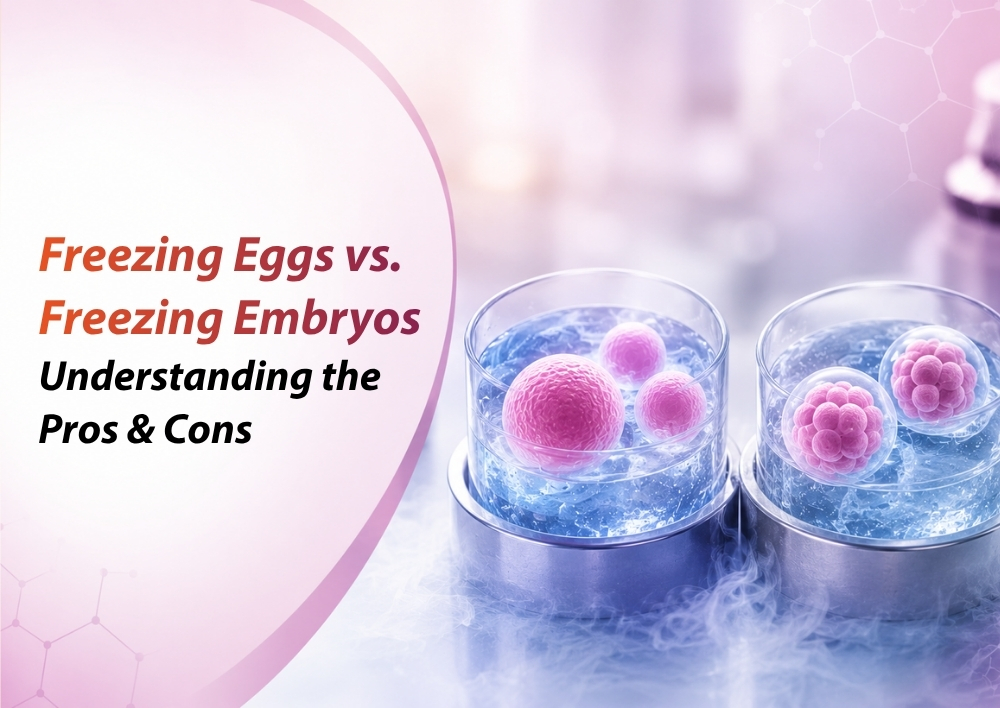
Freezing Eggs vs. Freezing Embryos: The Pros and Cons

- What is Fertility Preservation?
- What is Egg Freezing?
- How Does Egg Freezing Work?
- Pros of Egg Freezing
- Cons of Egg Freezing
- What is Embryo Freezing?
- How Does Embryo Freezing Work?
- Pros of Embryo Freezing
- Cons of Embryo Freezing
- Egg Freezing vs Embryo Freezing: Key Differences
- Egg Freezing vs Embryo Freezing: Which Has Better Success Rates?
- Who Should Consider Egg Freezing?
- Who Should Consider Embryo Freezing?
- How Long Can Eggs and Embryos Stay Frozen?
- Factors to Consider Before Choosing Between Egg Freezing and Embryo Freezing
- Your Fertility Preservation Journey at Miracles Healthcare
- Take the First Step Toward Protecting Your Fertility
Summary
Not ready to have a baby now? That doesn't mean you have to give up the possibility for the future.
The right time to become a parent is different for everyone. Some people choose to wait because of career aspirations, education, personal goals, or the search for the right partner, while others need to preserve fertility before undergoing medical treatment. Fertility preservation offers the opportunity to safeguard your reproductive future without rushing life's important decisions.
Among the most effective fertility preservation methods are egg freezing (oocyte cryopreservation) and embryo freezing (embryo cryopreservation). While both help preserve the possibility of future pregnancy, they differ in how they are performed, their success rates, flexibility, and who they are most suitable for. The right choice depends on factors such as your age, relationship status, medical history, and future family goals.
The success of fertility preservation doesn't depend only on whether you choose egg freezing or embryo freezing; it also depends on where you choose to preserve your fertility. At Miracles Healthcare, Gurgaon, our experienced fertility specialists, expert embryologists, and advanced in-house embryology lab provide world-class egg and embryo freezing services. Having successfully preserved frozen eggs for up to 10 years (as allowed by ART guidelines of India), we are committed to helping you protect your fertility with confidence and peace of mind.
So, should you freeze your eggs or your embryos? In this blog, we will explore everything you need to know about egg freezing vs embryo freezing, including how each procedure works, their benefits and limitations, success rates, costs, and the key factors to consider before making your decision.
Before jumping directly to the difference between egg freezing and embryo freezing, first of all, we will understand fertility preservation, egg freezing, embryo freezing, and their benefits and limitations in brief.
What is Fertility Preservation?
Fertility preservation represents medical techniques that allow individuals or couples to save their reproductive cells for future pregnancy.
People prefer fertility preservation for many reasons, including
-
Delaying pregnancy for personal or career reasons.
-
Cancer treatment (chemotherapy or radiation)
-
Low ovarian reserve
-
Autoimmune disorders
-
Gender-affirming treatment
The two most widely used fertility preservation methods are
-
Egg Freezing
-
Embryo Freezing
Let's understand each in detail.
What is Egg Freezing?
Egg freezing, also known as oocyte cryopreservation, involves collecting mature eggs from a female's ovaries and freezing them unfertilized.
The eggs remain stored until the woman decides to conceive. At that time, the eggs are thawed, fertilized with sperm in the laboratory via IVF, and transferred into the uterus.
Gurgaon's top-rated fertility specialist at Miracles Healthcare, Dr. Anviti Saraf, says: "Egg freezing is about preserving possibilities. It gives women the flexibility to plan pregnancy without compromising the quality of their eggs."
How Does Egg Freezing Work?
The process usually includes
-
Ovarian stimulation using fertility medications.
-
Monitoring with ultrasound and blood tests.
-
Egg retrieval under mild anesthesia.
-
Rapid freezing using vitrification technology.
-
Long-term storage in specialized fertility laboratories.
Pros of Egg Freezing
1. Gives Women More Reproductive Freedom: Women can preserve younger, healthier eggs and plan pregnancy when they feel emotionally, financially, or personally ready. According to the ART Act 2021, In India, the gametes, i.e Eggs and sperm, can be stored initially for up to 10 years. However, with consent from the patients, it can be extended.
2. No Need for a Partner: Egg freezing does not require sperm at the time of freezing.
This makes it an excellent option for
-
Single women.
-
Women delaying marriage.
-
Women uncertain about future partners.
3. Preserves Fertility Before Medical Treatments: Women undergoing chemotherapy or radiation can protect their fertility before treatment begins.
4. Better Quality Eggs: Since egg quality naturally declines with age, freezing eggs earlier may improve future pregnancy chances.
5. Provides More Future Choices: Women retain complete control over how and when they want to use their eggs.
Cons of Egg Freezing
-
Lower Success Rate Compared to Embryos: Eggs are delicate cells. Although vitrification has significantly improved results, not every frozen egg survives thawing or fertilizes successfully.
-
May Require Multiple Cycles: Women aged 35+ usually need more than one egg retrieval cycle to collect enough healthy eggs.
-
IVF is Still Required Later: Frozen eggs cannot result in pregnancy naturally. They must undergo IVF when the woman wishes to conceive.
What is Embryo Freezing?
Embryo freezing involves fertilizing mature eggs with sperm to form embryos. These embryos are then frozen using advanced cryopreservation techniques and stored for future pregnancy. It is one of the most successful and widely used fertility preservation methods in IVF.
"For couples planning parenthood later, embryo freezing provides a reliable way to preserve their best possibilities for a successful pregnancy.", says Dr. Anviti Saraf
How Does Embryo Freezing Work?
The process includes
-
Ovarian stimulation.
-
Fertilization with sperm.
-
Embryo development for 3–5 days.
-
Selection of healthy embryos.
-
Freezing through vitrification.
-
Storage until embryo transfer.
Pros of Embryo Freezing
-
Higher Pregnancy Success Rates: Embryos generally survive freezing and thawing better than unfertilized eggs. Since fertilization has already occurred, doctors know which embryos have developed successfully before freezing.
-
Fewer Uncertainties: The fertilization process is already complete, reducing one major variable during future IVF treatment.
-
Ideal for Couples: Couples planning children later can preserve embryos created from younger eggs and sperm.
-
Efficient IVF Treatment: If multiple healthy embryos are created, additional embryo transfers can be performed without repeating ovarian stimulation.
Cons of Embryo Freezing
-
Requires Sperm Before Freezing: Embryo freezing is only possible if sperm is available.
-
Less Flexibility: Future decisions require agreement from both genetic contributors in many cases.
Now that you have a fair understanding of both egg and embryo freezing, let's move on to the differences between the two procedures.
Egg Freezing vs Embryo Freezing: Key Differences
|
Feature |
Egg Freezing |
Embryo Freezing |
|
Fertilized before freezing |
No |
Yes |
|
Requires sperm |
No |
Yes |
|
Best for |
Single women or those who want to preserve fertility before choosing a partner |
Couples or individuals using donor sperm |
|
Flexibility |
Higher |
Lower |
|
Pregnancy success |
Good |
Slightly higher |
|
Future IVF needed |
Yes |
Yes |
|
Ownership concerns |
Minimal |
Possible legal or ownership issues in certain situations |
|
Cost |
Generally Low as it doesn’t include fertilization. |
Slightly higher due to IVF fertilization and embryo culture process |
Egg Freezing vs Embryo Freezing: Which Has Better Success Rates?
The success of both egg freezing and embryo freezing depends on various factors, including:
-
Age at the time of freezing.
-
Egg quality.
-
Sperm quality (for embryo freezing)
-
Embryo quality.
-
IVF laboratory expertise and freezing techniques.
-
Overall reproductive health.
In general, embryo freezing has slightly higher success rates than egg freezing. This is because embryos have already been fertilized and have successfully reached an early stage of development before being frozen. As a result, they are more likely to thaw and implant successfully in the uterus.
However, the gap between the two procedures has narrowed significantly due to vitrification. Modern egg freezing offers excellent survival rates after thawing, with many eggs remaining healthy enough for successful fertilization and pregnancy.
Females who freeze their eggs before the age of 35 generally have the best results because younger eggs are healthier and have a lower risk of chromosomal abnormalities.
So, Which Option is Better For You?
There is no one-size-fits-all answer.
-
Choose egg freezing if you want to preserve your fertility but do not have a partner.
-
Prefer embryo freezing if you have a partner or have decided to use donor sperm and are looking for the highest potential success rates.
In Short:
The age at which eggs are frozen has a much greater effect on the success of future pregnancy than whether you choose egg freezing or embryo freezing. Because both egg and embryo freezing at a younger age usually lead to better results, regardless of how long they remain frozen.
According to Dr. Anviti, "While embryo freezing may offer slightly higher success rates, the biggest factor influencing success is the age at which the eggs are frozen. Both egg and embryo freezing can provide excellent outcomes when performed at the right time with advanced vitrification techniques and expert IVF care."
Who Should Consider Egg Freezing?
Egg freezing may be suitable for females who
-
Are not ready for pregnancy.
-
Have not found the right partner.
-
Want to delay motherhood.
-
Are diagnosed with cancer.
-
Have a family history of early menopause.
-
Have endometriosis.
-
Want reproductive independence.
Who Should Consider Embryo Freezing?
Embryo freezing may be better for
-
Married couples.
-
Couples undergoing IVF.
-
Couples planning a delayed pregnancy.
-
Individuals with available donor sperm.
-
Those seeking slightly higher pregnancy success rates.
How Long Can Eggs and Embryos Stay Frozen?
Because of modern cryopreservation techniques
-
Eggs can remain frozen for many years. However, the exact duration of storage as per the ART Act 2021 can be 5-10 years initially. It may be extended as per the patient's willingness and the policies of the fertility center after permission from the ART board.
-
Embryos can also stay frozen for extended periods without significant loss of quality.
Successful pregnancies have been reported even after long-term storage.
Factors to Consider Before Choosing Between Egg Freezing and Embryo Freezing
Before choosing between egg freezing and embryo freezing, make sure to consider the following factors.
-
Your Age: Always remember, if you are young at the time of freezing, your chance of future success will always be better.
-
Relationship Status: Single women could prefer egg freezing, while couples may benefit from embryo freezing.
-
Future Family Plans: Discuss with your partner about how many children you may want in the future.
-
Medical Conditions: Certain health conditions may influence the most suitable option.
-
Financial Considerations: Discuss the costs of retrieval, freezing, storage, and future IVF with your fertility specialist.
-
Emotional and Legal Factors: Embryo freezing may involve shared decision-making and legal considerations, especially if circumstances change.
Your Fertility Preservation Journey at Miracles Healthcare
Fertility preservation is not just about freezing eggs or embryos; it is about preserving your future with the right expertise behind every step.
-
At Miracles Healthcare, the best fertility clinic in Gurgaon, your journey is guided by a team of highly experienced fertility specialists and embryologists who work together to create a personalized fertility preservation plan based on your age, ovarian reserve, medical history, and future family goals. From your first consultation to future IVF treatment, every decision is tailored to you.
-
Behind the scenes, our state-of-the-art in-house embryology laboratory plays an important role in safeguarding your fertility. Using advanced vitrification technology and stringent quality protocols, our embryologists have successfully preserved the eggs of patients for over a decade, ensuring safe and reliable long-term fertility preservation.
-
Beyond fertility care, Miracles Healthcare offers the advantage of a multispecialty healthcare network. Whether fertility preservation is part of cancer treatment, managing endometriosis or PCOS, or planning pregnancy later in life, specialists across multiple disciplines work together to support your reproductive health.
-
Getting in touch with our fertility team is equally flexible and stress-free. You can reach our specialists through Call / WhatsApp +91 124 479 7600 / +91 98209 65000 for quick queries, a phone call for immediate guidance, online consultation for convenience, or by visiting any of our centres in Gurgaon. The idea is simple: you choose how you want to connect, and we make sure expert advice reaches you without delay.
Easily Accessible Fertility Care Across Gurgaon
With a presence across multiple locations in Gurgaon, including Sector 14, Sector 56, and Sector 82, expert fertility care is never far away. From consultations and investigations to fertility preservation and future IVF treatment, your care remains connected across every stage.
1. Miracles Fertility & IVF Clinic, Sec 14, Gurgaon
Here, patients have access to complete fertility services including IVF, IUI, ICSI, fertility screening, egg preservation, embryo preservation, and semen preservation.
2. Miracles Apollo Cradle, Sec 14, Gurgaon
Patients have access to advanced gynaecology, obstetrics, surgical care, and NICU support under one roof.
3. Miracles Mediclinic, Sec 56, Gurgaon
Patients can benefit from seamless access to consultations, diagnostics, lab testing, MRI, and CT scan services—helping ensure accurate evaluation at every stage of fertility planning.
4. Miracles Apollo Cradle/Spectra, Sec 82, Gurgaon
It extends comprehensive care with consultations, diagnostics, CT scans, general surgery, and preventive health checks, making it easier to manage associated medical needs during fertility treatment.
Together, these centres create a connected care network where your fertility preservation, diagnostics, and specialist support work in sync, so you don’t have to move between disconnected facilities.
Take the First Step Toward Protecting Your Fertility
Whether you are planning for the future, delaying parenthood, or preparing for medical treatment, fertility preservation can help safeguard your chances of building a family when the time is right. Consult an experienced fertility specialist near you at Miracles Healthcare to understand your options, discuss success rates, and create a personalized fertility preservation plan that aligns with your life goals.
Written and Verified by:

Dr. Anviti Saraf Exp: 11
MBBS, M.S. (Obstetrics & Gynaecology), FNB (Reproductive Medicne), DNB, MRCOG (UK)
Meet the Doctor
Frequently Asked Questions
Embryo freezing is usually considered more reliable because embryos have already been fertilized, but egg freezing is better for people who want to preserve future fertility without a partner or sperm donor.
Egg retrieval is more uncomfortable, as it is a minor procedure done under sedation; embryo transfer is usually quick and mostly painless, like a Pap smear.
No, frozen embryos generally have similar or even slightly better success rates compared to fresh transfers with modern freezing techniques (vitrification).
Embryos are more developed than eggs, so they tend to survive thawing and implantation more predictably than eggs, but “stronger” isn’t medically precise.
Yes, embryo freezing is usually more expensive because it includes IVF fertilization, lab work, and embryo culture in addition to freezing costs. It can range from Rs. 3 Lacs to Rs. 5 Lacs. To know the exact cost, you can visit a fertility clinic near you.






Was the information useful?
0 0