


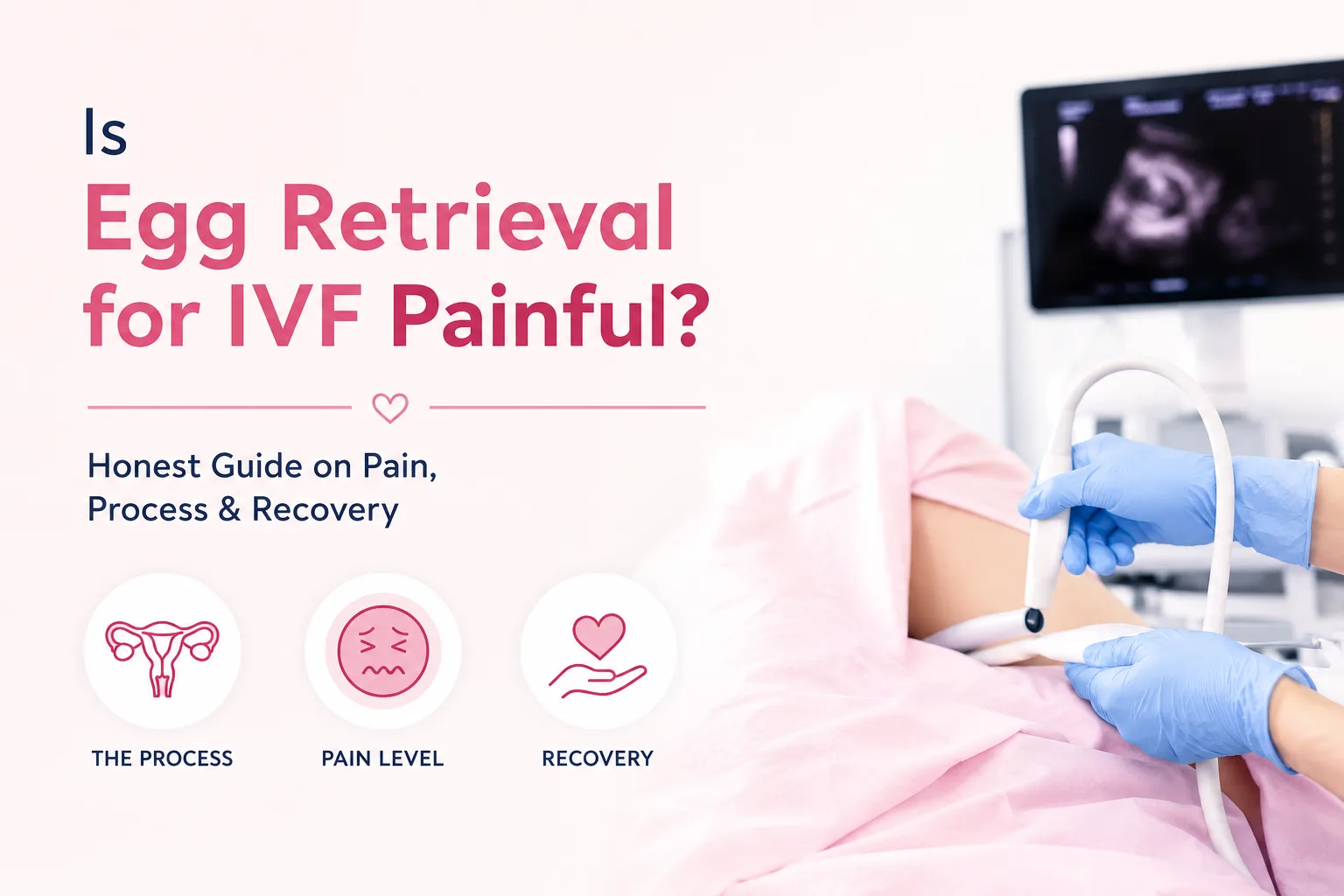
Is Egg Retrieval for IVF Painful? Honest Guide on Pain, Process & Recovery
Summary
If you are preparing for IVF, one question that almost every patient asks is - is egg retrieval for IVF painful? It is one of the most natural fears to have, and you deserve a clear, honest answer rather than vague reassurances. The short answer is: during the procedure itself, you will be under sedation and should not feel pain. What follows - mild cramping, bloating, and a sense of pressure - is normal and typically short-lived. This guide walks you through everything you need to know about the egg retrieval process, from what happens in the procedure room to how long recovery takes and when to seek medical attention.
What Is Egg Retrieval in IVF?
Egg retrieval - medically referred to as oocyte retrieval - is a minor surgical procedure that forms the core of the IVF process. After a woman undergoes a cycle of hormonal stimulation to encourage her ovaries to produce multiple mature eggs, those eggs are collected from the ovarian follicles through a carefully guided procedure. These eggs are then taken to the embryology laboratory, where they are fertilised with sperm to create embryos. The embryos are subsequently transferred to the uterus in the hope of achieving a successful pregnancy.
Understanding what egg retrieval involves - and how much discomfort is actually involved - helps reduce anxiety and allows patients to prepare practically and emotionally for this key step in their IVF journey.
How Is the Egg Retrieval Procedure Performed?
The egg retrieval procedure is performed transvaginally under ultrasound guidance. Here is a step-by-step overview of what happens:
-
Sedation is administered: You will receive intravenous sedation or light general anaesthesia before the procedure begins. You will be completely unconscious or in a deeply relaxed, pain-free state throughout.
-
Ultrasound guidance: A vaginal ultrasound probe fitted with a thin needle guide is inserted. The specialist uses real-time ultrasound imaging to locate and visualise each mature ovarian follicle.
-
Follicle aspiration: A fine needle is passed through the vaginal wall into each follicle. The follicular fluid - which contains the egg - is gently aspirated (suctioned out) into collection tubes.
-
Laboratory handoff: The fluid is immediately passed to the embryologist in the adjacent laboratory, who identifies and evaluates each egg under a microscope.
-
Procedure completion: The entire retrieval process takes approximately 15 to 30 minutes, depending on the number of follicles and ovarian anatomy.
-
Recovery room: Once the procedure is complete, you are moved to a recovery area where you rest for 1 to 2 hours as the sedation wears off. You will need a companion to take you home, as driving is not permitted on the day of retrieval.
Is Egg Retrieval for IVF Painful? The Honest Answer
This is the question most patients are really asking. Here is an honest, medically accurate answer across each phase:
During the Procedure
No - egg retrieval for IVF is not painful during the procedure. Sedation ensures that you are either asleep or deeply relaxed, and you will have no awareness of the needle or the aspiration. Most patients have no memory of the procedure at all.
Immediately After the Procedure
As the sedation wears off over the first hour or two, it is common to feel:
-
Mild to moderate cramping, similar to period pain
-
A sensation of pressure or heaviness in the pelvic area
-
Bloating, particularly if multiple eggs were retrieved
-
Light spotting or vaginal discharge, which is normal
-
Mild nausea from the sedation medication
These sensations are expected and are not a cause for concern. Most patients describe the post-procedure discomfort as manageable and similar to moderate menstrual cramps.
Over the Following Days
Most women feel significantly better within 24 to 48 hours. Some bloating may persist for 3 to 5 days, particularly if a larger number of follicles were stimulated. Over-the-counter pain relief such as paracetamol is usually sufficient. Ibuprofen is generally avoided unless specifically recommended by your fertility specialist, as it can potentially interfere with ovarian function.
What Factors Influence Pain Levels After Egg Retrieval?
Not every woman experiences the same level of discomfort after egg retrieval. Several factors affect how you might feel:
-
Number of eggs retrieved: The more follicles stimulated and eggs retrieved, the more the ovaries are enlarged, which increases the degree of bloating and discomfort
-
Individual pain threshold: Sensitivity to pelvic discomfort varies significantly from person to person
-
Ovarian anatomy: Women with ovaries that are anatomically more difficult to access may experience slightly more post-procedural soreness
-
Type and depth of sedation used: Deeper sedation generally results in a more comfortable recovery
-
Presence of conditions such as endometriosis: Underlying gynaecological conditions may contribute to a more pronounced post-retrieval discomfort
What to Expect Before Egg Retrieval: Preparation
Preparation for egg retrieval begins weeks before the actual procedure. Here is what the process involves leading up to retrieval day:
Ovarian Stimulation
Fertility medications - typically injectable gonadotropins - are administered for approximately 10 to 14 days. These stimulate the ovaries to develop multiple follicles simultaneously, rather than the single egg that matures in a natural cycle. During this phase, patients attend regular monitoring appointments - blood tests and transvaginal ultrasounds - to track follicle growth and hormone levels.
Trigger Injection
Once the follicles reach an appropriate size (typically 17 to 20 mm), a trigger injection of hCG (human chorionic gonadotropin) or a GnRH agonist is administered. This triggers the final maturation of the eggs. Egg retrieval is scheduled precisely 34 to 36 hours after the trigger injection.
Pre-Procedure Instructions
-
Fast for a minimum of 6 to 8 hours before the procedure
-
Avoid alcohol and smoking in the days leading up to retrieval
-
Arrange for a companion to accompany you home, as you will not be able to drive after sedation
-
Follow all medication instructions provided by your fertility specialist
Recovery After Egg Retrieval: What to Do at Home
Recovery from egg retrieval is generally quick. Here is how to take care of yourself in the days following the procedure:
-
Rest on retrieval day: Plan to spend the day at home. Light activity is fine the following day for most women.
-
Pain relief: Paracetamol is typically recommended for cramps. A warm heating pad placed on the lower abdomen can also provide comfort.
-
Stay hydrated: Drinking plenty of fluids, particularly electrolyte-rich drinks, helps support recovery and reduces the risk of OHSS.
-
Eat light, nourishing meals: Avoid heavy, gas-producing foods for the first 24 to 48 hours.
-
Avoid strenuous exercise: High-impact activities should be avoided for at least a week, as enlarged ovaries are at a slightly higher risk of torsion.
-
Avoid sexual intercourse: Until cleared by your specialist, typically for 1 to 2 weeks after retrieval.
-
Attend all follow-up appointments: These are essential for embryo development updates and planning the embryo transfer.
What Is Ovarian Hyperstimulation Syndrome (OHSS)?
OHSS is the most important complication to be aware of after egg retrieval for IVF. It occurs when the ovaries respond too strongly to stimulating hormones, causing them to become swollen and leak fluid into the abdomen.
Mild OHSS affects a small proportion of IVF patients and typically resolves within 1 to 2 weeks with rest and hydration. Symptoms include bloating, mild abdominal discomfort, and nausea.
Moderate to severe OHSS is less common and requires medical attention. Symptoms to watch out for include:
-
Rapid weight gain (more than 1 kg in 24 hours)
-
Severe abdominal pain or significant bloating
-
Difficulty breathing or shortness of breath
-
Reduced urinary output or dark-coloured urine
-
Persistent nausea or vomiting
Patients with PCOS or those who produce a high number of follicles in response to stimulation are at a slightly elevated risk of OHSS. At Miracles Fertility & IVF Clinic, close monitoring during the stimulation phase allows the team to adjust protocols and reduce the risk of OHSS proactively.
When Should You Contact Your Fertility Doctor After Egg Retrieval?
While discomfort after egg retrieval is expected, some symptoms require prompt medical attention. Contact your doctor immediately if you experience:
-
Severe or worsening abdominal pain that does not respond to paracetamol
-
Heavy vaginal bleeding (more than a light period)
-
Fever above 38°C
-
Significant difficulty urinating
-
Sudden and marked abdominal distension
-
Signs consistent with moderate or severe OHSS as listed above
Prompt communication with your fertility team ensures that any complications are identified and managed early - protecting both your health and your treatment outcome.
IVF and Egg Retrieval at Miracles Fertility & IVF Clinic, Gurgaon
For couples and individuals navigating the IVF journey in Delhi NCR, Miracles Fertility & IVF Clinic at Sector 14, Gurgaon offers comprehensive fertility care backed by 12+ years of dedicated expertise. With a success rate exceeding 65% across 1,500+ IVF cycles, transparent pricing with no hidden costs, and a full suite of fertility treatments, it is one of the most trusted fertility destinations in the region.
Fertility services available at Miracles Fertility & IVF Clinic:
-
Donor egg cycles
-
Fertility screening and semen analysis
Miracles Healthcare Locations
Miracles Fertility & IVF Clinic, Sector 14, Gurgaon SCO 1, 2 & 3, Old Delhi–Gurugram Road, Sector 14, Gurugram - 0124-4797600 View Location Services: IVF, IUI, ICSI/PICSI, egg preservation, semen analysis, donor egg cycles, fertility screening
Miracles Apollo Cradle, Sector 14, Gurgaon SCO 1, 2 & 3, Delhi Road, Sector 14, Gurugram - 0124-4797600 View Location Services: Gynaecological consultations, maternity care, Level III NICU, 24x7 emergency
Miracles Apollo Cradle/Spectra, Sector 82, Gurgaon Plot No. 45, Vatika India Next, Sector 82, Gurugram - 0124-352-8282 View Location Services: Full-service hospital - surgeries, maternity, diagnostics, CT scan, 24x7 emergency
Miracles Mediclinic, Sector 56, Gurgaon SCO-68-69, More Market, Block B, Sector 56, Gurugram - 906-906-8800 View Location Services: OPD consultations, MRI scan, NABL-certified diagnostics, health checks
Book Your Fertility Consultation Today
If you are beginning your IVF journey or have questions about the egg retrieval process, the specialist team at Miracles Fertility & IVF Clinic is here to guide you every step of the way. With 65%+ IVF success rates, 1,500+ cycles completed, transparent pricing, and 12+ years of trusted fertility expertise, Miracles Healthcare is one of Gurgaon's most recommended destinations for comprehensive fertility care.
Call: 0124-4797600
WhatsApp: 98209-65000
Location: SCO 1, 2 & 3, Old Delhi–Gurugram Road, Sector 14, Gurugram
Written and Verified by:

Frequently Asked Questions
No. Egg retrieval is performed under intravenous sedation, which means you will be in a pain-free, deeply relaxed or unconscious state throughout. You will have no sensation of the needle or the aspiration process. The procedure itself takes approximately 15 to 30 minutes.
Mild to moderate cramping and bloating are completely normal after egg retrieval and are experienced by most women. This discomfort is typically comparable to period pain and usually resolves within 24 to 72 hours. Paracetamol and a warm heating pad are effective for managing post-retrieval discomfort.
Most women feel well enough to resume light daily activities the day after retrieval. Significant bloating may persist for 3 to 5 days. Strenuous physical activity should be avoided for at least a week. Full recovery before embryo transfer - whether fresh or frozen - is an important part of the treatment timeline.
The number of eggs retrieved depends on a woman's ovarian reserve, age, and response to stimulation medications. On average, 8 to 15 eggs may be retrieved per cycle. Not all retrieved eggs will be mature, and not all mature eggs will fertilise successfully - which is why retrieving multiple eggs is the goal of ovarian stimulation.
Ovarian Hyperstimulation Syndrome (OHSS) is a response to fertility medications where the ovaries become overstimulated and swollen. Mild OHSS is relatively common and self-resolving. Moderate to severe OHSS is uncommon and requires medical management. Women with PCOS or high antral follicle counts are at a slightly higher risk. Close monitoring during stimulation significantly reduces this risk.
Yes. Egg retrieval is a day procedure. After spending 1 to 2 hours in the recovery area as the sedation wears off, patients are discharged home. You must be accompanied by a responsible adult and must not drive on the day of the procedure.
You can call 0124-4797600, WhatsApp at 98209-65000, or book online through the Miracles Healthcare website. In-person consultations are available at Miracles Fertility & IVF Clinic, Sector 14, Gurgaon. Online consultations are also available for patients travelling from Delhi or other parts of NCR.




Was the information useful?
0 0