


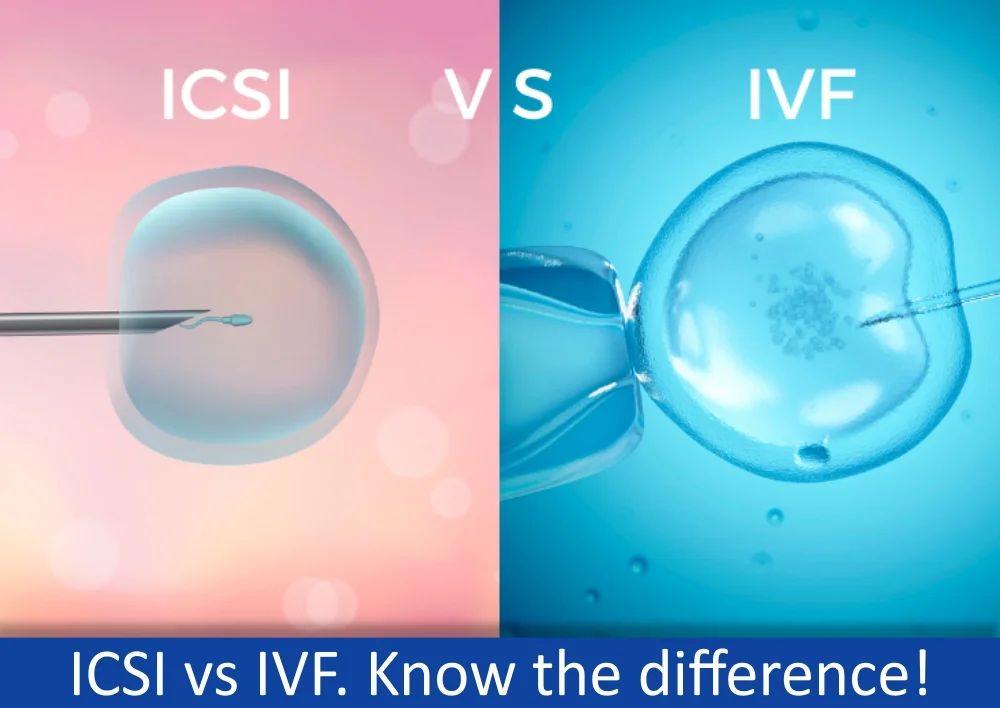
ICSI vs IVF - Know the Difference!
Summary
Overview
For many couples, achieving pregnancy happens naturally. However, some face challenges in conceiving and may require fertility treatment. Thanks to advances in reproductive medicine, Assisted Reproductive Technology (ART) has helped millions of couples fulfill their dream of parenthood.
Two of the most commonly recommended fertility treatments are In Vitro Fertilization (IVF) and Intracytoplasmic Sperm Injection (ICSI). While both procedures aim to achieve fertilization outside the body, the way fertilization occurs differs significantly.
Understanding the difference between IVF and ICSI can help couples make informed decisions about their fertility journey.
What is IVF?
In Vitro Fertilization (IVF) is a widely used fertility treatment in which eggs are retrieved from the ovaries and combined with sperm in a laboratory dish. Fertilization occurs naturally when the sperm penetrates the egg on its own.
Once fertilization takes place and embryos develop, one or more healthy embryos are transferred into the uterus to achieve pregnancy.
IVF is commonly recommended for
-
Blocked or damaged fallopian tubes.
-
Ovulation disorders.
-
Unexplained infertility.
-
Mild male factor infertility.
-
Couples who have not conceived with other fertility treatments.
Dr. Anviti Saraf, Senior Fertility Specialist at Miracles Fertility & IVF Clinic, Gurgaon, says, "IVF has given hope to countless couples, but the key to success lies in timely evaluation, accurate diagnosis, and personalized fertility care."
What is ICSI?
Intracytoplasmic Sperm Injection (ICSI) is an advanced fertility treatment and a specialized form of IVF. In this procedure, an embryologist carefully selects a healthy sperm and injects it directly into a mature egg using highly specialized microscopic equipment. This technique helps overcome fertilization challenges, particularly in cases of male infertility.
After fertilization, the embryo is closely monitored in the laboratory for development before being transferred into the uterus to achieve pregnancy.
When is ICSI Recommended?
ICSI is commonly recommended for:
-
Poor sperm motility (movement)
-
Abnormal sperm morphology (shape)
-
Previous IVF fertilization failure
-
Surgical sperm retrieval cases
-
Severe male factor infertility
According to Dr. Anviti Saraf, "ICSI has revolutionized the treatment of male infertility by enabling fertilization even in cases where sperm quality or quantity is significantly compromised, giving many couples a greater chance of achieving parenthood."
Dr. Anviti Saraf, a senior fertility specialist at Miracles Fertility & IVF Clinic, Gurgaon, has extensive experience in managing complex fertility cases and helping couples achieve successful pregnancies through advanced reproductive treatments.
|
IVF vs ICSI: Key Differences |
||
|
Feature |
IVF |
ICSI |
|
Fertilization Method |
Egg and sperm are placed together in a laboratory dish |
A single sperm is injected directly into the egg |
|
Sperm Requirement |
Requires a sufficient number of healthy sperm |
Can be performed even with very few healthy sperm |
|
Best Suited For |
Female infertility and unexplained infertility |
Severe male factor infertility |
|
Laboratory Procedure |
Natural fertilization in the lab |
Manual fertilization by an embryologist |
|
Fertilization Assistance |
Minimal intervention |
Maximum assistance to sperm |
|
Complexity |
Less complex |
More specialized and technically advanced |
|
Cost |
Generally lower |
Usually higher due to specialized techniques |
While some women conceive naturally, others have a difficult time to become pregnant. With technology and science advancing, there are new medical procedures through which a woman can become a mother and embrace motherhood. Every woman longs for a child, and if she is unable to bear a child, it is disheartening for her. In Vitro Fertilization or IVF is the procedure that allows a woman to become pregnant by assisting in fertilization, development of the embryo and implantation.
IVF is one of the popular techniques of Assisted Reproductive Technology (ART), which effectively works in a combination of medication and surgical procedures, which involves fertilization of the egg with a sperm and the implantation of the fertilized egg in the uterus.
Another popular method of ART is ICSI or Intracytoplasmic Sperm Injection, which involves an embryologist selecting a healthy sperm with the help of a microscope and some very technically advanced medical equipment, and then injecting it directly into the egg. After inserting the sperm directly into the egg, the embryologist checks in again after two to three days, to check whether the eggs have fertilized and developed into embryos or not.
IVF and ICSI, both are popular techniques of the ART. The only difference between the two is the process by which the sperm fertilizes the egg. The former method involves the egg and sperm left on a petri dish and fertilized on their own, while the latter involves the injecting of the sperm directly into the egg. Couples who are trying for a child often consider visiting the best IUI Clinic in Gurgaon, for a successful pregnancy.
Couples suffering from sperm related infertility often opt for ICSI, as per the advice of their doctors. ICSI is a common and successful way of treating the cause of male infertility because the sperm is getting additional assistance. IVF, on the other hand, is suitable for a wide variety of couples suffering from various issues with infertility. Hence, there are different types of IVF treatments for couples of different ages and suffering from various fertility issues. There are particular IVF treatments which solely depend on the age of the woman, her Body Mass Index and her reserve of quality ovaries.
There are a lot of factors which directly affect the IUI Cost in Gurgaon and the value of the treatment. And, before choosing the right fertilization process, there are a series of tests, like blood tests and ultrasounds, that one must do, for a precise diagnosis of why the couple is not pregnant. Depending on the diagnosis and the reason why fertilization of the egg is not taking place, the doctor prescribes medication which helps in fertilization.
Why Choose Miracles Fertility & IVF Clinic for IVF and ICSI?
Choosing the right fertility center can make a significant difference in your fertility journey. At Miracles Fertility & IVF Clinic, we combine advanced reproductive technology with personalized care to help couples achieve their dream of parenthood.
What Makes Miracles Fertility & IVF Clinic Different?
-
65%+ IVF Success Rate backed by advanced fertility treatments and experienced specialists.
-
1,500+ IVF Cycles Successfully Performed, helping numerous couples overcome infertility challenges.
-
Experienced Team of Fertility Specialists with expertise in IVF, ICSI, IUI, and advanced fertility treatments.
-
Personalized Treatment Plans designed according to each couple's fertility condition, age, and reproductive goals.
-
State-of-the-Art IVF Laboratory equipped with modern technology for embryo culture and monitoring.
-
Comprehensive Fertility Evaluation, including hormonal testing, ovarian reserve assessment, ultrasound scans, and semen analysis.
-
Advanced Fertility Treatment like IVF, IUI, ICSI, Egg Freezing, Sperm Freezing for both male and female infertility factors.
-
Patient-Centric Approach with transparent communication and continuous support throughout the treatment journey.
-
Multiple Convenient Locations Across Gurgaon, making fertility care easily accessible for couples from Sector 14, Sector 56, Sector 82, Golf Course Road, Sohna Road, New Gurgaon, and nearby areas.
-
Comprehensive Women's Healthcare Support, from fertility treatment to pregnancy and maternity care under one roof.
At Miracles Fertility & IVF Clinic, we understand the emotional and physical challenges associated with infertility. Our goal is to provide compassionate care, advanced fertility solutions, and the highest standards of medical excellence to help you take the next step toward parenthood.
Written and Verified by:

Dr. Anviti Saraf Exp: 11
MBBS, M.S. (Obstetrics & Gynaecology), FNB (Reproductive Medicne), DNB, MRCOG (UK)
Meet the Doctor
Frequently Asked Questions
Yes. In IVF, the sperm fertilizes the egg naturally in a laboratory dish, while in ICSI, a single sperm is injected directly into the egg by an embryologist.
No. ICSI is generally considered safe and has risks similar to conventional IVF when performed by experienced fertility specialists.
There is a small risk that an egg may be damaged during the injection process, but this is uncommon when performed in a specialized fertility laboratory.
Neither is universally better. IVF is suitable for many infertility conditions, while ICSI is usually preferred for severe male infertility or previous fertilization failure.
No. The ICSI procedure itself is performed in the laboratory. The woman undergoes the same egg retrieval process as IVF, which is done under anesthesia or sedation.
The ICSI procedure takes only a few minutes per egg in the laboratory, while the complete treatment cycle, including ovarian stimulation and embryo transfer, usually takes 2–4 weeks.
Success rates vary depending on factors such as age, egg quality, sperm quality, and overall fertility health. Many couples achieve pregnancy in their first ICSI cycle, but individual outcomes may differ.
Miracles Fertility & IVF Clinic is a trusted fertility center in Gurgaon, offering advanced IVF and ICSI treatments, experienced fertility specialists, and personalized fertility care.
Miracles Fertility & IVF Clinic has a team of highly experienced infertility specialists who provide customized treatment plans for IVF, ICSI, and other fertility concerns.
You can consult the fertility experts at Miracles Fertility & IVF Clinic, Gurgaon, for a comprehensive fertility evaluation and personalized treatment recommendations based on your reproductive health needs.






Was the information useful?
0 0