


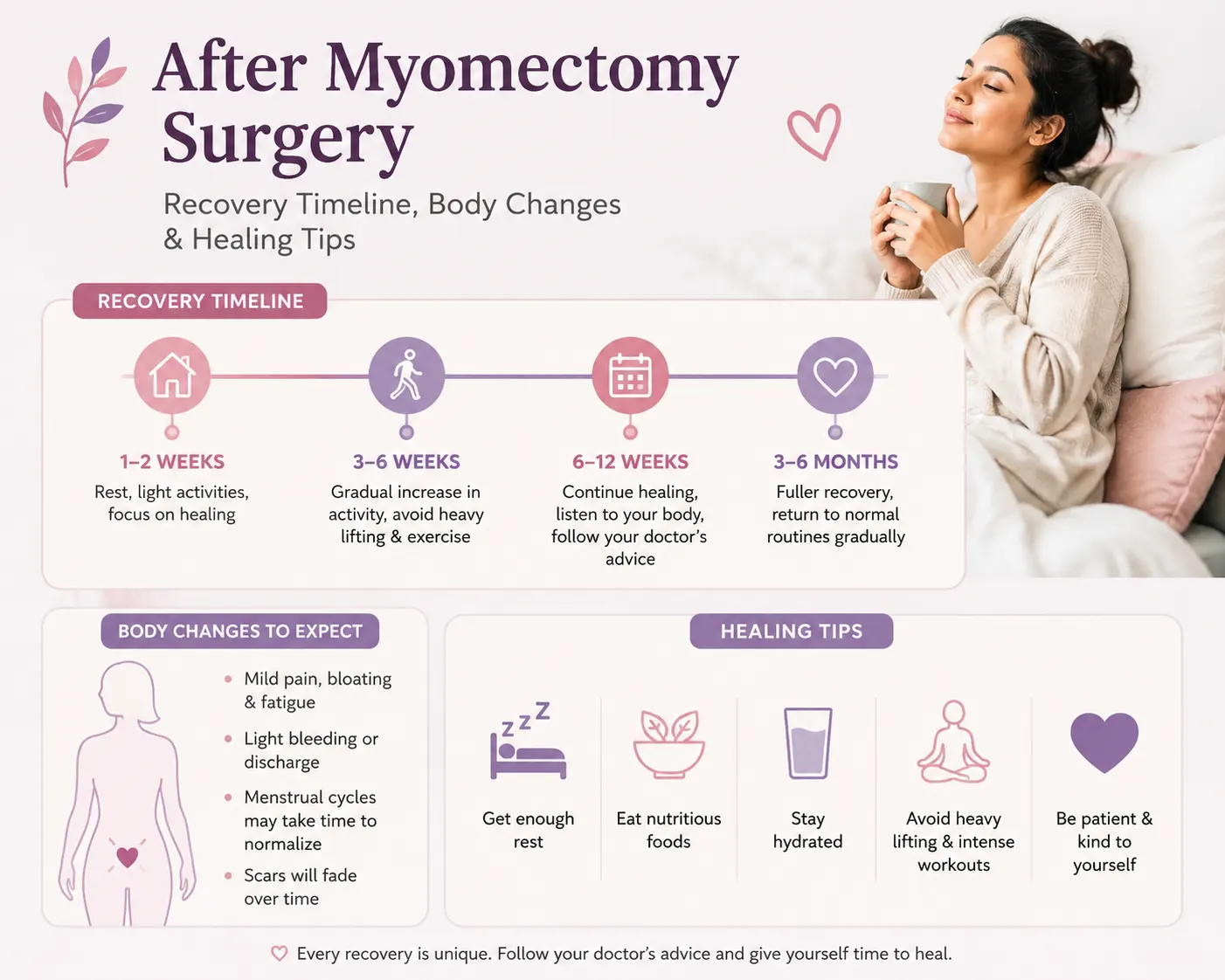
After Myomectomy Surgery: Recovery Timeline, Body Changes & Healing Tips

Summary
If you have recently undergone or are preparing for a myomectomy, knowing exactly what to expect after myomectomy surgery can make a significant difference to how smoothly and confidently you recover. Myomectomy is a uterine-preserving surgical procedure that removes fibroids while keeping the uterus intact - and unlike a hysterectomy, it allows women to retain their fertility. Recovery, however, requires patience, proper care, and a clear understanding of what is normal at each stage of healing. This guide covers everything from the first 24 hours post-surgery to full recovery - including pain management, physical changes, activity restrictions, warning signs, and when you can expect to return to normal life.
What Is Myomectomy Surgery?
A myomectomy is a surgical procedure to remove uterine fibroids - non-cancerous growths made up of muscle and connective tissue that develop in or around the uterus. Unlike a hysterectomy, which removes the entire uterus, myomectomy preserves the uterus and, with it, the possibility of future pregnancy. It is the recommended surgical option when fibroids are causing significant symptoms - heavy menstrual bleeding, pelvic pain, bloating, bladder pressure, or fertility difficulties - and have not responded adequately to medication.
There are three main surgical approaches to myomectomy:
-
Laparoscopic (keyhole) myomectomy - Small incisions in the abdomen through which a camera and instruments are inserted. This is the minimally invasive approach, preferred wherever clinically possible.
-
Hysteroscopic myomectomy - A thin scope is passed through the vagina and cervix to remove fibroids located inside the uterine cavity. No external incisions are required.
-
Open (abdominal) myomectomy - A larger incision is made in the lower abdomen to access and remove fibroids. This approach is used for large, multiple, or deeply embedded fibroids.
The type of myomectomy performed directly determines recovery time, hospital stay, and the degree of post-surgical discomfort. At Miracles Apollo Cradle, Sector 14, minimally invasive laparoscopic myomectomy is the standard approach wherever the patient's condition allows, enabling faster recovery and minimal downtime.
Immediately After Myomectomy Surgery: The First 24 Hours
The immediate post-operative period is focused on stabilisation, pain management, and early monitoring. Here is what to expect in the first 24 hours after myomectomy surgery:
-
Recovery room - You will be moved to a recovery area once the anaesthesia begins to wear off. Vital signs, pain levels, and uterine bleeding are monitored closely.
-
Pain management - Intravenous pain medication is administered initially, transitioning to oral analgesics as you stabilise.
-
Urinary catheter - A catheter may be in place for the first few hours. It is typically removed once you are mobile and able to urinate independently.
-
Mild to moderate cramping - Pelvic cramping and pressure are normal and expected as the uterus begins its healing response.
-
Light vaginal bleeding or discharge - A small amount of spotting or watery discharge is normal and does not indicate a complication.
-
Nausea - This is a common response to general anaesthesia and usually resolves within a few hours.
-
Hospital stay - Laparoscopic and hysteroscopic myomectomy patients are typically discharged the same day or after an overnight stay. Open myomectomy patients may remain hospitalised for 2 to 3 days.
Week-by-Week Recovery Timeline After Myomectomy Surgery
Week 1: Rest and Stabilisation
The first week after myomectomy surgery is the most physically demanding. Your body is in active healing mode and requires complete rest.
-
Pelvic pain and cramping are at their most noticeable in the first 3 to 5 days and are managed with prescribed pain relief
-
Bloating and abdominal swelling are common, particularly after laparoscopic surgery (due to the gas used during the procedure)
-
Fatigue is significant - rest is not optional; it is necessary
-
Light vaginal spotting or brownish discharge may continue for up to 2 weeks
-
Short, gentle walks within the home are encouraged from Day 2 to promote circulation and reduce the risk of blood clots
-
Avoid any lifting, bending, or straining
Week 2: Gradual Improvement
By the second week, most patients begin to notice a meaningful improvement in energy levels and a reduction in pain.
-
Cramping reduces significantly; paracetamol is usually sufficient for pain management
-
Bloating begins to subside; normal bowel function typically resumes by Days 5 to 7
-
Short walks outside are generally possible and encouraged
-
Laparoscopic myomectomy patients may begin to feel close to normal; open myomectomy patients are still in early recovery
-
Continue to avoid driving, lifting anything heavier than 2 to 3 kg, and all strenuous activity
Weeks 3 to 4: Increasing Activity
This phase marks a transition toward more functional daily activity, though full exertion remains off-limits.
-
Most laparoscopic myomectomy patients can return to desk-based or light work from Week 3
-
Energy levels are largely restored; fatigue is intermittent rather than constant
-
Longer walks and gentle stretching are generally well-tolerated
-
The first post-operative menstrual cycle may occur during this period - it may be heavier or more painful than usual, which is normal
-
Incision sites (for laparoscopic or open surgery) continue to heal; avoid exposure to sunlight or swimming until wounds are fully closed
Weeks 4 to 6: Return to Normal Life
Most patients who underwent laparoscopic or hysteroscopic myomectomy have functionally recovered by Week 4. Open myomectomy patients typically reach this milestone at Week 6.
-
Return to full-time work is possible for most patients by Week 4 (laparoscopic) or Week 6 (open)
-
Light exercise, such as walking and yoga, may be reintroduced
-
Sexual intercourse may be resumed after your gynaecologist confirms healing at your follow-up appointment - typically between Week 4 and Week 6
-
Driving is usually possible once you are off strong pain medication and can react quickly
Week 6 and Beyond: Full Recovery
By 6 to 8 weeks post-surgery, most women are fully recovered. A key follow-up consultation at this stage will assess uterine healing, scar tissue formation, and fertility readiness if conception is planned.
Body Changes After Myomectomy Surgery
Understanding the physical changes that occur after myomectomy surgery helps separate normal healing from causes for concern.
Changes in Menstruation
The first two or three menstrual cycles after myomectomy may be heavier or more painful than usual, as the uterus heals. Over subsequent cycles, most women experience significantly lighter, less painful periods - often one of the most welcomed outcomes of uterine fibroid removal.
Reduction in Bloating and Pelvic Pressure
One of the most immediate improvements women notice in the weeks following myomectomy is a marked reduction in the pelvic heaviness and visible abdominal bloating that large fibroids cause. As post-operative swelling resolves and the uterus returns to its natural size, the abdomen feels flatter and more comfortable.
Improved Bladder Function
Fibroids pressing on the bladder often cause urinary urgency and frequency. After myomectomy surgery, bladder pressure typically resolves within the first few weeks of recovery as swelling reduces and fibroid bulk is eliminated.
Emotional and Hormonal Adjustment
Recovery is not only physical. Hormonal fluctuations in the weeks following surgery can contribute to mood changes, irritability, or emotional sensitivity. This is a normal part of the healing process. Rest, nutritional support, and speaking openly with your care team all contribute to emotional well-being during recovery.
Scar Healing
Laparoscopic myomectomy leaves very small scars - typically 0.5 to 1 cm - that heal well and fade significantly over 6 to 12 months. Open myomectomy leaves a longer horizontal scar along the bikini line, similar to a caesarean section. Scar massage after wound closure and appropriate sun protection supports optimal healing.
How to Support Recovery After Myomectomy Surgery
Nutrition
-
Prioritise iron-rich foods - leafy greens, lentils, lean meat - to replenish iron lost during surgery and heavy pre-operative bleeding
-
Include protein-rich foods to support tissue repair
-
Stay well-hydrated to prevent post-surgical constipation and support healing
-
High-fibre foods help maintain regular bowel function - constipation and straining can increase post-operative pain
Rest and Activity
-
Sleep is the body's primary repair mechanism - prioritise 7 to 9 hours per night
-
Begin gentle walking as early as Day 2; increase duration gradually over subsequent weeks
-
Avoid all heavy lifting (more than 3 kg) for a minimum of 4 weeks
-
Avoid impact exercise, gym training, and swimming until cleared by your specialist
Physiotherapy Pelvic floor physiotherapy is recommended after myomectomy, particularly when the surgery involved the inner layers of the uterine wall. The in-house physiotherapy team at Miracles Apollo Cradle/Spectra, Sector 82 works closely with the gynaecology team to provide structured post-operative rehabilitation for myomectomy patients.
Follow-up Appointments: Never skip post-operative appointments. These allow your gynaecologist to assess wound healing, review pathology reports (confirming the removed tissue was benign), and advise on return to work, exercise, and - when applicable - conception planning.
Warning Signs After Myomectomy Surgery: When to Seek Immediate Help
While most post-operative discomfort is normal, the following symptoms require prompt medical attention:
-
Heavy vaginal bleeding - soaking more than one pad per hour for two consecutive hours
-
Fever above 38°C
-
Severe abdominal pain that is worsening rather than improving
-
Redness, warmth, swelling, or discharge from the incision site
-
Inability to urinate or very dark, reduced urinary output
-
Signs of a blood clot - calf pain, swelling, or leg redness
-
Persistent nausea, vomiting, or inability to eat
If you experience any of the above, contact your gynaecologist immediately or visit the emergency department at your nearest Miracles Healthcare facility.
Myomectomy at Miracles Healthcare, Gurgaon
At Miracles Healthcare, a trusted multi-specialty hospital in Gurgaon serving patients since 2002, myomectomy is performed using minimally invasive laparoscopic techniques wherever clinically appropriate - prioritising tissue preservation, minimal blood loss, and rapid recovery. Across 15,000+ gynaecological surgeries performed at Miracles Healthcare, the surgical site infection rate has remained below 0.001% - one of the most exceptional safety records in Delhi NCR.
The hospital's integrated care model means that gynaecology, diagnostics, physiotherapy, and post-operative follow-up are all available under one roof - supporting patients from surgery through to complete recovery.
Miracles Healthcare Locations
Miracles Apollo Cradle, Sector 14, Gurgaon SCO 1, 2 & 3, Delhi Road, Sector 14, Gurugram - 0124-4797600 View Location Services: Gynaecological surgeries including myomectomy, laparoscopy, hysteroscopy | Level III NICU | 24x7 emergency | Maternity care
Miracles Apollo Cradle/Spectra, Sector 82, Gurgaon Plot No. 45, Vatika India Next, Sector 82, Gurugram - 0124-352-8282 View Location Services: Gynaecological surgeries | Physiotherapy | CT scan | Comprehensive diagnostics | 24x7 emergency
Miracles Mediclinic, Sector 56, Gurgaon SCO-68-69, More Market, Block B, Sector 56, Gurugram - 906-906-8800 View Location Services: Gynaecology OPD | MRI scan | NABL-certified diagnostics | Pre- and post-surgical workup
Miracles Mediclinic, Sector 14, Gurgaon SCO 1, 2 & 3, Sector 14, Gurugram - 0124-4797600 View Location Services: Consultations | Health check-up packages | Pathology | Post-operative follow-up diagnostics
Book Your Consultation at Miracles Healthcare
Whether you are preparing for myomectomy or navigating recovery after myomectomy surgery, the gynaecology team at Miracles Healthcare is here to guide you at every step. With 15,000+ gynaecological surgeries performed, a near-zero infection rate, NABH-accredited facilities, and a Google rating of 4.9 across 12,000+ reviews, Miracles Healthcare is one of the most trusted destinations for women's surgical care in Gurgaon and across Delhi NCR.
• Call: 0124-4797600
• WhatsApp: 98209-65000
• Miracles Apollo Cradle, Sector 14
-
SCO 1, 2 & 3, Delhi Road, Sector 14, Gurugram
• Miracles Apollo Cradle/Spectra, Sector 82
-
Plot No. 45, Vatika India Next, Sector 82, Gurugram
Written and Verified by:

Frequently Asked Questions
Recovery time depends on the surgical approach. Laparoscopic and hysteroscopic myomectomy patients typically recover within 2 to 4 weeks. Open (abdominal) myomectomy requires 4 to 6 weeks for full recovery. Your gynaecologist will provide a personalised recovery plan based on the complexity of your surgery.
Yes. Mild to moderate pelvic cramping, bloating, and abdominal soreness are completely normal in the first 1 to 2 weeks after myomectomy surgery. Pain is usually well-managed with prescribed analgesics and reduces significantly by the end of the second week. Worsening pain, fever, or heavy bleeding are not normal and require prompt medical review.
Menstruation typically returns within 4 to 6 weeks of myomectomy surgery. The first one or two cycles may be heavier or more painful than usual as the uterus heals. Over subsequent cycles, most women experience noticeably lighter, less painful periods - a significant and lasting improvement in quality of life.
Yes. Myomectomy is specifically designed to remove fibroids while preserving the uterus and fertility. Most women are advised to wait 3 to 6 months before attempting conception, to allow the uterus adequate time to heal. Your gynaecologist will advise on the appropriate waiting period based on the size and location of the fibroids removed.
Focus on iron-rich foods (leafy greens, lentils, eggs, lean meat), high-protein foods (paneer, legumes, fish) to support tissue repair, and high-fibre foods (oats, fruits, vegetables) to prevent constipation. Stay well-hydrated. Avoid processed foods, excess sodium, and alcohol during the recovery period.
Most laparoscopic myomectomy patients can return to desk-based or light work by Week 3 to 4. Open myomectomy patients may need 5 to 6 weeks before returning to work. If your role involves physical labour or extended standing, discuss a phased return with your specialist.
Call 0124-4797600, WhatsApp at 98209-65000, or book through the Miracles Healthcare website. Consultations are available at Miracles Apollo Cradle (Sector 14), Miracles Apollo Cradle/Spectra (Sector 82), Miracles Mediclinic (Sector 56), and Miracles Mediclinic (Sector 14). Online consultations are also available.






Was the information useful?
0 0