


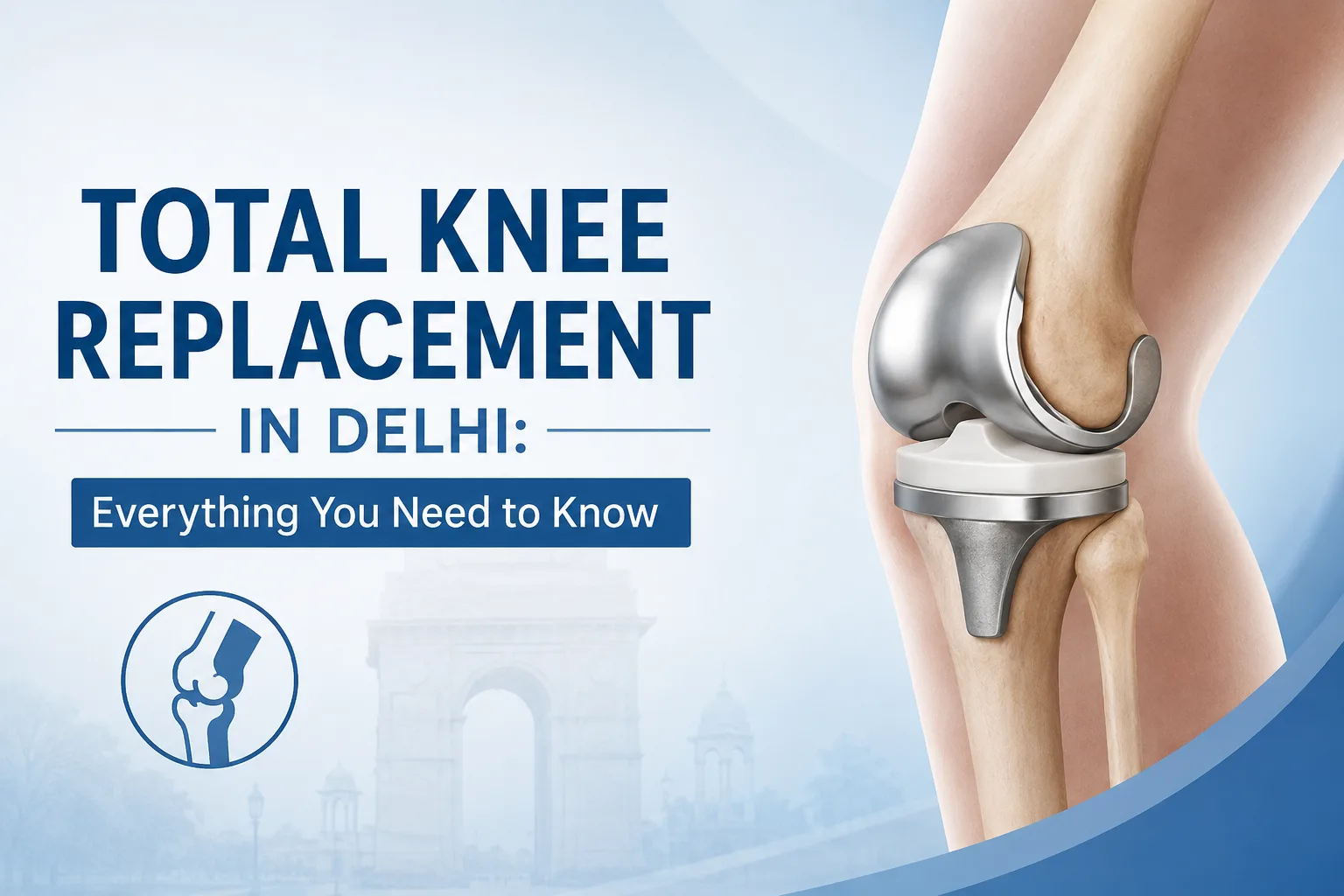
Total Knee Replacement in Delhi: Everything You Need to Know

Summary
Introduction
Chronic knee pain that limits your daily activities - climbing stairs, walking to the market, or simply standing up from a chair - can be debilitating. When physiotherapy, medication, and injections no longer provide relief, total knee replacement in Delhi or the NCR region becomes a life-changing option worth exploring seriously.
Total knee replacement (TKR), also known as total knee arthroplasty, is a well-established procedure that removes the damaged surfaces of the knee joint and replaces them with precision-engineered metal and plastic components. The goal is straightforward: eliminate pain and restore mobility so patients can return to an active, independent life.
At Miracles Healthcare, a trusted multi-speciality hospital in Gurgaon serving the Delhi NCR region since 2002, our experienced orthopaedic team has performed over 26,000+ surgeries, bringing world-class joint replacement care to patients across the region.
What Is Total Knee Replacement?
Total knee replacement is a surgical procedure in which the worn-out cartilage and bone surfaces of the knee joint are removed and replaced with an artificial implant made of high-grade metal alloys and medical-grade polyethene plastic.
The procedure addresses three compartments of the knee:
-
Medial compartment (inner side of the knee)
-
Lateral compartment (outer side of the knee)
-
Patellofemoral compartment (front of the knee, between the kneecap and thighbone)
When all three compartments are affected, a total knee replacement is performed. When only one compartment is damaged, a partial (unicompartmental) knee replacement may be recommended - a less invasive option with a faster recovery.
Who Needs Total Knee Replacement?
A knee replacement is typically recommended when:
-
Osteoarthritis has caused severe cartilage loss and bone-on-bone friction
-
Rheumatoid arthritis has damaged the joint lining and surrounding tissues
-
Post-traumatic arthritis following a fracture or ligament injury has led to deformity
-
Knee pain is constant, even at rest, severely affecting sleep and quality of life
-
Non-surgical treatments - physiotherapy, weight management, anti-inflammatory medication, and cortisone injections - have failed to provide lasting relief
-
There is significant stiffness, swelling, or visible deformity in the knee
-
The patient is unable to perform basic daily activities such as walking short distances, climbing stairs, or rising from a chair
Age is no longer the primary deciding factor. Surgeons today evaluate each patient individually based on the degree of joint damage, overall health, weight, activity levels, and quality of life impact.
Types of Knee Replacement Procedures
Total Knee Replacement (TKR)
The most common type replaces all three compartments of the knee with an artificial implant. Best suited for patients with advanced, widespread arthritis affecting the entire joint.
Partial Knee Replacement (Unicompartmental)
Only the damaged portion of the knee is replaced, preserving healthy bone and ligaments. Offers a faster recovery and a more natural feel post-surgery.
Revision Knee Replacement
A second surgery to replace or repair a previously implanted knee prosthesis that has worn out, loosened, or failed over time.
Bilateral Knee Replacement
Both knees are replaced either simultaneously (same sitting) or in staged procedures, depending on the patient's health and the surgeon's recommendation.
What Makes Miracles Healthcare's Orthopaedic Programme Stand Out?
If you are searching for total knee replacement in Delhi NCR, Miracles Healthcare in Gurgaon offers a compelling combination of clinical expertise, advanced technology, and patient-first care. Here is what sets our orthopaedic and joint replacement programme apart:
-
Minimally Invasive Surgery: All joint replacement surgeries are performed using minimally invasive techniques - smaller incisions, less blood loss, faster healing, and reduced hospital stay.
-
Muscle & Bone Preservation: Our consultants focus on preserving muscles, ligaments, and bone stock during surgery. This approach leads to a more natural-feeling knee and quicker functional recovery.
-
Navigation Technique: We use computer navigation for precise implant placement - a technique more accurate than conventional methods and equally effective as robotic surgery, but significantly more cost-effective for patients.
-
Same-Day Walking: Patients are typically up and walking the same day of surgery, reducing the risk of clots and post-operative complications.
-
3-Day Discharge: Most patients undergoing joint replacement are discharged by the third day after surgery.
-
Near-Zero Infection Rate: Our dedicated orthopaedic OT contributes to an infection rate of less than 0.001% - just 1 SSI case across 26,000+ surgeries performed.
-
Integrated Physiotherapy: Our in-house team of physiotherapists works hand-in-hand with the orthopaedic team to ensure proper post-surgical rehabilitation and long-term recovery.
-
Premier-Trained Specialists: Our orthopaedic consultants carry experience from institutions including the NHS (UK) and AIIMS, bringing benchmarked expertise to Gurgaon globally.
The Total Knee Replacement Procedure: Step by Step
1. Pre-Surgical Evaluation: A thorough assessment including X-rays, MRI (if needed), blood tests, cardiac evaluation, and fitness review to ensure you are ready for surgery.
2. Anaesthesia: Most TKR procedures are performed under spinal anaesthesia (regional block), which is safer and offers excellent pain control post-surgery.
3. The Surgery (60–90 minutes): The surgeon removes damaged cartilage and bone, precisely shapes the remaining bone surfaces, and implants the prosthetic components - femoral, tibial, and patellar - securing them with bone cement or press-fit technology.
4. Wound Closure & Recovery Room: The incision is closed in layers, and the patient is monitored in the recovery area for a few hours.
5. Post-Operative Physiotherapy: Within hours of surgery, guided breathing exercises begin. The next morning, physiotherapy-assisted walking starts - a critical step in preventing stiffness and blood clots.
6. Discharge & Rehabilitation: Patients are typically discharged on day 3, with a structured home physiotherapy plan and scheduled follow-up visits.
Orthopaedic Services Across Miracles Healthcare Locations
Miracles Healthcare, a multi-speciality hospital in Gurgaon, offers comprehensive orthopaedic and joint replacement services across multiple accessible locations in the Delhi NCR region:
-
Miracles Apollo Cradle, Sector 14, Gurgaon – SCO 1, 2 & 3, Delhi Rd, Sector 14, Gurugram, Haryana 122007 | 0124-4797600 |Specialises in orthopaedic surgeries including knee and joint replacement, ENT, gynaecological, and general surgeries. Equipped with dedicated orthopaedic OT and advanced operating theatres.
-
Miracles Mediclinic, Sector 14, Gurgaon – SCO-1, 2 & 3, Sector 14, Gurugram, Haryana 122007 | 0124-4797600 |Orthopaedic consultations, pre-surgical health check-ups, NABL-certified diagnostic lab tests, and pathology services.
-
Miracles Mediclinic, Sector 56, Gurgaon – SCO-68-69, More Market, Block B, Sector 56, Gurugram, Haryana 122011 | 906-906-8800 | Orthopaedic consultations, MRI scans, CT scans, health check-ups, and NABL-certified diagnostic services - ideal for pre- and post-surgical evaluations.
-
Miracles Apollo Cradle/Spectra, Sector 82, Gurgaon – Plot No. 45, Vatika India Next, Sector 82, Gurugram, Haryana 122012 | 0124-352-8282 | Full-spectrum care including orthopaedic surgeries, MRI/CT scans, diagnostics, consultations, and 24×7 pharmacy.
All locations are easily accessible to patients from Delhi, Huda City Centre, Cyber City, Palam Vihar, Manesar, Sohna, and Old Gurgaon. Book your consultation by calling or WhatsApp-ing 98209-65000 or 0124-4797600.
Recovery Timeline After Total Knee Replacement
|
Timeframe |
Milestones |
|
Day of Surgery |
Walking with support begins within hours |
|
Day 1–2 |
Physiotherapy sessions, stair practice |
|
Day 3 |
Discharge in most cases |
|
Week 2–4 |
Walking independently with a stick or a walker |
|
Week 6–8 |
Driving (manual assessment required) |
|
3 Months |
Return to light activity and work |
|
6–12 Months |
Full functional recovery; natural-feeling knee |
A well-placed implant from a skilled surgeon, combined with dedicated physiotherapy, can last 15–25 years or more.
Why Choose Miracles Healthcare for Orthopaedic Care Near Delhi?
Miracles Healthcare is rated 4.9 on Google across thousands of patient reviews and has been trusted by over 7 lakh patients since 2002. Key reasons patients from across Delhi NCR choose us:
-
150+ experienced specialists across all medical disciplines
-
Over 26,000 surgeries performed with a near-zero infection rate
-
NABH-accredited standards at Miracles Apollo Cradle facilities
-
NABL-certified labs for accurate pre- and post-operative diagnostics
-
Tie-ups with all leading insurance companies for cashless treatment
-
Free parking, WhatsApp report delivery, and in-room QR service requests
-
Recognised by Times of India 2023 as the No. 1 Gynaecology & Obstetrics Hospital across Gurgaon & Faridabad; honoured by Forbes India 2023 among 200 select companies with global business potential
Explore our full range of joint care and orthopaedic health services or book a pre-surgical health check to get started.
Written and Verified by:

Frequently Asked Questions
Anyone experiencing severe, persistent knee pain due to arthritis or joint damage that has not responded to non-surgical treatments for over 3–6 months is a potential candidate. Your orthopaedic surgeon will evaluate X-rays and overall health to confirm suitability.
Modern anaesthesia and multimodal pain management ensure that patients are comfortable throughout the procedure and in the recovery period. Most patients report significantly less pain within a week compared to their pre-surgery knee pain.
A well-implanted total knee prosthesis typically lasts 15–25 years. Factors such as patient weight, activity levels, and implant quality influence longevity.
Navigation-assisted surgery uses computer guidance to place the implant with high precision - comparable to robotic techniques - while being significantly more affordable. It reduces the risk of fat embolism and improves alignment accuracy.
At Miracles Healthcare, patients walk on the day of surgery itself, assisted by our physiotherapy team. Most patients are walking independently with a support aid by day 2–3.
Yes. Miracles Healthcare has tie-ups with all leading insurance companies and TPA providers, facilitating cashless hospitalisation for eligible patients. Contact our team at 98209-65000 for specific insurance-related queries.
Yes. MRI is available at Miracles Mediclinic, Sector 56, and CT scans are available at both Sector 56 and Miracles Apollo Cradle/Spectra, Sector 82. All imaging services use equipment from leading global brands like GE and Philips.







Was the information useful?
0 0