


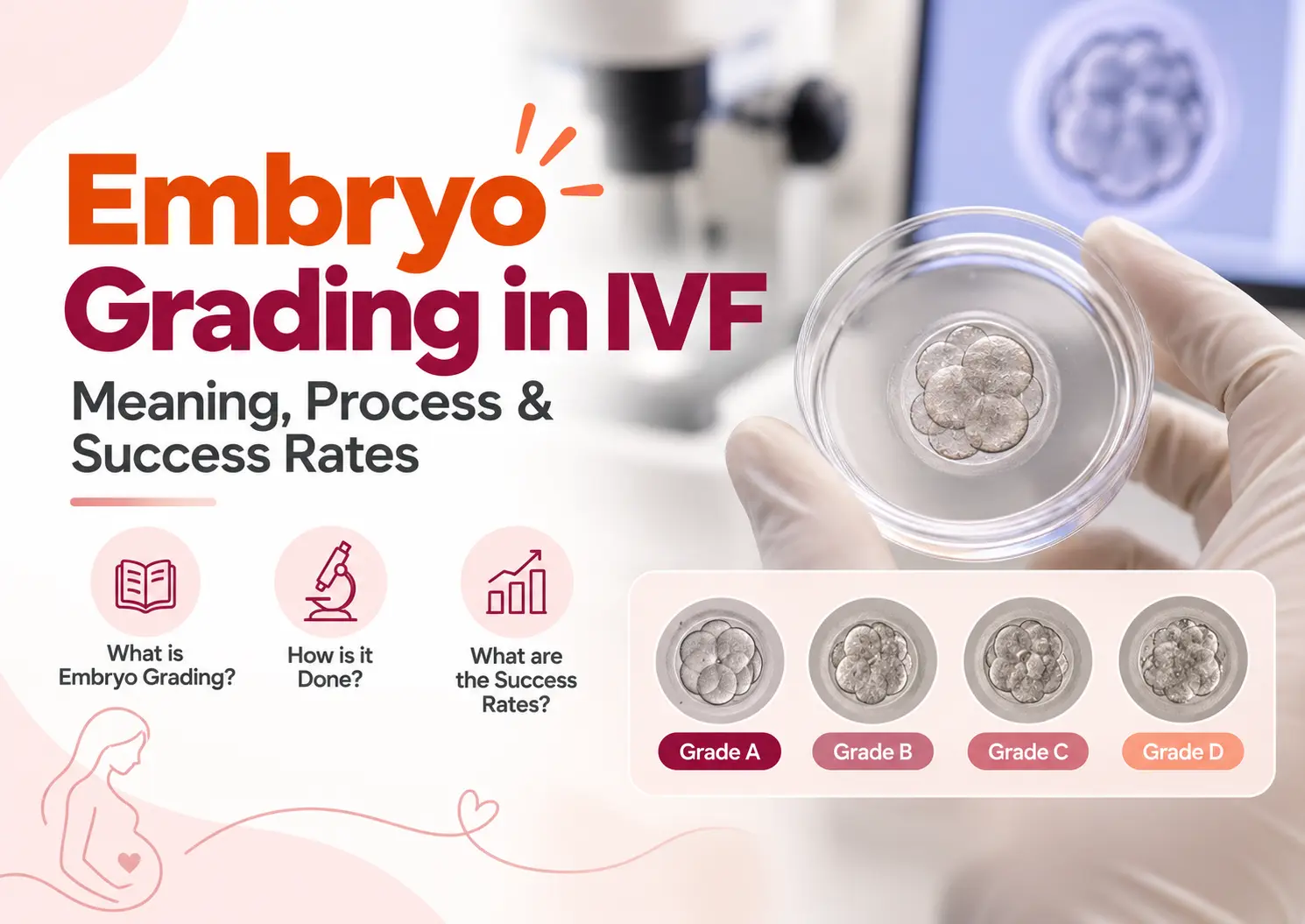
Embryo Grading in IVF: Meaning, Process & Success Rates


- What is Embryo Grading in IVF?
- What Are the Types of Embryo Grading?
- Why is Embryo Grading Important in IVF?
- How Does the Embryo Develop During IVF?
- Does a Higher Embryo Grade Mean Higher IVF Success Rate?
- Can a Lower-Grade Embryo Still Result in Pregnancy?
- IVF Embryo Grading Chart/ Embryo Grading Table
- Which Embryo Grades Are Considered Good?
- Why Do Different IVF Clinics Use Different Embryo Grading Systems?
- Embryo Grade is Important, but it is Not the Whole Story
- Advanced Embryology and IVF Treatment in Gurgaon at Miracles Healthcare
Summary
During IVF treatment, your fertility specialist or embryologist may tell you that your embryo is “4AA” or a “good-quality Day 3 embryo.” These numbers and letters can raise important questions: What does embryo grading mean? Is 4AA better than 4BB? Does a higher grade guarantee pregnancy?
Embryo grading helps embryologists assess how embryos are developing and identify those with potentially better implantation prospects. It is mainly based on morphology, or the embryo’s visible appearance and development in the laboratory. However, grading of embryos does not guarantee IVF success, and embryos with lower grades can also result in healthy pregnancies.
In this blog, Dr. Anviti Saraf, a top-rated infertility specialist in Gurgaon at Miracles Healthcare, explains embryo grading in IVF, how embryos are graded, and how embryo quality may influence IVF success rates.
What is Embryo Grading in IVF?
Embryo grading is a method used by embryologists to evaluate the development and visible characteristics of embryos created during an IVF cycle.
After eggs are retrieved and fertilized in the IVF laboratory, the resulting embryos are carefully monitored as they divide and develop. At specific stages of development, embryologists assess characteristics such as:
-
Number of cells
-
Speed of cell division
-
Cell symmetry
-
Fragmentation
-
Developmental stage
-
Inner cell mass quality
-
Trophectoderm quality
These observations help the fertility team compare embryos and decide which embryo may be most suitable for:
-
Embryo transfer
-
Freezing and future use
-
Further observation and culture
-
In certain situations, embryo biopsy as part of genetic testing
Embryo morphology assessment remains one of the most commonly used methods for evaluating embryo developmental quality in IVF laboratories.
However, one important thing to remember is that embryo grading evaluates appearance and development; it does not provide a complete picture of the embryo's genetic or chromosomal status.
What Are the Types of Embryo Grading?
Embryo grading depends on the stage of embryo development. The two main types are Day 3 embryo grading and Day 5 or Day 6 blastocyst grading.
Dr. Anviti Saraf explains, “Embryos are graded differently at different stages because their development and visible characteristics change over time. Understanding the grading method can help patients better understand their IVF treatment and embryo transfer options.”
Day 3 Embryo Grading
Day 3 embryos are assessed at the cleavage stage. Embryologists mainly look at:
-
Number of cells
-
Cell size and symmetry
-
Fragmentation
-
Pattern of cell division
Embryo grading helps the fertility team assess development and make informed decisions about embryo transfer or freezing. However, the grade alone cannot guarantee implantation or pregnancy.
Why is Embryo Grading Important in IVF?
During an IVF cycle, multiple eggs may fertilise and develop into embryos, but they may not all develop at the same rate or show the same characteristics. Embryo grading helps the fertility team compare embryos based on their development and visible quality.
It is important because it helps:
-
Assess embryo development: Identify how well embryos are progressing at different stages.
-
Prioritise embryos for transfer: Embryos with more favourable morphology may be considered for transfer first.
-
Support freezing decisions: Suitable embryos can be selected for cryopreservation and future use.
-
Estimate implantation potential: Higher-quality embryos may have a better average chance of implantation, although grading does not guarantee pregnancy.
-
Guide IVF treatment decisions: The grading information helps the fertility team make informed decisions based on the embryos available in that cycle.
Dr. Anviti says, “Embryo grading helps us assess how an embryo is developing and identify those with better potential. However, a good grade does not guarantee pregnancy, and lower-grade embryos can also lead to healthy pregnancies.”
How Does the Embryo Develop During IVF?
Understanding embryo development makes it easier to understand embryo grading.
Day 0: Fertilization
After egg retrieval, mature eggs are fertilised through conventional IVF or ICSI. The laboratory then checks for normal fertilisation.
Day 1: Fertilization Assessment
Normally fertilized eggs are identified and monitored to assess their early development.
Day 2 and Day 3: Cleavage Stage
The embryo divides into multiple cells called blastomeres. By Day 3, embryologists assess:
-
Number of cells
-
Cell size and symmetry
-
Fragmentation
A good-quality Day 3 embryo generally shows appropriate development, relatively even cells, and limited fragmentation.
Day 4: Morula Stage
The cells compact closely together to form a structure called a morula.
Day 5 or Day 6: Blastocyst Stage
Some embryos continue developing into blastocysts, which contain:
-
Inner Cell Mass (ICM): Develops into the fetus.
-
Trophectoderm (TE): Contributes to the placenta and supporting structures.
-
Blastocoel: The fluid-filled cavity inside the blastocyst.
Blastocyst development allows embryologists to assess embryos at a more advanced stage for selection and transfer.
Day 5/ Day 6 Embryo Grading
In Inner Cell Mass (ICM) and Trophectoderm (TE)
-
Number of cells
-
Cell size and symmetry
-
Fragmentation
-
Blastocoel cavity size( expansion)
Does a Higher Embryo Grade Mean Higher IVF Success Rate?
Dr. Saraf says, “A higher embryo grade may indicate better developmental potential, but it does not guarantee IVF success. We consider the couple’s overall fertility profile before deciding on embryo transfer.”
Pregnancy and implantation can also depend on several factors, including:
-
Age: Age can affect egg quality and the risk of chromosomal abnormalities.
-
Egg and sperm quality: Both influence fertilisation and embryo development.
-
Embryo chromosomal health: A good-looking embryo may still have a chromosomal abnormality that morphology alone cannot detect.
-
Uterine health: Fibroids, polyps, and other uterine conditions may affect implantation.
-
Endometrial receptivity: The readiness of the uterine lining is important for successful implantation.
-
Hormonal and medical factors: Hormonal balance, previous fertility history, and overall health can influence outcomes.
-
Embryo transfer: Careful embryo placement is an important part of the IVF process.
Can a Lower-Grade Embryo Still Result in Pregnancy?
Yes. A lower-grade embryo can still implant and result in a healthy pregnancy. Embryo grading reflects visible characteristics and developmental potential, but it cannot predict the outcome with certainty.
Similarly, even a high-grade embryo may not implant. Therefore, fertility specialists consider embryo grade along with the patient’s age, fertility history, uterine health, and other clinical factors when planning treatment.
IVF Embryo Grading Chart/ Embryo Grading Table
Understanding an embryo grade becomes easier when you know what each part of the grading system represents. For blastocysts, the Gardner grading system uses a number followed by two letters.
|
Grade |
What It Indicates |
|
1–2 |
Early blastocyst development with limited expansion |
|
3 |
Full blastocyst with a visible cavity |
|
4 |
Expanded blastocyst |
|
5 |
Blastocyst beginning to hatch |
|
6 |
Fully hatched blastocyst |
|
A |
More favourable ICM or TE appearance |
|
B |
Moderate ICM or TE quality |
|
C |
Less favourable ICM or TE appearance |
Which Embryo Grades Are Considered Good?
There is no single “best” embryo grade because grading only describes an embryo’s appearance and development at a particular stage. For blastocysts, many IVF laboratories use the Gardner grading system, which combines a number and two letters:
-
Number (1–6): Indicates the level of blastocyst expansion
-
First letter: Describes the inner cell mass (ICM), which develops into the fetus
-
Second letter: Describes the trophectoderm (TE), which contributes to the placenta
The letters A, B, and C indicate the appearance and organisation of these cell groups, with A generally representing more favourable morphology.
For example, 4AA, 4AB, and 5AA are commonly considered good-quality blastocyst grades. However, a higher grade does not guarantee implantation or pregnancy, and embryos with lower grades can also result in healthy pregnancies.
Why Do Different IVF Clinics Use Different Embryo Grading Systems?
You may notice that embryo grades are reported differently across IVF clinics. This is because laboratories may use different grading systems, criteria, or reporting protocols for cleavage-stage and blastocyst embryos.
If you receive an embryo grade, ask your embryologist:
-
Which grading system does your lab use?
-
What does my grade mean?
-
Which embryos are suitable for transfer or freezing?
-
How does the grade affect my overall IVF treatment plan?
Embryo Grade is Important, but it is Not the Whole Story
Embryo grading helps embryologists assess embryo development and select embryos for transfer or freezing. A grade such as 4AA, 4AB, or 4BB reflects the embryo’s visible characteristics at a specific stage.
A higher grade may indicate better developmental potential, but it does not guarantee implantation or pregnancy. Similarly, lower-grade embryos can also result in healthy pregnancies. Embryo grading is just one part of the IVF success picture, along with age, fertility history, treatment response, and other factors.
Confused about your embryo grade or what comes next? Consult an IVF specialist near you at Miracles Healthcare to understand your embryo report and explore the right IVF approach based on your individual fertility needs.
Advanced Embryology and IVF Treatment in Gurgaon at Miracles Healthcare
Since 2014, Miracles Healthcare has been a trusted IVF hospital in Gurgaon, providing advanced fertility care to couples facing challenges in conceiving. With experienced fertility specialists, dedicated embryology services, and personalised treatment planning, the centre supports couples through every stage of their fertility journey, from fertilization and embryo development to grading, freezing, and embryo transfer.
-
1,500+ IVF cycles: Experience in managing diverse fertility needs and treatment requirements.
-
ICMR-approved embryology lab: Dedicated in-house laboratory for essential IVF and embryo-related procedures.
-
Experienced team: Fertility specialists and embryologists work together from fertilization and embryo culture to grading, freezing, and transfer.
-
Advanced services: IVF, ICSI, blastocyst culture, embryo freezing, egg and sperm freezing, assisted hatching, and PGT.
-
Multispeciality support: Access to gynaecology, diagnostics, internal medicine, paediatrics, surgery, and other specialties when required.
-
Multiple locations: Miracles Healthcare has centres across Sector 14, Sector 56, and Sector 82, Gurgaon.
Looking for expert IVF and embryology care in Gurgaon? Visit Miracles Healthcare and consult our specialists for personalised guidance based on your individual needs.
Written and Verified by:

Dr. Anviti Saraf Exp: 11
MBBS, M.S. (Obstetrics & Gynaecology), FNB (Reproductive Medicne), DNB, MRCOG (UK)
Frequently Asked Questions
Grades such as 4AA, 5AA, or 4AB are generally considered good-quality blastocysts. However, embryo grade alone cannot guarantee implantation or pregnancy.
There is no single success rate for a Grade 1 embryo because outcomes depend on factors such as age, embryo stage, uterine health, and treatment history. Your fertility specialist can explain the expected chances for your specific case.
Dr. Anviti clarifies that both are considered high-quality blastocysts. 5AA is more expanded than 4AA, but the difference in grade does not automatically mean one will result in a higher chance of pregnancy.
Yes, two embryos can be sufficient for an IVF cycle, but the number needed varies based on age, embryo quality, fertility history, and the treatment plan. More embryos do not necessarily mean better outcomes.
Blastocyst grading usually includes one number and two letters. The number represents blastocyst expansion, while the first and second letters describe the inner cell mass (ICM) and trophectoderm (TE).
The number, usually 1–6, indicates the stage of blastocyst expansion. A higher number generally means the blastocyst is more expanded or has begun hatching.






Was the information useful?
0 0