


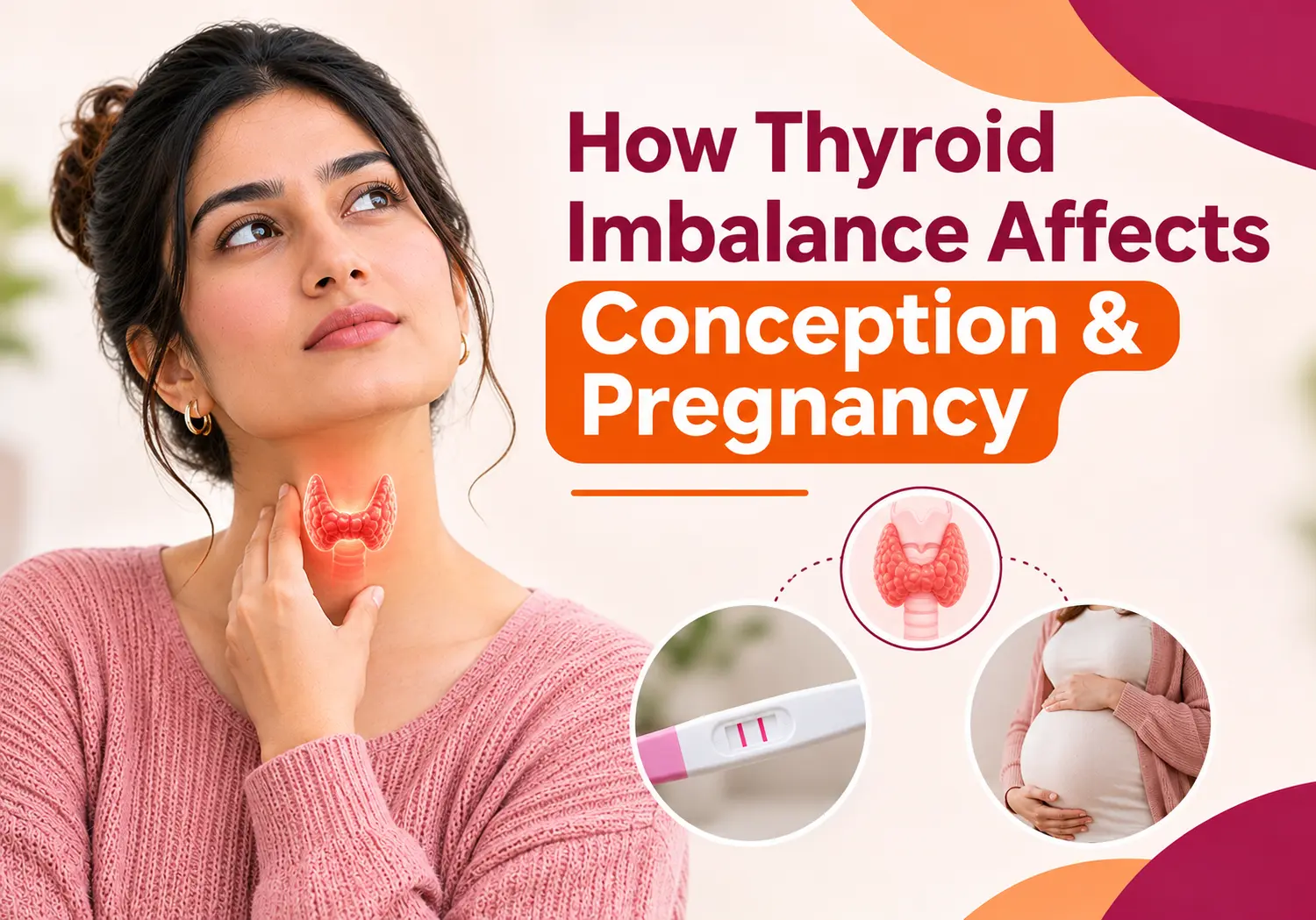
How Does Thyroid Imbalance Affect Female Fertility?

- What is the Role of the Thyroid Gland in Female Reproductive Health?
- How Does Thyroid Imbalance Affect Female Fertility?
- Can Thyroid Problems Affect Egg Quality or Ovarian Reserve?
- How is Thyroid Imbalance Diagnosed During a Fertility Evaluation?
- What Are the Symptoms of Thyroid-Related Infertility in Women?
- Can Thyroid Imbalance Affect IVF Treatment?
- When Should You Consult a Fertility Specialist?
- Conclusion
Summary
-
Thyroid hormones play an important role in regulating menstrual cycles, reproductive hormones, and ovarian function.
-
Both hypothyroidism (underactive thyroid) and hyperthyroidism (overactive thyroid) may affect female fertility.
-
Hypothyroidism can contribute to irregular periods, elevated prolactin levels, and ovulation difficulties.
-
Hyperthyroidism may cause lighter or irregular periods and interfere with normal ovulation.
-
Thyroid imbalance can affect the hormonal processes involved in conception and may make pregnancy planning more challenging.
-
Thyroid dysfunction does not automatically indicate poor egg quality or reduced ovarian reserve.
-
Common thyroid tests include TSH, Free T4, T3, and thyroid antibody tests, depending on individual medical requirements.
-
Thyroid imbalance may also be relevant during IVF treatment, making appropriate assessment and management important.
-
Women experiencing irregular periods or difficulty conceiving should consider consulting a fertility specialist for evaluation.
-
Appropriate thyroid management can support reproductive health, although pregnancy outcomes depend on several individual fertility factors.
Thyroid hormones play an important role in regulating several functions in the body, including metabolism, menstrual cycles, and reproductive health. When thyroid hormone levels are too high or too low, they may interfere with ovulation, menstrual regularity, and the hormonal processes involved in conception.
For women planning a pregnancy, an irregular menstrual cycle or difficulty conceiving can raise questions about thyroid health. Conditions such as hypothyroidism (underactive thyroid) and hyperthyroidism (overactive thyroid) may affect reproductive function, although the impact varies from one woman to another.
Understanding the connection between thyroid imbalance and female fertility can help women recognise when a medical assessment may be useful, what investigations a doctor may recommend and how thyroid conditions can be managed while planning a pregnancy.
What is the Role of the Thyroid Gland in Female Reproductive Health?
The thyroid is a small, butterfly-shaped gland located at the front of the neck. It produces two main hormones: thyroxine (T4) and triiodothyronine (T3). These hormones help regulate metabolism, body temperature, energy use, and several other essential functions.
Thyroid hormones also interact with the reproductive hormone system. They work alongside hormones involved in the menstrual cycle, ovulation, and ovarian function.
When thyroid hormone levels move outside the normal range, this hormonal interaction may be affected. In some women, thyroid dysfunction can contribute to irregular periods, changes in ovulation, or difficulty conceiving.
According to Dr. Anviti Saraf, Senior Fertility Specialist in Gurgaon at Miracles Healthcare, thyroid health is one of the factors that may be considered during a fertility evaluation. Understanding a woman's hormonal health can help doctors identify possible concerns and plan appropriate investigations.
How Does Thyroid Imbalance Affect Female Fertility?
Both hypothyroidism (underactive thyroid) and hyperthyroidism (overactive thyroid) can affect female reproductive health. Depending on their severity, these conditions may interfere with hormonal regulation, menstrual cycles, and ovulation, potentially making conception more difficult.
1. Hypothyroidism and Female Fertility
Hypothyroidism occurs when the thyroid gland does not produce enough thyroid hormones. It may affect the hormonal signals involved in ovulation and menstrual regularity.
Women with hypothyroidism may experience:
-
Irregular or heavy periods
-
Changes in menstrual cycle length
-
Ovulation difficulties
-
Elevated prolactin levels in some cases
-
Difficulty conceiving
Elevated prolactin can interfere with reproductive hormone signals and affect ovulation. However, not every woman with hypothyroidism experiences fertility problems, and many conceive with appropriate medical management.
2. Hyperthyroidism and Female Fertility
Hyperthyroidism occurs when the thyroid gland produces excess thyroid hormones. Untreated or poorly controlled hyperthyroidism may affect menstrual patterns and reproductive hormone activity.
Possible effects include:
-
Irregular or lighter periods
-
Infrequent or missed periods
-
Changes in ovulation
-
Difficulty conceiving in some women
Dr. Anviti Saraf says, “When thyroid hormone levels are higher than normal, they may interfere with the hormonal balance required for regular ovulation. Identifying and managing the underlying thyroid condition can be an important part of fertility planning.”
Women diagnosed with hyperthyroidism who are planning a pregnancy should discuss treatment and thyroid monitoring with their doctor.
3. Thyroid Imbalance and Ovulation
Ovulation is the release of a mature egg from the ovary. Thyroid hormones interact with the reproductive hormone system that regulates this process.
When thyroid function is significantly disturbed, hormonal communication may be affected, potentially leading to irregular or absent ovulation. This can make it difficult to identify the fertile window and reduce opportunities for conception.
Other conditions, including PCOS and elevated prolactin, can also affect ovulation. Therefore, thyroid imbalance should not be assumed to be the only cause.
4. Thyroid Imbalance and Menstrual Changes
Thyroid hormones influence the hormonal communication between the brain, pituitary gland, and ovaries. When thyroid function is abnormal, women may notice:
-
Unpredictable menstrual cycles
-
Heavy or unusually light bleeding
-
Longer gaps between periods
-
Infrequent or missed periods
Persistent menstrual changes may require medical evaluation, particularly when a woman is planning a pregnancy.
Can Thyroid Problems Affect Egg Quality or Ovarian Reserve?
Thyroid hormones are involved in ovarian function and the development of ovarian follicles, which contain immature eggs. This is one reason thyroid health is considered during reproductive health assessments.
However, it is important to distinguish between ovarian function and ovarian reserve. Ovarian reserve refers to the remaining quantity of eggs, while egg quality relates to the likelihood of an egg supporting normal fertilisation and embryo development.
Some studies have explored associations between thyroid disorders, thyroid antibodies and ovarian reserve. However, the evidence does not establish that every woman with a thyroid condition has reduced egg quality or diminished ovarian reserve.
Dr. Anviti Saraf says, “Thyroid health is one part of a woman's overall reproductive health. If a woman is experiencing irregular periods or difficulty conceiving, her evaluation should consider multiple factors rather than focusing on a single hormone result.”
How is Thyroid Imbalance Diagnosed During a Fertility Evaluation?
If a woman is experiencing difficulty conceiving, irregular periods, or symptoms suggestive of thyroid dysfunction, a doctor may recommend thyroid function testing.
The investigations depend on her symptoms, medical history, menstrual pattern, and fertility concerns.
1. TSH Test
The thyroid-stimulating hormone (TSH) test is commonly used as an initial investigation to assess thyroid function. TSH is produced by the pituitary gland and helps regulate thyroid hormone production.
An abnormal TSH result may indicate that the thyroid is underactive or overactive. However, the result needs to be interpreted in the context of the laboratory reference range, symptoms, and other test findings.
2. Free T4 and Sometimes T3 Tests
Free T4 measures the available thyroxine hormone in the blood. A doctor may recommend it alongside TSH to understand thyroid function more clearly.
A T3 test may also be advised in selected cases, particularly when hyperthyroidism is suspected.
3. Thyroid Antibody Tests
Thyroid antibody tests, such as thyroid peroxidase antibodies (TPO antibodies), may be recommended when an autoimmune thyroid condition is suspected.
These tests can help identify conditions such as Hashimoto's thyroiditis. However, the presence of thyroid antibodies does not automatically mean that a woman has infertility or needs thyroid medication.
4. Other Fertility Investigations
If conception has been delayed, a fertility specialist may recommend additional investigations based on the woman's individual history. These may include:
-
Pelvic ultrasound to assess the uterus and ovaries
-
AMH test to assess ovarian reserve
-
Antral follicle count (AFC)
-
Prolactin and other relevant hormone tests
-
Ovulation assessment
-
Partner's semen analysis
Dr. Anviti Saraf advises, “A fertility evaluation should look at the complete reproductive health of both partners. Thyroid function tests may be useful, but they are considered alongside age, ovulation, ovarian reserve, reproductive history, and male fertility factors.”
What Are the Symptoms of Thyroid-Related Infertility in Women?
Thyroid imbalance can affect female fertility by disrupting reproductive hormone levels, menstrual regularity, and ovulation. Women with hypothyroidism or hyperthyroidism may experience symptoms that indicate a possible effect on their reproductive health.
Symptoms associated with hypothyroidism:
-
Irregular or heavy menstrual periods
-
Infrequent periods or missed periods
-
Irregular or delayed ovulation
-
Elevated prolactin levels in some cases
-
Difficulty conceiving
Symptoms associated with hyperthyroidism:
-
Lighter or less frequent menstrual periods
-
Irregular menstrual cycles
-
Changes in ovulation patterns
-
Unpredictable fertile windows
-
Difficulty conceiving
Some women with thyroid-related fertility concerns may not experience noticeable symptoms. These signs can also occur due to other hormonal or reproductive conditions. Thyroid function tests and a medical evaluation can help identify whether thyroid imbalance is contributing to difficulty conceiving.
Can Thyroid Imbalance Affect IVF Treatment?
Thyroid health may also be relevant for women undergoing fertility treatments such as IVF (in vitro fertilisation).
During IVF, ovarian stimulation medicines are used to support the development of multiple follicles. Changes in hormone levels during treatment may be particularly relevant for women who already have thyroid dysfunction or thyroid autoimmunity.
Uncontrolled overt hypothyroidism or hyperthyroidism may affect reproductive health and pregnancy outcomes. Therefore, doctors may assess thyroid function before starting fertility treatment and recommend appropriate management when needed.
However, having a thyroid condition does not automatically mean that IVF will fail or that a woman cannot undergo fertility treatment.
The decision to proceed with IVF, the need for thyroid medication, and the timing of treatment depend on individual test results and clinical assessment.
When Should You Consult a Fertility Specialist?
Consider seeking medical advice from a fertility specialist near you if you experience:
-
Missed or Irregular periods over several menstrual cycles
-
Difficulty conceiving despite regular attempts
-
A known thyroid condition while planning pregnancy
-
Repeatedly abnormal thyroid function test results
-
Symptoms of an underactive or overactive thyroid
-
A history of pregnancy loss along with thyroid-related concerns
-
Difficulty conceiving despite treatment for a thyroid disorder
As a general guideline, women under 35 are usually advised to seek an infertility evaluation after 12 months of regular, unprotected intercourse without conception. Women aged 35 or older should generally seek an evaluation after six months. Women over 40, or those with known reproductive health concerns, may benefit from earlier assessment.
Conclusion:
Thyroid imbalance can affect female fertility by influencing menstrual cycles, ovulation, and reproductive hormone levels. Identifying and managing thyroid conditions can be an important part of pregnancy planning. A fertility expert can assess your thyroid health and other reproductive factors to recommend an appropriate course of care based on your medical needs.
Miracles Healthcare is an ICMR-registered fertility hospital in Gurgaon, providing fertility care since 2014. Its team of experienced fertility specialists, gynaecologists, and embryologists supports women and couples through fertility evaluations and appropriate treatment options based on individual clinical findings.
To consult a fertility doctor near you at Miracles Healthcare and discuss how thyroid health may affect your fertility, call 906-906-8800.
Written and Verified by:

Dr. Anviti Saraf Exp: 11
MBBS, M.S. (Obstetrics & Gynaecology), FNB (Reproductive Medicne), DNB, MRCOG (UK)
Meet the Doctor
Frequently Asked Questions
Yes, women with thyroid disorders can get pregnant naturally. Appropriate diagnosis and management of thyroid hormone levels can help support reproductive health and pregnancy planning.
Yes, pregnancy is possible with a TSH level of 3.5 mIU/L. Its significance depends on your thyroid hormone levels, pregnancy status, medical history, and individual clinical assessment.
Yes, both hypothyroidism and hyperthyroidism may affect menstrual cycles, ovulation, and reproductive hormone balance, potentially making conception more difficult.
Not necessarily. Women who have undergone thyroid removal can conceive, provided their thyroid hormone levels are appropriately managed with prescribed medication and regular monitoring.
There is no universal list of foods that everyone with a thyroid condition must avoid. Excessive iodine, kelp supplements, and high-soy or highly processed foods may need individual consideration depending on the condition and treatment.
A balanced diet, adequate sleep, and regular physical activity support overall health, but they cannot replace thyroid treatment. Follow your doctor's advice and avoid starting supplements without medical guidance.





Was the information useful?
0 0