


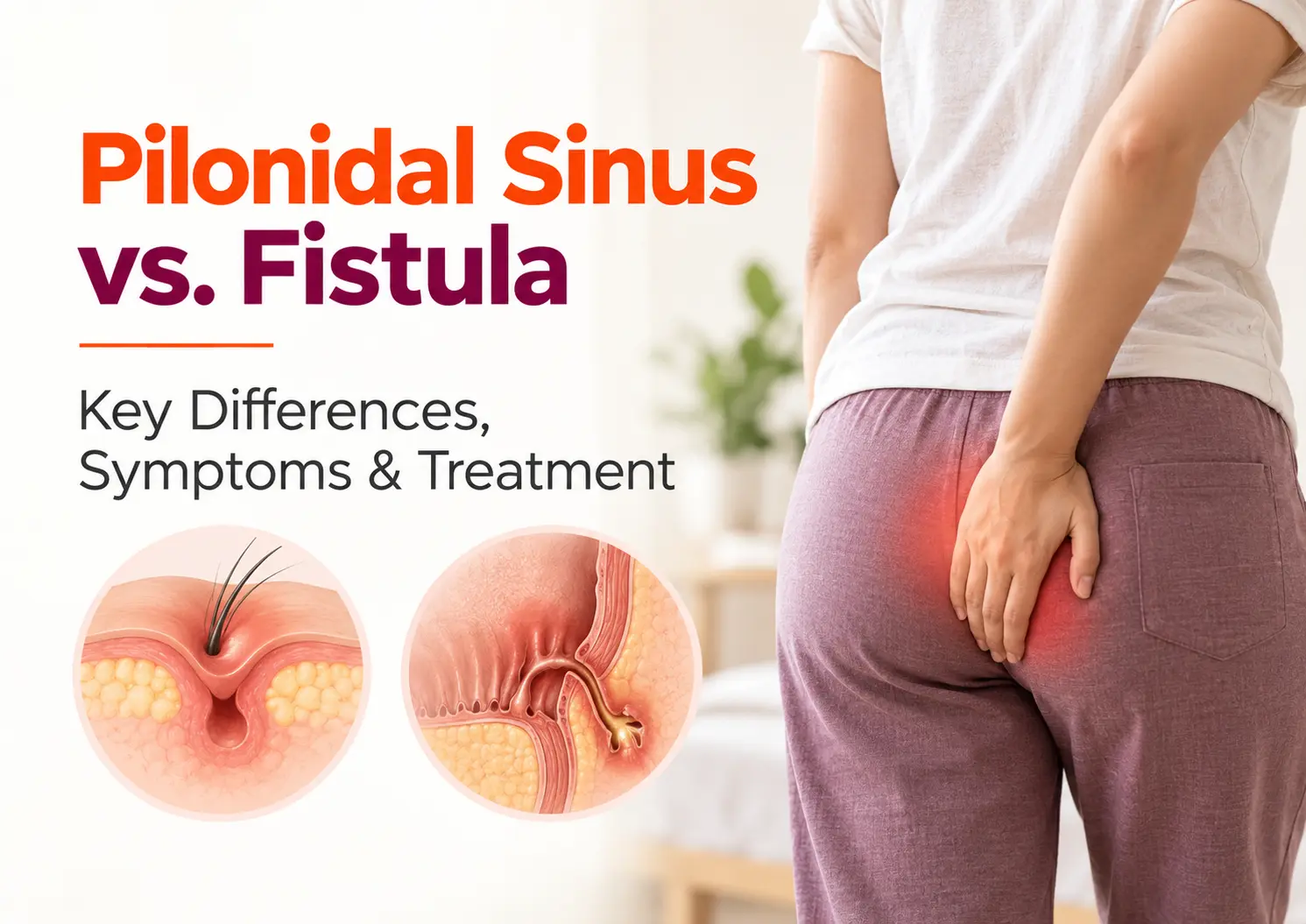
Pilonidal Sinus vs. Fistula: Are They the Same?

- What is a Pilonidal Sinus?
- What is an Anal Fistula?
- Pilonidal Sinus vs Fistula: Key Differences
- How are Pilonidal Sinus and Anal Fistula Diagnosed?
- Pilonidal Sinus vs Fistula: Treatment Options
- When Should You Consult a Doctor?
- Conclusion
- Get Expert Treatment for Pilonidal Sinus and Anal Fistula at Miracles Healthcare, Gurgaon
Summary
-
Pilonidal sinus and anal fistula are different conditions that may cause pain, swelling, and discharge but differ in their location, causes, and treatment.
-
Pilonidal sinus usually develops near the tailbone, in the cleft between the buttocks, often due to hair penetration and inflammation.
-
Anal fistula is an abnormal tunnel connecting the anal canal or rectum to the skin around the anus, commonly developing after an anal abscess.
-
Diagnosis and treatment depend on the condition. A physical examination is usually the first step, while complex or recurrent fistulas may require imaging.
-
Treatment options vary by severity. Pilonidal sinus may need local care, abscess drainage, or surgery. Anal fistulas often require a surgical procedure based on the tract’s location and complexity.
-
Persistent pain, recurring swelling, discharge, or fever should not be ignored, as these symptoms may require medical evaluation.
-
Miracles Healthcare is a NABH-accredited multispeciality hospital in Gurgaon, offering surgical evaluation and treatment for conditions such as pilonidal sinus and anal fistula through its team of experienced general surgeons. Call 906-906-8800 to book a consultation and discuss suitable treatment options.
Pilonidal sinus and fistula are two conditions that can cause pain, swelling, discharge, and discomfort, particularly around the lower back or anal region. Because some of their symptoms overlap, people may confuse the two conditions or assume they require the same treatment. However, pilonidal sinus and fistula differ in where they develop, what causes them, and how they are treated.
A pilonidal sinus usually develops in the cleft between the buttocks, near the tailbone, while an anal fistula typically forms a tunnel connecting the inside of the anal canal or rectum to the skin near the anus. Although both conditions may produce pus or fluid, identifying the underlying cause is essential for appropriate treatment.
In this blog, we will explore the differences between pilonidal sinus and fistula, their symptoms, causes, diagnosis, treatment options, and when to consult a doctor.
What is a Pilonidal Sinus?
A pilonidal sinus is a small tunnel or cavity that develops in the skin and underlying tissue, most commonly near the tailbone at the top of the cleft between the buttocks. It may contain trapped hair, skin debris, and inflammatory tissue.
The condition often develops when loose hair penetrates the skin, triggering inflammation and sometimes infection. A pilonidal sinus may remain relatively quiet for some time or develop into a painful swelling or abscess.
Common Symptoms of Pilonidal Sinus
Symptoms may vary depending on whether the sinus is inflamed or infected. Common signs include:
-
Pain or tenderness near the tailbone, particularly while sitting.
-
A small opening or pit in the skin between the buttocks.
-
Redness and swelling around the affected area.
-
Pus, blood, or foul-smelling discharge from an opening.
-
A painful lump that may indicate an abscess.
-
Difficulty sitting comfortably when the area is inflamed.
Some people have a pilonidal sinus without noticeable symptoms. Others experience repeated episodes of swelling, discharge, and pain.
Dr. Govind Yadav, Senior General Surgeon in Gurgaon at Miracles Healthcare, explains, “Early recognition of pilonidal sinus symptoms, especially pain, swelling, or discharge near the tailbone, can help patients seek timely evaluation and appropriate treatment”
Causes of a Pilonidal Sinus
Pilonidal sinus is associated with hair penetrating the skin and an inflammatory reaction. Several factors may increase the likelihood of developing the condition, including prolonged sitting, friction in the buttock cleft, excess body hair, and a deep cleft between the buttocks, obesity, and diabetes.
It can occur in people who spend long periods sitting, although it is not limited to any particular occupation or lifestyle. Poor hygiene alone is not considered the sole cause of pilonidal sinus.
What is an Anal Fistula?
An anal fistula is an abnormal tunnel that forms between the anal canal or rectum and the skin surrounding the anus. It commonly develops after an infection in an anal gland leads to an abscess. If the infection does not heal completely, a persistent tract may remain.
Unlike a pilonidal sinus, an anal fistula is connected to the anal canal or rectum. This connection is an important difference because it influences the examination, treatment, and risk of recurrence.
Common Symptoms of an Anal Fistula
The symptoms of an anal fistula may include:
-
A small opening or hole in the skin near the anus.
-
Persistent or intermittent pus or fluid discharge.
-
Pain, irritation, or tenderness around the anus.
-
Redness and swelling near the opening.
-
Recurrent anal abscesses.
-
Skin irritation caused by repeated discharge.
-
Pain during bowel movements in some cases.
Fever, increasing pain, or rapidly developing swelling may indicate an active abscess or worsening infection and require prompt medical assessment.
Causes of an Anal Fistula
The most common cause of an anal fistula is an infection that begins in an anal gland and develops into an abscess. When the abscess drains but the tract remains, a fistula may form.
Other possible causes include Crohn’s disease, certain infections, previous surgery, or injury to the anal region. The underlying cause matters because it may affect the treatment plan and the likelihood of recurrence.
Dr. Govind says, “Identifying the underlying cause of an anal fistula is essential for planning appropriate treatment and reducing the risk of recurrence.”
Pilonidal Sinus vs Fistula: Key Differences
Although both conditions may cause skin openings and discharge, their anatomical locations and underlying causes are different.
|
Features |
Pilonidal Sinus |
Anal Fistula |
|
Location |
Usually in the cleft between the buttocks, near the tailbone |
Usually near the anus |
|
Structure |
A sinus tract or cavity beneath the skin, often associated with trapped hair |
An abnormal tunnel connecting the anal canal or rectum to the skin |
|
Common cause |
Hair penetration and inflammation of the skin |
Usually an infection of an anal gland followed by an abscess |
|
Typical symptoms |
Pain near the tailbone, swelling, and discharge from the buttock cleft |
Discharge near the anus, irritation, pain, and recurrent abscesses |
|
Connection to the anal canal |
Usually absent |
Present by definition |
|
Diagnosis |
Physical examination, with additional tests when needed |
Physical examination and, in selected cases, imaging or examination under anaesthesia |
|
Treatment |
May involve drainage of an abscess or surgery to remove the sinus |
Often requires a procedure or surgery tailored to the fistula’s course and involvement of the anal sphincter |
The most important difference is the location and connection of the tract. A pilonidal sinus near the tailbone is not the same as an anal fistula near the anus, even if both produce similar-looking discharge.
How are Pilonidal Sinus and Anal Fistula Diagnosed?
Diagnosis of Pilonidal Sinus
A doctor usually diagnoses a pilonidal sinus by examining the cleft between the buttocks and checking for skin pits, swelling, tenderness, or discharge.
If an abscess is present, the doctor will assess its severity and determine whether drainage is required. Imaging is not routinely needed for a straightforward pilonidal sinus but may be considered when the diagnosis is uncertain, or the disease is unusually extensive.
Dr. Govind says, “A careful physical examination helps identify a pilonidal sinus and assess whether an abscess or more extensive disease requires further evaluation.”
Diagnosis of Anal Fistula
Diagnosing an anal fistula involves examining the skin around the anus and assessing the suspected tract. Depending on the findings, a doctor may recommend a digital rectal examination or an examination of the anal canal using a suitable instrument.
An MRI scan or endoanal ultrasound may be recommended for complex, recurrent, or difficult-to-assess fistulas. These tests can help identify the course of the tract and its relationship to the anal sphincter muscles, which are important for controlling bowel movements.
Accurate diagnosis helps the surgeon select an appropriate treatment while minimising the risk of complications.
Pilonidal Sinus vs Fistula: Treatment Options
The treatment for each condition depends on its severity, whether an abscess is present, and the extent of the affected tract. Pilonidal sinus and anal fistula do not have the same treatment approach.
Treatment for Pilonidal Sinus
Treatment options may include:
-
Observation and local care: An asymptomatic pilonidal sinus may not require immediate surgery. Keeping the area clean and managing hair in the region as advised may help reduce irritation.
-
Abscess drainage: A painful, infected collection of pus may require incision and drainage. Drainage treats the acute abscess, but the underlying sinus may persist or recur.
-
Surgical treatment: Persistent, recurrent, or extensive disease may require surgery to remove the affected tissue or manage the sinus tract. The technique depends on the extent of the condition and the patient’s circumstances.
-
Open Surgery: The surgeon removes the pilonidal sinus and affected tissue, leaving the wound open to heal naturally. Regular dressing and wound care are required during recovery.
-
Flap Surgery: The surgeon removes the sinus and affected tissue, then covers the resulting wound with a flap of healthy surrounding skin and tissue.
-
Laser Ablation of Pilonidal Sinus: A minimally invasive procedure in which a laser fibre is used to treat the cleaned sinus tract. It may involve a smaller wound, less extensive wound care and quicker recovery in suitable cases. It can often be performed as a day-care procedure, allowing the patient to return home the same day.
-
The recovery period varies according to the procedure. Some wounds are closed surgically, while others are left open to heal over time.
Dr. Govind Yadav explains, “The right treatment for a pilonidal sinus depends on its severity and recurrence, so each patient needs an individual assessment before deciding on surgery.”
Treatment for Anal Fistula
An anal fistula often requires surgery because the persistent tract does not heal on its own. The choice of procedure depends on the location and complexity of the fistula and how much of the anal sphincter muscle is involved.
Treatment may include:
-
Fistulotomy: The surgeon opens the fistula tract so it can heal from the inside out. This may be suitable for selected fistulas that involve little or no sphincter muscle.
-
Seton placement: A surgical thread may be placed through the tract to allow drainage and manage infection, particularly in some complex fistulas.
-
Sphincter-preserving procedures: Techniques such as a LIFT procedure or an advancement flap may be considered when preserving the anal sphincter is important.
-
Laser Ablation of Fistula Tract: Antibiotics may be prescribed in specific circumstances, but they do not usually eliminate the fistula tract on their own. The treatment plan should be based on a specialist’s assessment.
When Should You Consult a Doctor?
Consult a general surgeon near you to seek medical attention if you experience any of the following symptoms:
-
Persistent skin opening: A small opening or pit near the tailbone or anus that does not heal.
-
Repeated discharge: Pus, blood, or foul-smelling fluid coming from the affected area.
-
Pain or swelling: Tenderness, a painful lump, or increasing discomfort near the tailbone or anus.
-
Recurring symptoms: Repeated episodes of swelling, discharge, or pain, even if they improve temporarily.
-
Fever or spreading redness: These may indicate an infection that needs prompt medical assessment.
-
Severe or worsening pain: A painful swelling that increases in size or becomes difficult to tolerate may indicate an abscess requiring urgent treatment.
-
Relevant medical history: Inform your doctor about previous abscesses, surgeries, digestive symptoms, or diagnosed inflammatory bowel disease to help guide investigations and treatment.
Conclusion:
Pilonidal sinus and anal fistula may share symptoms such as pain, swelling, and discharge, but they are not the same condition. A pilonidal sinus usually develops near the tailbone and is associated with hair penetration and inflammation. An anal fistula is an abnormal tunnel connecting the anal canal or rectum to the skin near the anus, commonly following an infection and abscess.
Their diagnosis and treatment differ, making a medical examination important when symptoms persist or recur. With an accurate diagnosis and an appropriate treatment plan, both conditions can be managed effectively.
If you notice a painful lump, a persistent skin opening, or recurring discharge near the buttocks or anus, consult a general surgery doctor near you for an assessment rather than relying on home treatment alone.
Get Expert Treatment for Pilonidal Sinus and Anal Fistula at Miracles Healthcare, Gurgaon
Miracles Healthcare is a NABH-accredited multispeciality hospital in Gurgaon, trusted by patients for healthcare services since 2002. With a team of 10+ general surgeons, the hospital provides care for conditions such as pilonidal sinus and anal fistula. Based on your symptoms and diagnosis, the surgical team helps you understand the available treatment options and choose the approach best suited to your needs.
With centres in Sector 14, Sector 56, and Sector 82 in Gurgaon, Miracles Healthcare offers access to surgical consultations across multiple locations.
If you are experiencing recurring swelling, pain, or discharge near the tailbone or anus, consult Dr. Govind Yadav at Miracles Healthcare to discuss your symptoms and available treatment options. Call 906-906-8800 to book your consultation and receive guidance tailored to your condition.
Written and Verified by:

Frequently Asked Questions
Many anal fistulas can be successfully treated with surgery, but a guaranteed cure is not possible in every case. The outcome depends on the fistula’s complexity, underlying cause, and risk of recurrence.
A pilonidal sinus may remain symptom-free without surgery, but a persistent sinus may not heal permanently and can become infected. Treatment depends on its symptoms and severity.
Anal fistulas can be more complicated because they may cause recurrent infections and abscesses, while piles usually cause bleeding, itching, or discomfort. The seriousness depends on the individual condition.
An anal fistula rarely heals permanently on its own because the abnormal tract remains. Medical evaluation is important to determine the appropriate treatment.
No specific food directly causes or cures an anal fistula. If constipation worsens your symptoms, limit foods that contribute to hard stools and prioritise fibre-rich foods and adequate fluids.
An asymptomatic pilonidal sinus may be monitored under medical guidance, but it can become infected or develop an abscess. Consult a doctor if you experience pain, swelling, redness, or discharge.





Was the information useful?
0 0