


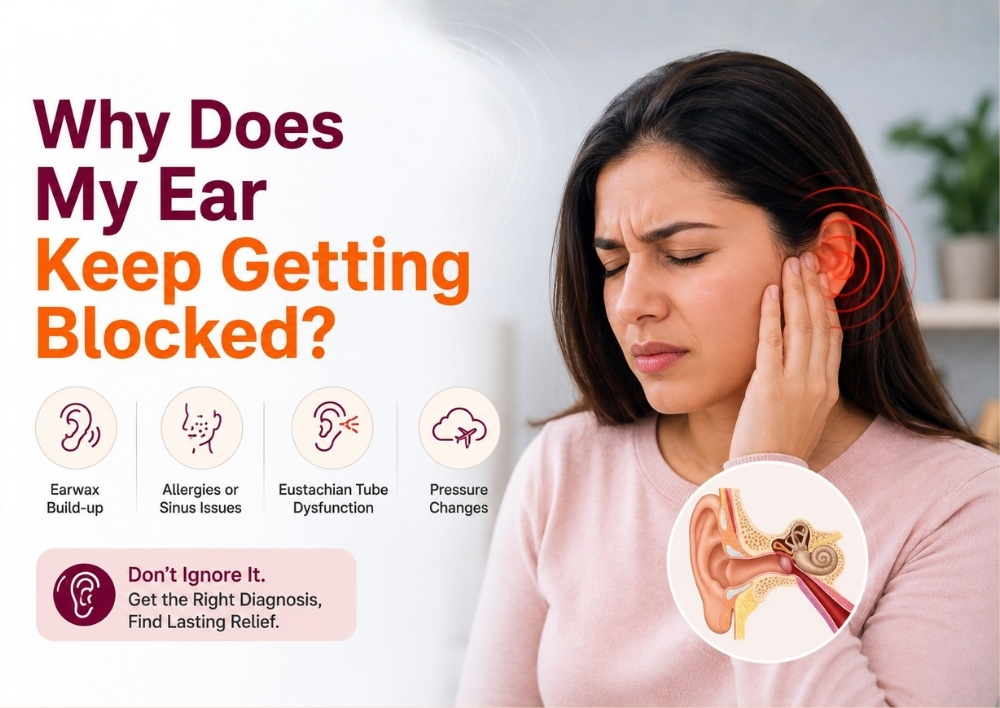
Why Does My Ear Keep Getting Blocked?

Summary
Have you ever felt like your ear is blocked, muffled, or “full,” even though there is nothing physically stuck inside it? If your ear keeps getting blocked and the sensation comes and goes, it can be frustrating, especially when you have trouble hearing clearly, feel pressure in your ear, or notice popping and discomfort. While occasional ear blockage can happen due to something as simple as earwax or a change in air pressure, repeated or persistent blockage may have an underlying cause that needs attention.
When the problem keeps coming back, repeatedly trying to clean or “pop” the ear may not address the actual cause. The ENT specialists at Miracles Healthcare, Gurgaon, recommend an evaluation if the blockage persists, occurs frequently, or is accompanied by hearing loss, pain, discharge, ringing, or dizziness. Identifying the underlying cause can help determine the appropriate treatment and prevent recurring ear problems from being ignored.
Let's understand the most common reasons why your ear may keep getting blocked.
What causes ear blockage
There are several possible reasons for ear blockage. Some are temporary, while others may require medical evaluation.
1. Earwax Buildup
Earwax, also called cerumen, naturally protects the ear canal by trapping dust and helping prevent irritation. However, when too much wax accumulates, it can block the ear canal and interfere with the passage of sound. This may lead to muffled hearing, a feeling of fullness or blockage, itching, discomfort, or ringing in the ear.
Dr. Monika Sharma, ENT Specialist in Gurgaon at Miracles Healthcare, says, “If earwax buildup is suspected, we examine the ear to confirm whether wax is causing the blockage and recommend an appropriate and safe method of removal when required."
2. Eustachian Tube Dysfunction
The Eustachian tube connects the middle ear to the back of the nose and helps equalise pressure on both sides of the eardrum. When this tube does not open properly, you may feel that your ear is blocked or under pressure.
Eustachian tube dysfunction can occur with:
-
A cold
-
Allergies
-
Sinus congestion
-
Nasal inflammation
-
Sudden changes in altitude
You may notice popping or clicking when swallowing or yawning. Hearing can also feel temporarily reduced.
3. Cold, Allergy, or Sinus Congestion
A blocked nose can affect the Eustachian tube and create pressure in the middle ear. This is why some people notice blocked ears during a cold, allergy flare-up, or sinus infection.
Dr. Monika says, “Nasal congestion from colds, allergies, or sinus problems can interfere with Eustachian tube function and make the ears feel blocked or pressurised.”
The ear may feel full even when there is no earwax blockage. Treating the underlying nasal or sinus problem may help relieve the ear symptoms.
4. Changes in Air Pressure
Have you ever experienced blocked ears during take-off or landing on a flight? This commonly happens because the pressure around you changes faster than the middle ear can adjust.
The same sensation can occur while travelling to high altitudes or during activities involving rapid pressure changes.
Yawning, swallowing, or chewing may help the ears equalise naturally. However, severe or persistent symptoms should not be ignored.
5. Fluid Behind the Eardrum
Fluid can sometimes collect in the middle ear, particularly after an upper respiratory infection or because of Eustachian tube problems. This can create a feeling of fullness and affect hearing.
Unlike earwax, this type of blockage cannot simply be removed from the ear canal. An ENT examination can help determine whether fluid is present behind the eardrum.
6. Ear Infection
An ear infection can cause blockage along with pain, pressure, reduced hearing, fever, or discharge. Some infections affect the outer ear, while others involve the middle ear.
If ear pain is significant, symptoms are worsening, or there is discharge from the ear, medical evaluation is recommended.
7. Foreign Object in the Ear
Children, in particular, may accidentally put small objects into their ears. In adults, insects or other material can occasionally enter the ear canal.
A foreign object should not be removed using sharp objects, cotton buds, or household tools. Attempting to remove it yourself can push it deeper or damage the ear canal.
8. Less Common Ear Problems
Repeated ear blockage can occasionally be related to other conditions affecting hearing or the middle or inner ear. For example, some hearing disorders can cause fullness, hearing changes, tinnitus, or dizziness.
Dr. Sharma says, “Persistent ear blockage with hearing changes, tinnitus, or dizziness should be evaluated by an ENT specialist to identify the underlying cause.”
This is one reason persistent or unexplained ear blockage should be assessed by an ENT doctor, particularly when it is associated with sudden hearing changes or balance problems.
How Is a Repeatedly Blocked Ear Diagnosed?
When your ear keeps getting blocked, an ENT specialist will evaluate the symptoms and examine the ear to identify the underlying cause. Diagnosis may include:
-
Medical history: The doctor may ask how often the blockage occurs, how long it lasts, whether one or both ears are affected, and whether you have symptoms such as muffled hearing, pain, ringing, dizziness, or discharge.
-
Ear examination: An otoscope is used to examine the ear canal and eardrum for earwax buildup, inflammation, infection, fluid, or other abnormalities.
-
Hearing test: If the blockage is associated with reduced or muffled hearing, a hearing test may be recommended to assess the extent and type of hearing loss.
-
Middle-ear assessment: Tests may be performed to check pressure and the movement of the eardrum, particularly when Eustachian tube dysfunction or fluid behind the eardrum is suspected.
-
Nose and throat examination: If allergies, sinus congestion, or Eustachian tube dysfunction may be contributing to the problem, the ENT expert may also examine the nose and throat.
-
Additional tests: Further investigations may be recommended when symptoms are persistent, one-sided, unexplained, or associated with significant hearing or balance problems.
Diagnosis aims to determine what is causing the blockage and whether the problem is affecting the ear canal, middle ear, or hearing function.
Treatment Options for a Blocked Ear
Treatment for a blocked ear depends on the underlying cause and the findings during an ENT evaluation. Once the cause is identified, the ear block problem solutions may include:
-
Earwax removal: Excessive earwax can be removed safely by an ENT specialist using an appropriate technique.
-
Medication: Medicines may be recommended when the blockage is associated with an ear infection, allergies, nasal congestion, or sinus-related inflammation.
-
Treatment for Eustachian tube dysfunction: The underlying nasal or allergy-related condition may be treated to improve Eustachian tube function and relieve pressure in the ear.
-
Management of fluid behind the eardrum: The doctor may recommend monitoring or treatment depending on the cause, duration, and effect on hearing.
-
Pressure-equalising measures: For blockage related to air travel or altitude changes, appropriate techniques to equalise pressure may be advised.
-
Treatment for associated hearing conditions: If the blockage is linked to hearing loss, tinnitus, dizziness, or another ear condition, treatment will be planned according to the specific diagnosis.
Dr. Monika Sharma says, “The right treatment for a blocked ear depends on identifying the underlying cause rather than treating the sensation of blockage alone.”
When Should You See an ENT Doctor for a Blocked Ear?
When Should You See an ENT Doctor for a clogged Ear?
Occasional ear pressure may resolve on its own, but you should consider consulting an ENT specialist if:
-
Your ear remains blocked for several days
-
The blockage keeps coming back
-
You notice persistent hearing loss
-
You have significant ear pain
-
There is fluid or discharge from the ear
-
You experience repeated ringing in the ear
-
You have dizziness or balance problems
-
Symptoms develop after an ear injury
-
You frequently experience ear pressure without an obvious reason
Sudden hearing loss requires prompt medical assessment. If hearing suddenly decreases, particularly in one ear, do not assume that it is simply earwax or congestion.
Don’t Ignore Recurring Ear Blockage, Find Out What’s Causing It
If your ear keeps getting blocked, repeatedly trying to clear it at home may not address the actual cause. A proper ENT evaluation can help identify whether the problem is related to earwax, pressure changes, allergies, infection, fluid behind the eardrum, or another ear condition. Book your consultation with an ENT specialist near you at Miracles Healthcare.
At Miracles Healthcare, Gurgaon, patients can access ENT evaluation and diagnostic support for common ear, nose, and throat concerns. The focus is on identifying the cause of symptoms and recommending appropriate treatment based on individual needs.
Expert ENT Care for Recurring Ear Blockage at Miracles Healthcare
Miracles Healthcare is a trusted ENT Hospital in Gurgaon that has been offering comprehensive diagnosis and treatment for recurring ear blockage and a wide range of ear, nose, and throat conditions since 2002.
-
Trusted by 7,00,000+ patients across multiple specialties.
-
Expert panel of 150+ specialist doctors, including experienced ENT specialists.
-
Comprehensive evaluation and treatment for recurring ear blockage caused by earwax buildup, Eustachian tube dysfunction, sinus congestion, allergies, ear infections, fluid behind the eardrum, pressure-related ear problems, hearing loss, and other ENT conditions.
-
Advanced ENT diagnostic techniques such as Ear Endoscopy, Nasal Endoscopy, Laryngoscopy, hearing evaluation, and other investigations to identify the underlying cause and plan appropriate treatment.
-
Multispeciality support under one roof for patients who require coordinated care for ENT, allergy, sinus, or other related health concerns.
-
Conveniently located at Sector 14, Sector 56 and Sector 82, Gurugram.
If you are experiencing recurring ear blockage, muffled hearing, ear pressure, or other persistent ear symptoms, consulting an ENT doctor near you can help you get the right diagnosis and treatment.
Different ways to connect with our ENT doctors
-
WhatsApp: Send your symptoms and relevant medical reports to our team for guidance.
-
Online Consultation: Consult an ENT specialist from the comfort of your home without visiting the hospital.
-
Hospital Consultation: Visit your nearest Miracles Healthcare centre for an in-person ENT evaluation.
-
Phone Consultation: Call our team to schedule an appointment with an ENT specialist.
Call Now: 1244797600 | WhatsApp: 9820965000
Written and Verified by:

Frequently Asked Questions
Avoid inserting cotton buds, manage allergies or congestion, and consult an ENT specialist if the blockage keeps recurring.
Repeated blocking and unblocking is often linked to Eustachian tube dysfunction, allergies, sinus congestion, or changes in air pressure.
Temporary blockage caused by congestion or pressure changes may resolve on its own, but persistent or recurring blockage needs medical evaluation.
Doctors treat the underlying cause, which may include safe earwax removal, medication for infection or congestion, or other appropriate ENT treatment.
Seek medical attention if blockage is persistent or accompanied by sudden hearing loss, severe pain, discharge, dizziness, or persistent ringing.






Was the information useful?
0 0