


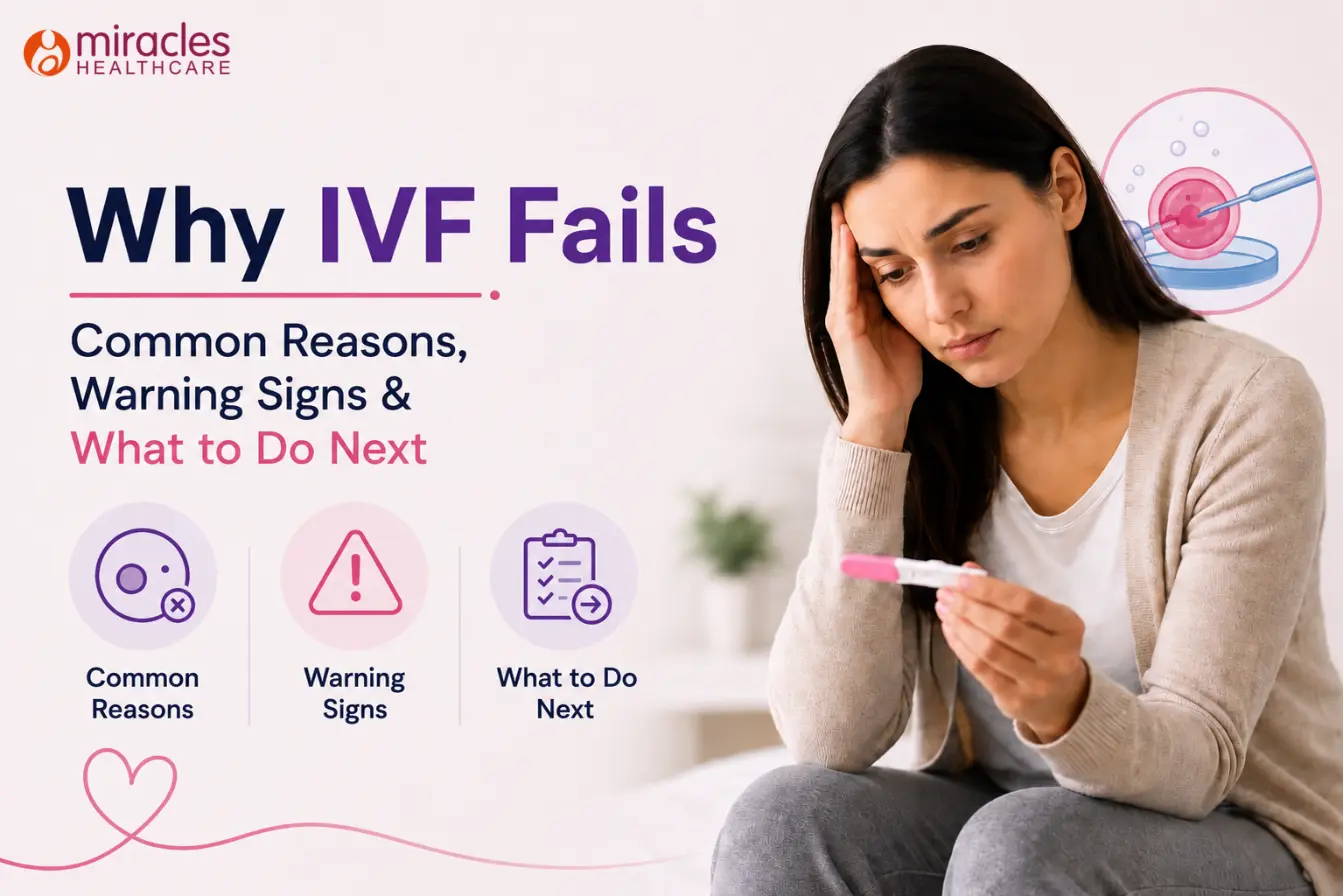
Why IVF Fails – Common Reasons, Warning Signs & What to Do Next
Summary
Introduction
For couples on the journey to parenthood, a failed IVF cycle can feel devastating. Yet it is more common than many realise - globally, even with the best technology, IVF does not result in a live birth in every attempt. In India, success rates per cycle typically range from 40% to 65%, depending on the clinic, the patient's age, and underlying medical conditions.
If you are asking why IVF fails, know that you are not alone - and more importantly, that failure in one cycle does not mean failure forever. Understanding the root causes is the most empowering step you can take toward a successful outcome in the next attempt.
At Miracles Fertility & IVF Clinic, Gurgaon - a trusted name in reproductive medicine with over 12 years of experience and 1,500+ IVF cycles - our fertility specialists take a deeply personalised approach to investigating and overcoming the causes of IVF failure.
What Does IVF Failure Mean?
IVF failure can occur at several different stages:
-
Failed fertilisation: The egg and sperm do not successfully combine in the lab
-
Poor embryo development: Embryos stop developing before they are ready for transfer
-
Failed implantation: The embryo is transferred, but does not attach to the uterine lining
-
Early pregnancy loss (chemical pregnancy): A pregnancy is detected but miscarries very early
-
Recurrent IVF failure: Two or more consecutive IVF cycles failing to result in a live birth
Each type of failure has different underlying causes, and identifying which stage is failing is critical to planning the next step.
Top Reasons Why IVF Fails
1. Age and Declining Egg Quality
This is one of the most significant and well-established reasons why IVF fails. As a woman ages, both the quantity and - more critically - the quality of her eggs decline. Poor egg quality leads to abnormal embryos that either fail to implant or are naturally rejected by the body.
-
Women under 35 generally have the highest IVF success rates
-
After 38, egg quality drops considerably
-
After 40, the chances of chromosomal abnormalities in eggs increase sharply
This does not mean IVF is impossible for older women - but it may require additional strategies such as preimplantation genetic testing (PGT) or donor egg cycles.
2. Chromosomal Abnormalities in the Embryo
Even when an embryo looks healthy under the microscope, it may carry chromosomal defects that prevent successful implantation or lead to early miscarriage. These abnormalities - such as extra or missing chromosomes - can be inherited from one or both parents or arise spontaneously during cell division.
Preimplantation Genetic Testing for Aneuploidies (PGT-A) allows specialists to screen embryos for such defects before transfer, significantly improving the chances of a successful pregnancy.
3. Poor Ovarian Response to Stimulation
During an IVF cycle, hormonal injections (typically FSH) are used to stimulate the ovaries to produce multiple eggs. In some women - especially those with low ovarian reserve (low AMH levels or low antral follicle count) - the ovaries fail to respond adequately, producing too few eggs for retrieval.
Signs of poor ovarian response include:
-
Fewer than 3–4 follicles are developing during stimulation
-
Premature ovulation before egg retrieval
-
Cycle cancellation due to insufficient egg development
In such cases, the IVF protocol may need to be adjusted, or alternative approaches like mini-IVF or donor eggs may be considered.
4. Embryo Quality Issues
Even with good-quality eggs and sperm, not all embryos develop into healthy blastocysts suitable for transfer. Embryo grading helps embryologists select the most viable embryo, but internal cellular defects may not always be visible during routine assessment.
Factors affecting embryo quality include:
-
Sperm DNA fragmentation
-
Lab environment (temperature, culture media)
-
Suboptimal stimulation protocol
-
Genetic factors in either partner
5. Implantation Failure - Uterine and Endometrial Issues
Even a genetically healthy embryo can fail to implant if the uterine environment is not receptive. This is one of the most complex aspects of why IVF fails. Common causes include:
-
Thin endometrial lining - an endometrium thinner than 7–8 mm is generally considered insufficient for implantation
-
Uterine polyps or fibroids - these can physically obstruct embryo attachment
-
Hydrosalpinx - fluid from blocked fallopian tubes can leak into the uterus and impair implantation
-
Uterine septum or adhesions - structural abnormalities that alter the uterine cavity
-
Endometriosis - affects uterine receptivity and can contribute to immune-related implantation failure
A thorough uterine assessment - including hysteroscopy and 3D ultrasound - before the next IVF attempt is strongly recommended if implantation failure has occurred.
6. Male Factor Infertility
IVF is often approached as a "female issue," but male factor infertility contributes to a significant proportion of failed cycles. Beyond basic semen analysis, sperm DNA fragmentation is a key parameter that often goes untested. High sperm DNA damage can lead to:
-
Poor fertilisation rates
-
Abnormal embryo development
-
Early pregnancy loss after successful implantation
ICSI (Intracytoplasmic Sperm Injection), where a single healthy sperm is directly injected into the egg, is often recommended in cases of male factor infertility. Miracles Fertility & IVF Clinic offers comprehensive semen testing, ICSI, and advanced sperm selection techniques for couples facing this challenge.
7. Immune System Reactions
In some cases, the body's immune system mistakenly identifies the embryo as a foreign body and mounts a response against it. This immune-related implantation failure is more common in women with autoimmune conditions, recurrent pregnancy loss, or a history of multiple failed cycles.
Immune testing - including Natural Killer (NK) cell activity testing, antiphospholipid antibody testing, and thyroid antibody panels - can help identify and manage such issues.
8. Lifestyle and Environmental Factors
Modifiable lifestyle factors play a more significant role in IVF outcomes than many patients realise:
-
Smoking - reduces ovarian reserve and impairs embryo development
-
Obesity or being underweight - both extremes disrupt hormonal balance
-
Excessive alcohol consumption negatively impacts egg and sperm quality
-
High stress levels may affect implantation through hormonal pathways
-
Poor sleep patterns - disrupt reproductive hormone rhythms
-
Environmental toxins - plastics (BPA), pesticides, and heavy metals can impair fertility
Addressing these factors before the next cycle can make a meaningful difference in outcomes.
9. Hormonal Imbalances
Conditions such as thyroid dysfunction, elevated prolactin, insulin resistance (in PCOS), or premature progesterone rise during stimulation can all compromise the chances of successful implantation. Comprehensive hormonal profiling before each IVF attempt is essential.
What Should You Do After a Failed IVF Cycle?
A failed cycle is not a dead end - it is information. The key is a thorough investigation to understand what went wrong so the next attempt can be better planned.
Steps to take after IVF failure:
-
Full debriefing with your fertility specialist - review the cycle in detail
-
Repeat hormonal and semen testing - hormonal profiles and sperm parameters can change
-
Uterine cavity assessment - hysteroscopy to rule out structural issues
-
Genetic testing of embryos - PGT-A before next transfer
-
Immune workup - if multiple cycles have failed
-
Lifestyle modifications - address smoking, weight, diet, and stress
-
Explore alternative protocols - different stimulation approaches, frozen embryo transfer (FET), or donor egg options
Why Choose Miracles Fertility & IVF Clinic, Gurgaon?
Miracles Fertility & IVF Clinic is part of Miracles Healthcare - a trusted multi-speciality hospital in Gurgaon since 2002. Our fertility centre stands apart for the following reasons:
-
Over 65% IVF success rate - among the highest in the NCR region
-
1,500+ IVF cycles completed with expertise and precision
-
12+ years of fertility care experience
-
Comprehensive fertility solutions - IVF, ICSI, IUI, donor egg cycle, egg freezing, semen preservation, fertility screening, and more
-
No hidden costs - transparent, competitive pricing
-
Dedicated fertility specialists with in-depth expertise in recurrent IVF failure
-
NABL-accredited labs for semen analysis, hormonal panels, and genetic testing
-
Patient-first approach - emotional support and personalised care throughout your journey.
Our Locations - Accessible Across Gurgaon & NCR
Patients from Gurgaon, Delhi, and surrounding areas can consult our fertility experts at:
Miracles Fertility & IVF Clinic, Sector 14, Gurugram, SCO 1, 2, 3, Old Delhi Gurugram Rd, Sector 14, Gurugram, Haryana 122007 |0124-4797600
Services: IVF, IUI, ICSI, Fertility Screening, Donor Egg Cycle, Semen Test, Egg Preservation, Semen Preservation
Miracles Apollo Cradle, Sector 14, Gurugram, SCO 1, 2 & 3, Delhi Rd, Sector 14, Gurugram, Haryana 122007 |0124-4797600
Services: Gynaecology, Obstetrics, Surgeries, Level III NICU, Diagnostics
Miracles Mediclinic, Sector 56, Gurugram, SCO-68-69, More Market, Block B, Sector 56, Gurugram, Haryana 122011,906-906-8800
Services: Consultations, Diagnostics, Lab Tests, MRI, CT Scans
Miracles Apollo Cradle/Spectra, Sector 82, Gurugram , Plot No. 45, VATIKA INDIA NEXT, Sector 82, Gurugram, Haryana 122012 |0124-352-8282
Services: Consultations, Diagnostics, CT Scans, General Surgery, Health Checks
We are conveniently accessible to patients from Huda City Centre, Cyber City, Palam Vihar, Manesar, Sohna, Old Gurgaon, and nearby areas of South Delhi and NCR.
Book a Fertility Consultation Today
If you have experienced a failed IVF cycle and are looking for answers, expert guidance is just a call away. The team at Miracles Fertility & IVF Clinic will help you understand what went wrong and chart the best path forward - with compassion, expertise, and complete transparency.
Call/WhatsApp: 98209-65000
Landline: 0124-4797600
Website: www.miracleshealth.com
Written and Verified by:

Frequently Asked Questions
A healthy-looking embryo may still carry chromosomal defects invisible to the naked eye or microscope. Additionally, even chromosomally normal embryos can fail to implant due to uterine issues, immune reactions, or poor endometrial receptivity. A detailed investigation after the cycle helps pinpoint the reason.
Many couples achieve success within 2–3 IVF cycles. Some may need more, depending on the underlying cause of infertility, the woman's age, and the quality of the embryos. Each failed cycle provides valuable information that helps refine the approach for the next attempt.
IVF itself does not reduce future fertility. The medications used during stimulation are temporary, and the ovaries recover. A failed cycle should be treated as a learning opportunity, not a permanent setback.
Yes. Recurrent implantation failure (RIF) - defined as failure after three or more good-quality embryo transfers - can be investigated through immune testing, genetic screening, uterine assessment, and hormonal workup. Targeted interventions based on these findings can significantly improve outcomes.
Yes. Egg quality declines naturally with age, making chromosomal abnormalities in embryos more likely. Women over 38 may benefit from preimplantation genetic testing or donor egg cycles to improve their chances of success.
Miracles Fertility & IVF Clinic combines clinical expertise, advanced laboratory technology, and patient-centred care with a success rate exceeding 65%. With no hidden costs, 12+ years of experience, and integrated diagnostic support from NABL-accredited labs, we provide a seamless, transparent fertility journey. Call us at 98209-65000 to schedule a consultation.




Was the information useful?
0 0