


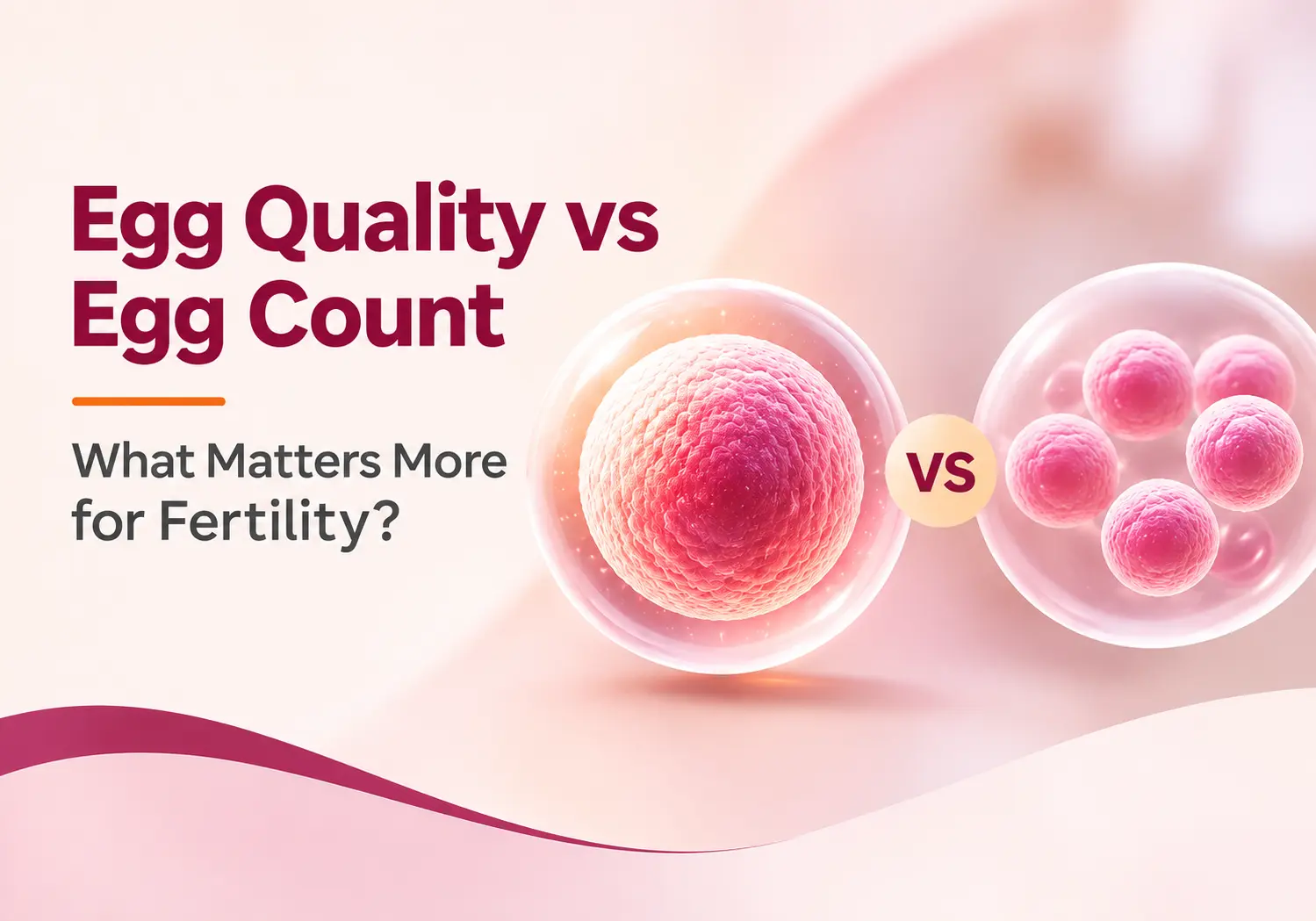
Egg Quality vs Egg Count: Understanding the Difference

- What is Egg Quality?
- Why is Egg Quality Important for Pregnancy?
- What is Egg Count?
- Why is Egg Quantity Important?
- Egg Quality vs Egg Quantity: What Is the Difference?
- How Does Age Affect Egg Quality and Quantity?
- What Are the Signs of Poor Egg Quality?
- How Can Egg Count Be Assessed?
- Can Egg Quality Be Improved Naturally?
- How Do Egg Quality and Count Affect IVF Treatment?
- When Should You Consult a Fertility Specialist?
- Understand Your Ovarian Reserve and Make Informed Fertility Decisions
Summary
-
Egg quality refers to the health and developmental potential of eggs, while egg quantity indicates the number of eggs remaining in the ovaries.
-
Both egg quality and egg quantity play important roles in female fertility and pregnancy outcomes.
-
Age is a major factor affecting ovarian reserve and egg quality, with noticeable changes generally occurring after the mid-30s.
-
Poor egg quality usually does not cause noticeable symptoms but may be associated with difficulty conceiving, chromosomal abnormalities, and pregnancy loss.
-
Egg quantity can be assessed through fertility investigations such as AMH testing, Antral Follicle Count (AFC), and FSH testing.
-
AMH levels indicate ovarian reserve but cannot directly measure egg quality or predict natural pregnancy.
-
A balanced diet, healthy weight, adequate sleep, and avoiding smoking can support overall reproductive health.
-
IVF outcomes depend on several factors, including egg quality, egg quantity, age, sperm health, and embryo development.
-
Women with low ovarian reserve may still conceive naturally, depending on their overall fertility health.
-
Timely consultation with a fertility specialist can help assess ovarian reserve, understand reproductive health, and explore suitable fertility treatment options.
When planning a pregnancy, many women focus on their menstrual cycle, ovulation dates, and overall reproductive health. However, there are two important factors that play a significant role in female fertility: egg quality and egg quantity. Although these terms are often used together, they represent two different aspects of reproductive health.
A woman may have a good number of eggs in her ovaries but still experience difficulty conceiving because of age-related changes in egg quality. Similarly, some women with a lower ovarian reserve may conceive naturally, depending on their individual reproductive health and other fertility factors.
So, what is the actual difference between egg quality and egg count? Does having more eggs mean better chances of pregnancy? And can egg quality be improved?
Understanding these differences can help women make informed decisions about their reproductive health, especially when planning pregnancy or considering fertility treatments such as IVF.
What is Egg Quality?
Egg quality refers to the health and developmental potential of a woman's eggs (oocytes). It determines how well an egg can mature, undergo fertilisation, support embryo development, and potentially result in a successful pregnancy.
A good-quality egg generally has the correct number of chromosomes and the cellular components needed for normal fertilisation and early embryo development.
One important factor influencing egg quality is a woman's age. Egg quality slowly changes by age. With increasing age, eggs are more likely to develop chromosomal abnormalities, which may affect fertilisation, embryo development, and the chances of a successful pregnancy.
It is important to understand that fertilisation alone does not guarantee pregnancy. The fertilised egg must divide normally, develop into a healthy embryo, and successfully implant in the uterus.
Dr. Anviti Saraf, Senior Fertility Specialist in Gurgaon at Miracles Healthcare, explains, "Egg quality is an important aspect of female fertility. As age advances, changes in egg quality can influence the chances of fertilisation and healthy embryo development, which is why understanding reproductive health is important when planning a pregnancy."
Why is Egg Quality Important for Pregnancy?
Egg quality can influence several stages of reproduction, including:
-
Fertilisation: A healthy egg has the potential to support normal fertilisation by a sperm.
-
Embryo development: Egg quality contributes to the embryo's ability to divide and develop during the early stages.
-
Chromosomal health: The likelihood of chromosomal abnormalities in eggs increases with age.
-
Pregnancy outcomes: Chromosomal abnormalities can affect implantation, embryo development, and the risk of miscarriage.
Egg quality is closely associated with a woman's age, although individual variations exist. It is one of the important factors considered during fertility evaluation.
What is Egg Count?
Egg count, also known as egg quantity, refers to the number of eggs remaining in a woman's ovaries. This is commonly associated with ovarian reserve.
Women are born with a finite supply of eggs. Egg count in women slowly decreases throughout life as eggs are used or naturally lost through a process called follicular atresia.
Unlike some other cells in the body, eggs are not continuously produced in large numbers throughout a woman's reproductive life.
Egg quantity is an important consideration when assessing reproductive potential and predicting how the ovaries may respond to fertility medications during treatments such as IVF.
Dr. Anviti Saraf explains, "Egg quantity provides important information about a woman's ovarian reserve. Evaluating ovarian reserve can help fertility specialists understand how the ovaries may respond to fertility treatment and guide further pregnancy planning."
Why is Egg Quantity Important?
Egg quantity provides information about the remaining egg supply and can help fertility specialists understand:
-
The approximate remaining ovarian reserve.
-
How the ovaries may respond to ovarian stimulation medications.
-
The potential number of eggs that may be retrieved during an IVF cycle.
-
Whether additional fertility evaluation may be appropriate.
-
How age and ovarian reserve may influence fertility planning.
However, having a higher egg quantity does not automatically mean that a woman has better-quality eggs or a higher probability of natural conception.
Egg Quality vs Egg Quantity: What Is the Difference?
Although egg quality and egg quantity are connected to female fertility, they measure different things.
|
Parameter |
Egg Quality |
Egg Count |
|
Meaning |
Refers to the health and developmental potential of eggs |
Refers to the number of eggs remaining in the ovaries |
|
Main factor |
Chromosomal and cellular health |
Ovarian reserve |
|
Age-related changes |
Quality generally declines with age |
Quantity gradually decreases with age |
|
Fertility relevance |
Influences fertilisation, embryo development and pregnancy outcomes |
Helps estimate ovarian response to fertility medications |
|
Assessment |
Cannot be directly measured through a routine blood test |
Estimated through AMH, AFC and other clinical assessments |
|
IVF relevance |
Influences embryo development and potential outcomes |
Helps predict the number of eggs that may be retrieved |
Both factors are important, but neither should be considered in isolation when evaluating female fertility.
How Does Age Affect Egg Quality and Quantity?
Age is one of the most significant factors influencing female reproductive health. Both egg quality and egg quantity change over time, but they do not decline in the same way.
A woman generally has her highest egg reserve before birth. This reserve slowly decreases throughout childhood and reproductive life. As women approach their mid-to-late 30s, age-related changes in egg quality and quantity become increasingly important.
In Your 20s
-
Egg quantity is generally higher compared with later reproductive years.
-
Egg quality is typically better, with a lower proportion of chromosomally abnormal eggs.
-
Fertility is generally at its highest during this stage.
In Your 30s
-
Egg quantity continues to decline.
-
Egg quality slowly changes with age.
-
Fertility may decrease, particularly after the mid-30s.
-
Some women may experience difficulty conceiving despite having regular menstrual cycles.
After 40
-
Both egg quantity and quality may be significantly reduced.
-
The proportion of eggs with chromosomal abnormalities increases.
-
The chances of miscarriage and age-related fertility difficulties increase.
-
Fertility evaluation may help women understand their reproductive options.
These are general age-related patterns, not individual predictions. Women of the same age can have different ovarian reserves and reproductive outcomes.
What Are the Signs of Poor Egg Quality?
One important thing to understand is that poor egg quality usually does not cause noticeable symptoms. A woman may have regular periods, predictable ovulation, and no obvious reproductive health concerns but still experience age-related changes in egg quality.
However, certain reproductive experiences may prompt further fertility evaluation.
These include:
-
Difficulty conceiving despite regular attempts.
-
Repeated pregnancy loss.
-
Previous IVF cycles with poor fertilisation or embryo development.
-
Advanced maternal age.
-
Previous fertility assessments indicating age-related reproductive concerns.
It is important to remember that these experiences do not confirm poor egg quality. Male fertility factors, uterine conditions, hormonal imbalances, and other medical factors can also contribute to difficulty conceiving.
A fertility specialist can recommend appropriate investigations based on individual medical history.
Dr. Anviti Saraf explains, "Poor egg quality cannot usually be identified through symptoms alone. A detailed fertility evaluation helps assess possible contributing factors and determine the next steps based on an individual's reproductive health."
How Can Egg Count Be Assessed?
Unlike egg quality, egg quantity can be estimated through specific fertility investigations. The egg count test helps assess ovarian reserve and guide fertility treatment planning.
1. Anti-Müllerian Hormone (AMH) Test
AMH is a hormone produced by small developing follicles in the ovaries. An AMH blood test helps estimate ovarian reserve.
-
Lower AMH levels may indicate a reduced ovarian reserve.
-
Higher AMH levels may be associated with a higher number of developing follicles.
-
AMH can help predict the likely response to ovarian stimulation during IVF.
However, AMH does not directly measure egg quality or determine whether a woman can conceive naturally.
2. Antral Follicle Count (AFC)
Antral follicle count is performed through a transvaginal ultrasound, usually during the early part of the menstrual cycle.
During this examination, the fertility specialist counts the small follicles visible in both ovaries.
AFC helps estimate the number of recruitable follicles and provides additional information about ovarian reserve.
3. Follicle-Stimulating Hormone (FSH) Test
FSH is a hormone released by the pituitary gland that stimulates ovarian follicle development.
FSH levels are generally measured on day 2 or 3 of the menstrual cycle.
Higher-than-expected FSH levels may suggest reduced ovarian reserve, although results need to be interpreted alongside other investigations.
Dr. Anviti Saraf explains, "FSH testing helps assess ovarian function and provides useful information about ovarian reserve. However, the results should always be evaluated alongside other fertility tests and the woman's overall reproductive health."
Can Egg Quality Be Improved Naturally?
Egg quality is influenced significantly by age and biological factors. There is currently no scientifically established method that can reverse age-related egg deterioration or guarantee improved egg quality.
However, maintaining overall reproductive and general health may support normal ovarian function.
Some healthy lifestyle measures include:
1. Follow a Balanced Diet
Include vegetables, fruits, whole grains, pulses, nuts, seeds, and adequate protein in your daily diet. A balanced nutritional pattern supports overall health and provides essential nutrients.
2. Maintain a Healthy Weight
Being significantly underweight or overweight may affect hormonal balance and ovulation. Maintaining a healthy weight through appropriate nutrition and physical activity can support reproductive health.
3. Avoid Smoking and Excessive Alcohol
Smoking is associated with reduced ovarian reserve and earlier reproductive ageing. Avoiding tobacco and limiting or avoiding alcohol are important steps when planning pregnancy.
5. Manage Stress
Chronic stress can affect overall well-being, sleep, and lifestyle habits. Relaxation techniques, adequate rest, and regular physical activity may help support emotional and physical health.
6. Get Adequate Sleep
Maintaining a consistent sleep schedule supports general metabolic and hormonal health.
7. Seek Timely Fertility Advice
Women planning pregnancy, particularly those above 35 or with a history of fertility concerns, may benefit from an early consultation with a fertility specialist.
Lifestyle changes support general health, but they cannot guarantee improved egg quality or prevent age-related chromosomal changes.
How Do Egg Quality and Count Affect IVF Treatment?
Egg quality and count are both important considerations during In Vitro Fertilisation (IVF).
During IVF, medications are used to stimulate the ovaries to develop multiple follicles. Mature eggs are then retrieved and fertilised with sperm in a laboratory.
However, the number of eggs retrieved and the number of healthy embryos developed are not necessarily the same.
For example, a woman may have a good ovarian reserve and produce several eggs during an IVF cycle. However, not all retrieved eggs will be mature, fertilise successfully, or develop into embryos suitable for transfer.
Similarly, a woman with a lower ovarian reserve may produce fewer eggs, but some of these may develop into good-quality embryos.
This is why fertility doctors evaluate both egg quality-related factors and ovarian reserve when planning IVF treatment.
Dr. Anviti Saraf explains, "IVF success is not determined by the number of eggs retrieved alone. Egg maturity, egg quality, fertilisation, embryo development, and individual reproductive factors all play an important role in planning treatment."
When Should You Consult a Fertility Specialist?
Understanding your egg quality and quantity can be particularly important when planning pregnancy or evaluating fertility concerns.
Consider seeking a consultation from a fertility specialist near you if:
-
You are below 35 and have been trying to conceive for 12 months without success.
-
You are 35 or older and have been trying to conceive for six months without success.
-
You are above 40 and planning pregnancy.
-
You have absent or irregular menstrual periods.
-
You have a history of endometriosis, ovarian surgery, or other reproductive health conditions.
-
You have experienced repeated pregnancy loss.
-
You are considering fertility preservation or IVF treatment.
Women with known fertility concerns may benefit from an earlier evaluation rather than waiting for the usual timelines.
Understand Your Ovarian Reserve and Make Informed Fertility Decisions
Egg quality and egg count are two different but equally important aspects of female reproductive health. Egg quantity estimates your remaining ovarian reserve, while egg quality relates to an egg's potential to fertilise and support healthy embryo development.
A higher egg count does not necessarily mean better egg quality, and a lower ovarian reserve does not automatically mean pregnancy is impossible. Age, hormonal health, reproductive history, sperm health, and other medical factors all contribute to fertility.
Planning a pregnancy or concerned about your egg quality and ovarian reserve? Consult a fertility doctor near you at Miracles Healthcare for an individualised fertility evaluation. Our team of fertility specialists can guide you through ovarian reserve testing, hormonal investigations, ultrasound evaluation, and suitable fertility treatment options based on your reproductive health.
Take an informed step towards your parenthood journey. Call us at 906-906-8800 and schedule a fertility consultation to understand your fertility status and discuss the next steps towards family planning.
Written and Verified by:

Dr. Anviti Saraf Exp: 11
MBBS, M.S. (Obstetrics & Gynaecology), FNB (Reproductive Medicne), DNB, MRCOG (UK)
Meet the Doctor
Frequently Asked Questions
Egg count is estimated through ovarian reserve tests, mainly AMH blood testing and an Antral Follicle Count (AFC) using ultrasound. These tests help assess ovarian reserve but do not measure the exact number of eggs remaining.
Yes. Egg quality can vary, particularly with age, and affects the chances of normal fertilisation, embryo development, and a successful pregnancy.
Not necessarily. Ten follicles may not produce exactly ten eggs, as some follicles may not contain a mature or retrievable egg.
There is no single test that directly confirms egg quality. Age, fertility history, ovarian reserve assessment, and response to treatment help specialists evaluate fertility potential.
Not always. Four follicles may yield fewer than four eggs, and the number of mature eggs retrieved can vary.
Egg quality cannot be reliably improved within 30 days, as it is strongly influenced by age and biological factors. Healthy lifestyle habits may support overall reproductive health but cannot guarantee better egg quality.




Was the information useful?
0 0