


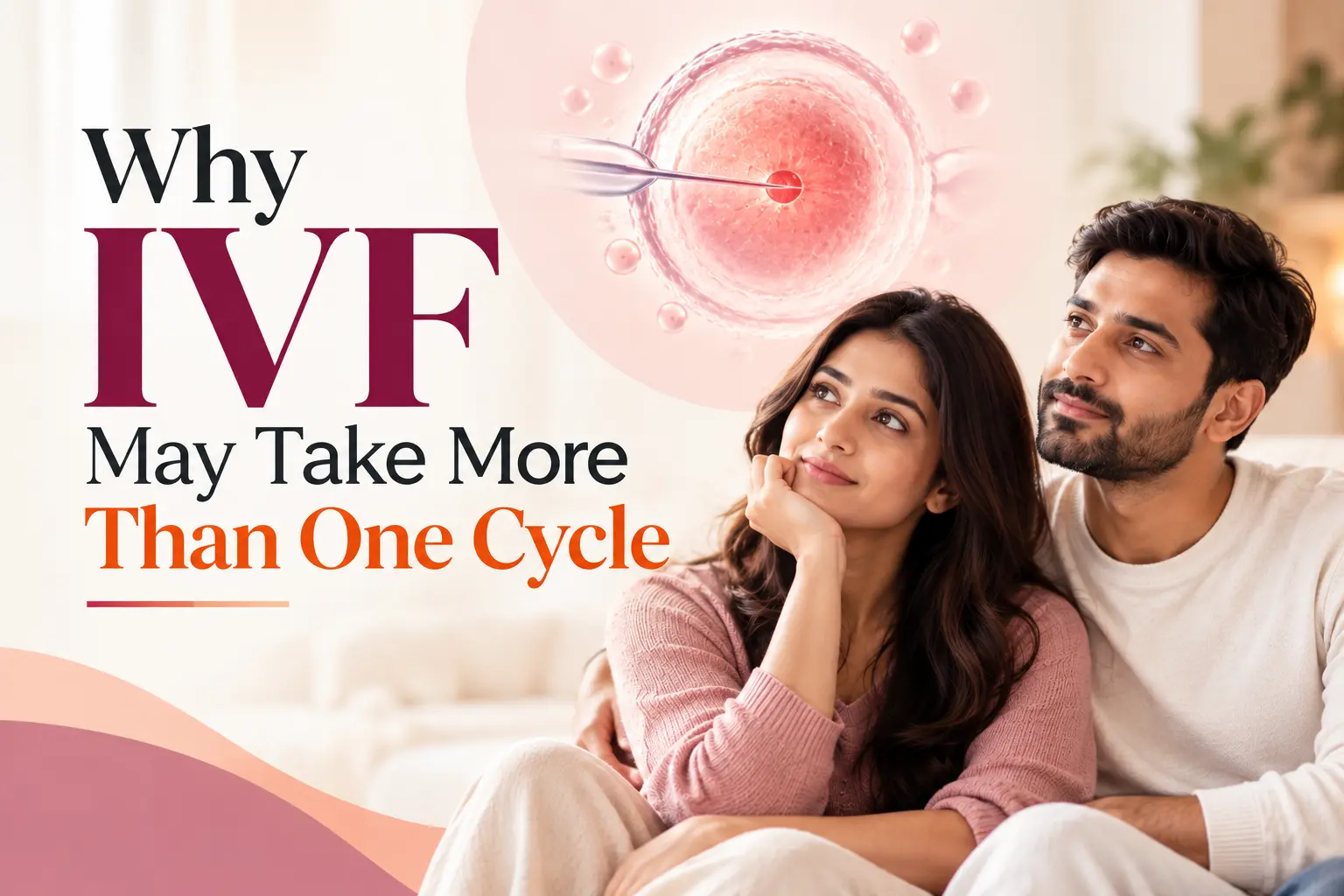
Why Do Some Couples Need More Than One IVF Cycle?


- How Many IVF Cycles May Be Needed?
- Why Do Some Couples Need More Than One IVF Cycle?
- What is the IVF First Cycle Success Rate?
- What is the IVF Second Cycle Success Rate?
- What Happens After a Failed IVF Cycle?
- Can The Chance of IVF Success Be Improved Before Another Cycle?
- One Cycle Doesn’t Define Your IVF Journey
- When IVF Takes More Than One Attempt: How Miracles Healthcare Can Help
Summary
IVF does not always result in pregnancy after the first attempt, and some couples may need more than one IVF cycle. Factors such as age, egg quality, ovarian reserve, sperm health, fertilization, embryo development, chromosomal status, uterine health, and response to ovarian stimulation can influence IVF outcomes. A failed IVF cycle does not necessarily mean that future attempts will be unsuccessful, as the results can provide valuable information for planning further treatment.
After an unsuccessful IVF cycle, a fertility specialist may review the number and quality of eggs and embryos, fertilization rates, embryo development, endometrial preparation, and other individual factors before recommending the next step. Depending on the situation, the treatment approach may remain the same or be adjusted to improve the chances of achieving a successful pregnancy in a subsequent cycle.
For many couples, IVF treatment offers an important option when pregnancy does not happen naturally. However, one IVF cycle does not always result in a successful pregnancy. Some couples may need more than one IVF cycle before achieving a viable pregnancy, while others may need to review or modify their treatment approach after an unsuccessful attempt.
An IVF cycle involves several stages, including ovarian stimulation, egg retrieval, fertilization, embryo culture, and embryo transfer. Each stage can be influenced by different biological and medical factors. Even when an embryo looks healthy and the treatment is performed correctly, implantation and pregnancy cannot be guaranteed.
"Understanding why multiple IVF cycles may be needed can help couples approach treatment with realistic expectations and understand when further evaluation may be useful," says Dr. Anviti Saraf, IVF specialist near you in Gurgaon at Miracles Healthcare
How Many IVF Cycles May Be Needed?
There is no fixed number of IVF cycles that every couple needs. Some couples conceive during their first IVF attempt, while others may require multiple cycles. The number depends on individual factors such as age, ovarian reserve, sperm quality, embryo development, previous treatment outcomes, and the reason for infertility.
A cycle that does not result in pregnancy does not necessarily mean that future IVF attempts will be unsuccessful. The first cycle can provide valuable information about how the ovaries respond to stimulation, the number of eggs retrieved, fertilization, embryo development, and the overall response to treatment.
Dr. Anviti Saraf fertility specialist explains, “IVF treatment is not the same for every couple. The response seen in one cycle can help us understand the individual fertility factors and decide whether any changes may be needed in a subsequent cycle.”
Based on the findings from the first attempt, a fertility expert may review the treatment protocol, stimulation medicines, timing, fertilisation approach, or other aspects of care before planning another cycle. The decision to proceed with another attempt is made after considering the couple’s individual circumstances and treatment history.
Why Do Some Couples Need More Than One IVF Cycle?
“Doctor, my friend got pregnant in her very first IVF cycle, so why are we being told that we may need more than one cycle?” is a question I often hear from couples during their IVF journey. It is natural to compare your experience with someone else’s, but every couple has a different fertility profile. IVF outcomes can vary because factors such as female age, egg quality, sperm factors, embryo development, and the underlying cause of infertility are different in every case.”, says Dr. Anviti Saraf
1. Age and Egg Quality
Female age is one of the important factors affecting IVF outcomes. As age increases, changes in egg quality can affect fertilization, embryo development, and chromosomal stability. This does not mean that IVF cannot work at an older age, but the number and developmental potential of available embryos may differ.
Some couples may therefore need multiple IVF cycles to obtain embryos suitable for transfer.
Age is an important factor in IVF outcomes, particularly because egg quality can change with age. For a detailed understanding, read Age-related infertility - and the possibility of success in IVF?.
2. Low Ovarian Reserve
Ovarian reserve refers to the remaining supply of eggs in the ovaries. When ovarian reserve is reduced, ovarian stimulation may result in fewer eggs being retrieved.
Fewer eggs can mean fewer opportunities for fertilization and embryo development. Not every retrieved egg will fertilize, and not every fertilized egg will develop into a blastocyst.
As a result, some patients with reduced ovarian reserve may require more than one cycle to obtain an embryo suitable for transfer.
3. Fewer Eggs Retrieved
Even when ovarian reserve is adequate, the number of eggs retrieved during a particular IVF cycle can vary. The response to ovarian stimulation depends on several factors, including ovarian reserve, age, hormone levels, ovarian response, and the stimulation protocol.
If only a small number of mature eggs are obtained, the number of embryos available later in the process may also be limited.
4. Fertilization Problems
Not every retrieved egg will fertilize successfully. Fertilization can be affected by both egg and sperm-related factors. In certain situations, ICSI may be recommended, particularly when there are specific male-factor fertility concerns or previous fertilization problems.
“Even when a good number of eggs are retrieved, not every egg will fertilize. If fertilization is lower than expected, we look at the egg and sperm factors and the response seen in the previous cycle before deciding how to approach the next attempt.”, explains Dr. Anviti Saraf
However, ICSI cannot guarantee fertilization or embryo development. If fertilization rates are lower than expected, the fertility specialist may review the previous cycle before planning another attempt.
5. Embryos May Not Develop Normally
After fertilization, embryos need to continue dividing and developing.
Some embryos may stop developing before reaching the blastocyst stage. Others may develop more slowly or show morphological characteristics associated with lower developmental potential.
Therefore, having several fertilized eggs does not necessarily mean that the couple will have several embryos available for transfer.
6. Embryo Chromosomal Abnormalities
An embryo can appear suitable based on its morphology while still carrying a chromosomal abnormality. Chromosomal abnormalities can affect embryo development and implantation and may increase the likelihood of miscarriage.
In selected cases, preimplantation genetic testing for aneuploidy (PGT-A) may be considered to provide information about the chromosome number of embryos. PGT-A is not appropriate or necessary for every IVF patient, so the decision should be individualized after discussion with a fertility specialist.
7. Embryo Implantation May Not Occur
Even when a good-quality embryo is transferred, implantation may not occur.
Successful implantation involves interaction between the embryo and the endometrium. Embryo characteristics, chromosomal status, uterine factors, and the timing of endometrial preparation can all be relevant. A single unsuccessful embryo transfer does not automatically indicate a problem with the uterus or the IVF treatment.
Dr. Anviti says, “Even a good-quality embryo may not implant successfully, as implantation depends on many factors involving both the embryo and the uterine environment.”
8. Uterine or Endometrial Factors
The condition of the uterus and endometrium is another part of the IVF process. Certain conditions, including some uterine fibroids, endometrial polyps, adenomyosis, or uterine abnormalities, may affect fertility treatment depending on their location and severity.
If implantation repeatedly fails, the fertility specialist may review the patient's medical history and determine whether additional evaluation of the uterus or endometrium is appropriate.
9. Male-Factor Infertility
Sperm quality can also influence IVF results.
A semen analysis typically assesses sperm concentration, motility, and morphology. In some cases, sperm-related factors may contribute to fertilization problems or affect embryo development. Depending on the situation, the fertility specialist may recommend ICSI or further evaluation before another IVF cycle.
10. Underlying Medical Conditions
Certain medical conditions can affect fertility or pregnancy outcomes. Conditions involving the reproductive system, thyroid, metabolic health, or other aspects of overall health may need to be evaluated and managed as part of fertility treatment.
This does not mean that every failed IVF cycle is caused by an undiagnosed medical condition. However, when treatment has not worked as expected, reviewing the patient's overall health can be an important part of planning the next step.
11. Ovarian Stimulation Response
Every patient responds differently to fertility medications. Some may produce an adequate number of mature follicles, while others may have a lower or higher-than-expected response. The fertility specialist may review hormone levels, follicular development, egg maturity, and the outcome of the previous cycle before considering another stimulation protocol.
The goal is not simply to retrieve the maximum possible number of eggs but to develop a treatment approach appropriate for the individual patient.
12. IVF Laboratory and Embryology Factors
Embryo development takes place under carefully controlled laboratory conditions.
The IVF laboratory's culture systems, embryology protocols, equipment, quality-control measures, and embryo assessment processes are important parts of the treatment environment.
Dr. Saraf says, “Embryo development is closely monitored in the IVF laboratory, and careful embryology practices and quality-control measures are important for maintaining a consistent treatment environment.”
What is the IVF First Cycle Success Rate?
IVF success rates vary by age and individual fertility factors. Cumulative live-birth rates after one IVF retrieval can be around 50% in women under 35 in some datasets, while the rate is generally lower with increasing age. These figures represent cumulative outcomes and should not be treated as an individual's guaranteed chance of success.
What is the IVF Second Cycle Success Rate?
The success rate of a second IVF cycle can be around 30%–50% per cycle, depending on factors such as age, egg quality, ovarian reserve, sperm quality, embryo quality, and the reason for infertility. The cumulative chance of success can increase with additional IVF cycles, as each cycle provides more opportunities to obtain suitable embryos.
A first unsuccessful cycle does not necessarily mean that the next attempt will fail. The previous cycle can help the fertility specialist understand ovarian response, egg retrieval, fertilisation, embryo development, and implantation before planning the next treatment.
Dr. Anviti Saraf explains, “A second IVF cycle is not simply a repeat of the first. We review how the patient responded to the previous treatment and, when needed, make appropriate changes based on those findings.”
The decision to proceed with another IVF cycle depends on the couple’s age, fertility factors, previous treatment response, and overall health.
Want to understand IVF success rates in more detail? Read our guide: IVF Success Rates: How Many Cycles Should You Expect?.
What Happens After a Failed IVF Cycle?
A failed IVF cycle should generally be reviewed rather than simply repeated without considering what happened during the previous attempt.
The fertility specialist may review:
-
Number of eggs retrieved
-
Number of mature eggs
-
Fertilization rate
-
Number and quality of embryos
-
Whether embryos reached the blastocyst stage
-
Embryo grading
-
Details of embryo transfer
-
Endometrial preparation
-
Any previous pregnancy or miscarriage history
-
Sperm-related factors
-
Response to ovarian stimulation
Based on this information, the doctor may recommend continuing with a similar approach or making specific changes.
If your IVF cycle has been unsuccessful, understanding the possible reasons can help you discuss the next steps with your fertility specialist. Read more about IVF Failure Explained: Top Reasons Your IVF Cycle May Fail.
Can The Chance of IVF Success Be Improved Before Another Cycle?
Appropriate preparation and individualized treatment may help optimize the conditions for treatment.
Depending on the patient's circumstances, preparation may include:
-
Managing existing medical conditions
-
Reviewing medications and supplements with the doctor
-
Avoiding smoking and tobacco exposure
-
Maintaining a healthy lifestyle
-
Addressing identified nutritional deficiencies
-
Evaluating sperm health where appropriate
-
Reviewing ovarian stimulation protocols
-
Assessing the uterus when clinically indicated
-
Discussing embryo culture and transfer options with the fertility team
It is important to avoid unproven treatments or supplements marketed as guaranteed ways to improve IVF success rates.
One Cycle Doesn’t Define Your IVF Journey
Needing more than one IVF cycle does not necessarily mean that the treatment has failed or that future attempts will not work. Every IVF cycle provides information about ovarian response, egg and sperm factors, fertilization, embryo development, implantation, and other aspects of treatment.
After an unsuccessful cycle, a detailed review with a fertility specialist can help identify what happened during the previous attempt and whether any part of the treatment should be continued, investigated further, or modified. The decision to undergo another IVF cycle should be based on the couple’s individual fertility factors, previous treatment response, and overall health rather than comparison with someone else’s IVF journey.
If your first IVF cycle was unsuccessful or you have been advised to consider another attempt, consult a fertility specialist near you at Miracles Healthcare for a second opinion to understand your previous cycle and discuss the most appropriate next step for your individual situation.
When IVF Takes More Than One Attempt: How Miracles Healthcare Can Help
Miracles Healthcare is an ICMR-registered hospital for fertility treatment in Gurgaon, providing fertility care since 2014. The hospital offers IVF, IUI, and ICSI, along with fertility evaluation, egg freezing, sperm freezing, embryo freezing, blastocyst culture, and other assisted reproductive services.
-
1,500+ IVF cycles: With experience across 1,500+ IVF cycles, Miracles Healthcare supports couples with different fertility concerns and treatment needs.
-
In-house ICMR-approved Embryology Lab: The dedicated laboratory at the Sector 14 centre supports key laboratory procedures involved in assisted reproductive treatment.
-
Experienced fertility and embryology team: Our team includes experienced fertility specialists, embryologists, and nursing staff, allowing patients to receive coordinated care throughout the IVF process. Treatment is planned according to individual fertility factors, previous treatment outcomes, and reproductive goals.
-
Individualised IVF treatment: Every couple may have different treatment requirements. Factors such as age, ovarian reserve, egg and sperm quality, previous IVF outcomes, and embryo development are considered when planning treatment.
-
Coordination between specialists and embryologists: The fertility specialist oversees the clinical aspects of treatment, while the embryology team manages the laboratory procedures. Their coordination helps integrate clinical and laboratory findings throughout the IVF cycle.
-
Multispeciality support: Miracles Healthcare provides access to specialists in gynaecology and obstetrics, oncology, internal medicine, surgery, orthopaedics, ENT, paediatrics, and diagnostics when fertility care needs to be considered alongside other medical conditions.
-
Multiple locations: Dedicated IVF and embryology services are available at Sector 14, while the wider Miracles Healthcare network also includes Sector 56 and Sector 82.
-
Patient-focused fertility care: Along with clinical and laboratory expertise, the fertility team helps couples understand their treatment options, the role of embryology, and what to expect at each stage of the IVF process.
Written and Verified by:

Dr. Anviti Saraf Exp: 11
MBBS, M.S. (Obstetrics & Gynaecology), FNB (Reproductive Medicne), DNB, MRCOG (UK)
Meet the Doctor
Frequently Asked Questions
A second IVF cycle is not necessarily more successful than the first. Its outcome depends on factors such as age, ovarian response, egg and sperm quality, embryo development, and changes made after reviewing the previous cycle.
Dr. Anviti Saraf suggests that the gap between IVF cycles varies depending on recovery, treatment protocol, and individual health. Your fertility specialist can advise when it is appropriate to start another cycle.
There is no specific IVF cycle that is considered the most successful for everyone. Success depends more on individual fertility factors and the treatment approach than on the cycle number.
An IVF cycle may be cancelled if there is poor ovarian response, inadequate follicle development, premature ovulation, very low egg yield, or another medical concern that makes continuing the cycle unsuitable.
Dr. Anviti Saraf explains that there is no fixed number of IVF cycles considered safe for every person. The decision depends on age, ovarian reserve, previous treatment response, overall health, and the risks associated with repeated treatment.
IVF can be unsuccessful for several reasons, including embryo chromosomal abnormalities, egg or sperm factors, implantation problems, age-related fertility changes, and uterine or endometrial factors.




Was the information useful?
0 0