


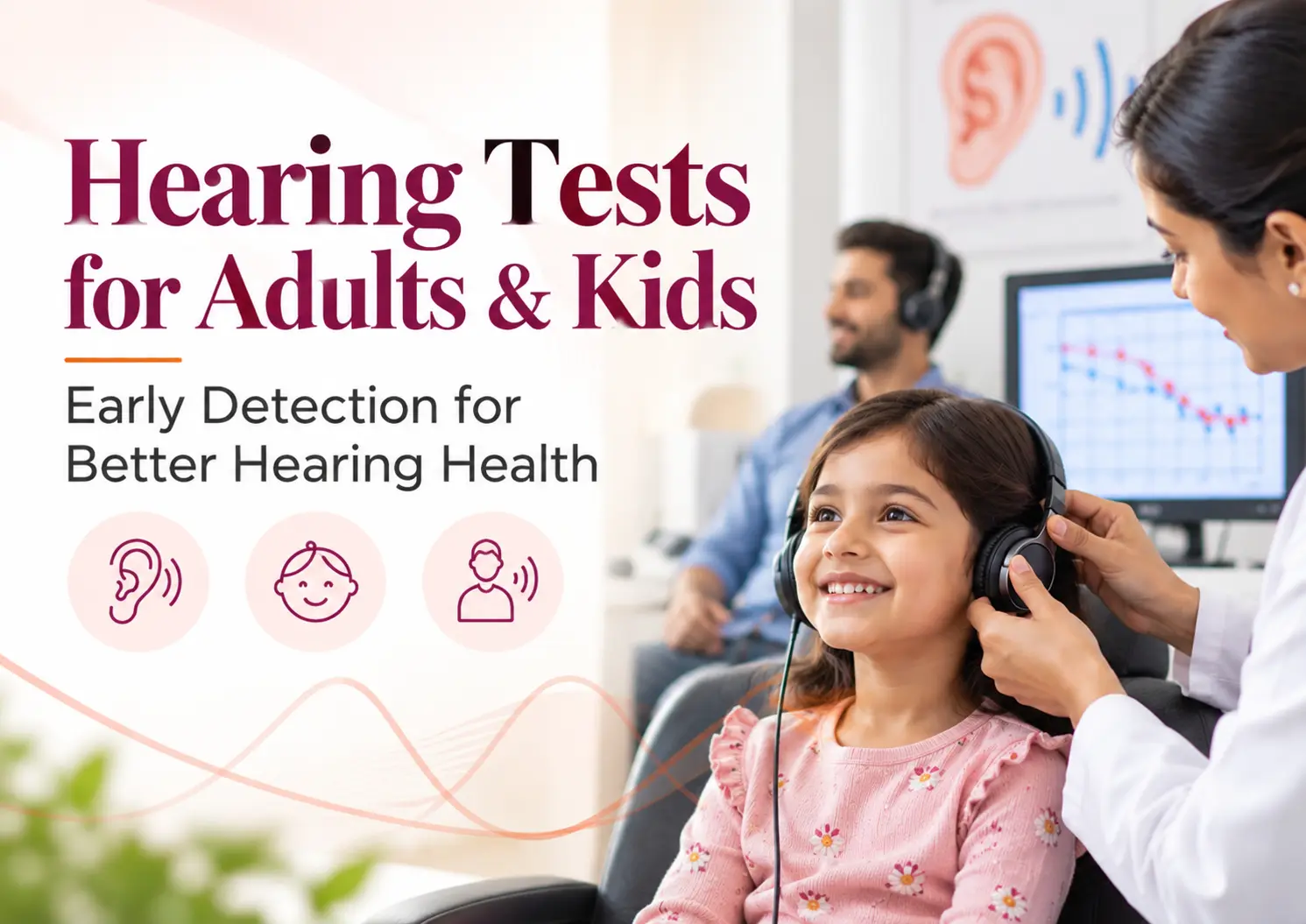
Adult and Kids Hearing Screening: Why Hearing Tests Matter at Every Age

- What is Hearing Screening?
- Why is Hearing Screening Important?
- Hearing Test by Age
- Common Types of Hearing Tests for Adults and Children
- Adult vs Kids Hearing Screening: What is Different?
- Does a Normal Hearing Test Result Mean Everything is Normal?
- What Can Cause Hearing Loss in Children?
- What Can Cause Hearing Loss in Adults?
- How Often Should Hearing Be Checked?
- How Can Parents Support Their Child's Hearing Health?
- How Can Adults Protect Their Hearing?
- When Should You See an ENT Specialist?
- Notice a Change in Hearing? Get It Checked
- Hearing Screening for Every Age at Miracles Healthcare, Gurgaon
Summary
Hearing difficulties can develop at any age and may not always be easy to notice. Hearing screening helps identify possible hearing problems early in newborns, children, and adults. For children, early assessment can support speech, language, learning, and social development. At the same time, adults may benefit from testing when they experience difficulty following conversations, frequent noise exposure, or slow changes in hearing.
The appropriate test depends on age, symptoms, and the ability to respond. Newborns may undergo OAE or ABR screening, while older children and adults may require tests such as pure-tone audiometry, speech audiometry, or tympanometry. At Miracles Healthcare, our team of experienced ENT specialists provides age-appropriate hearing evaluation for children and adults. If you have concerns about your or your child’s hearing, schedule an assessment for timely evaluation and expert guidance.
Hearing loss does not always announce itself with an obvious sign. A child may hear sounds but struggle to understand speech, while an adult may slowly increase the television volume without realizing that their hearing has changed. Because hearing difficulties can develop slowly, adult and child hearing screening plays an important role in identifying problems early.
Hearing screening is a quick way to check whether a person’s hearing is within an expected range or whether a more detailed hearing evaluation may be required. For children, screening can support speech, language, learning, and social development. For adults, it can help identify age-related hearing changes, noise-related damage, ear conditions, or other causes of hearing difficulty.
Whether you are a newborn, school-going child, working adult, or older person, timely hearing screening can make it easier to recognize hearing concerns and seek appropriate care.
What is Hearing Screening?
Dr. Priyanjana Acharyya, ENT Specialist in Gurgaon at Miracles Healthcare, explains, “Hearing screening is a simple first step that can help identify hearing concerns early and determine whether a detailed evaluation is needed. However, it does not always provide a complete diagnosis. If the screening indicates a possible problem, we may recommend further hearing tests."
Depending on the person's age and ability to respond, screening may involve:
-
Listening to different sounds or tones
-
Responding when a sound is heard
-
Checking how the ear responds to sound
-
Testing the movement of the eardrum
-
Using specialized tests for babies who cannot respond verbally
The method depends on the person's age, communication abilities, and the reason for the screening.
Why is Hearing Screening Important?
-
Supports communication: Good hearing helps children and adults communicate clearly at home, school, and work.
-
Helps children develop: Early detection of hearing problems can support speech, language, learning, and social development.
-
Identifies hidden hearing changes: Hearing loss may develop slowly without obvious signs.
-
Recognizes common warning signs: Asking people to repeat themselves, increasing device volume, watching faces closely, or avoiding noisy places may indicate hearing difficulty.
-
Encourages early action: Regular hearing screening can identify changes early and help determine whether further evaluation is needed.
Hearing Test by Age
1. Hearing Screening for Kids
Children develop communication skills rapidly during the early years, and hearing plays an important role in this process. They need to hear sounds and speech clearly to learn how language is spoken and understood.
Dr. Priyanjana says, “Children may have hearing difficulties without showing obvious signs, which is why timely hearing screening is important for their speech, language, and overall development.”
A child may have hearing difficulty from birth or develop it later because of ear infections, certain diseases, loud-noise exposure, genetic factors, or other conditions. Therefore, kids' hearing screening should not be considered necessary only when a child clearly appears unable to hear. Early screening can help identify concerns before they start to affect communication and learning.
Newborn Hearing Screening
A hearing test in a newborn is performed soon after birth to identify possible hearing loss early. Babies cannot tell parents that they cannot hear properly, so specialized screening methods are used.
Two commonly used technologies include:
-
Otoacoustic emissions (OAE): This test measures sounds produced by the inner ear in response to stimulation.
-
Automated auditory brainstem response (AABR): This assesses the auditory pathway's response to sound.
If a newborn does not pass an initial screening, it does not necessarily mean the baby has permanent hearing loss. Temporary factors, such as fluid in the ear after birth, can affect the result. Follow-up testing is important to determine whether additional evaluation is needed.
Hearing Screening in Infants and Toddlers
As children grow, their hearing can be assessed using age-appropriate techniques. An ENT specialist may observe how a child responds to sounds or use specialized equipment based on the child's age and development.
Dr. Acharyya says, “Parents should not ignore small changes in how their child responds to sounds, as early hearing assessment can help identify concerns in time.”
Parents should pay attention to changes such as:
-
Not responding to loud sounds
-
Not turning toward a familiar voice
-
Delayed babbling or speech development
-
Difficulty following simple verbal instructions
-
Frequently saying “what?”
-
Watching a speaker's face very closely
-
Increasing the volume of television or mobile devices
-
Difficulty understanding speech in noisy surroundings
These signs do not always indicate hearing loss, but they can be a reason to arrange a hearing evaluation.
Hearing Screening for School-Age Children
School-age children depend on hearing to follow classroom discussions, understand instructions, participate in activities, and interact with other children.
A child with hearing difficulty may sometimes appear inattentive or distracted when the underlying issue is actually difficulty hearing the teacher. School hearing screening can help identify children who may require further evaluation.
Parents may consider a hearing assessment if a child:
-
Struggles to follow instructions
-
Frequently asks for repetition
-
Has difficulty understanding speech from a distance
-
Finds it harder to hear in noisy environments
-
Complains of blocked ears or hearing difficulty
-
Has repeated ear infections
-
Experiences ringing or unusual sounds in the ears
-
Shows delayed speech or language development
Early identification can help families understand the possible cause and discuss appropriate care with an ENT doctor.
If you notice any of these signs in your child, consider scheduling a hearing assessment with an Ear Nose Throat specialist near you for timely evaluation and appropriate care.
2. Adult Hearing Screening
Adults may experience hearing changes for many different reasons. Age-related hearing loss is one common cause, but hearing can also be affected by prolonged exposure to loud sounds, ear infections, earwax blockage, certain medications, injuries, and other medical conditions.
Hearing screening may be particularly relevant for adults who:
-
Frequently work around loud machinery
-
Regularly attend loud concerts or events
-
Use headphones at high volume
-
Have a history of repeated ear problems
-
Notice difficulty understanding conversations
-
Frequently ask people to repeat themselves
-
Increase the television or phone volume
-
Experience ringing in the ears
-
Have difficulty hearing in restaurants or crowded places
-
Have a family history of hearing loss
-
Notice a slow change in hearing with age
People who already have symptoms may require a complete hearing evaluation rather than relying on a simple screening test.
Want to know how everyday earphone habits may affect your hearing over time? Read our blog, “Health Alert: How Long Hours of Earphone Use Can Permanently Damage Hearing” to learn more about safe listening and hearing health.
Common Types of Hearing Tests for Adults and Children
There is no single hearing test that is suitable for everyone. ENT specialists select testing methods based on age, symptoms, developmental level, and the suspected cause.
1. Pure-Tone Audiometry
The pure-tone audiometric test is one of the commonly used hearing tests for older children and adults.
The person generally wears headphones or earphones and listens to tones at different frequencies and volumes. They indicate when they hear a sound. The results can help determine the softest sounds a person can hear across different frequencies.
2. Speech Audiometry
Speech testing evaluates how well a person can hear and understand spoken words. It can provide useful information about day-to-day communication ability and may be performed along with pure-tone testing.
Dr. Priyanjana says, “Speech audiometry helps us understand how well a person can recognize and understand speech, not just hear sounds.”
3. Tympanometry
Tympanometry evaluates the function of the middle ear and eardrum. It can help identify problems such as:
-
Fluid behind the eardrum
-
Middle-ear problems
-
Abnormal eardrum movement
-
Pressure-related issues
This test can be especially useful when a child has recurrent ear infections or complains of blocked ears.
4. Otoacoustic Emissions Test
OAE testing measures sounds generated by the inner ear, particularly by the cochlea, in response to sound stimulation. It is useful for newborns and young children because it does not require them to verbally respond to sounds.
Dr. Acharyya says, “OAE testing is especially helpful in young children because it can evaluate inner-ear function without requiring them to respond verbally.
5. Auditory Brainstem Response
An auditory brainstem response (ABR) test measures electrical activity along the auditory pathway in response to sound.
It may be used when conventional behavioral hearing testing is difficult or when more detailed assessment is required.
6. Behavioral Hearing Tests for Children
Young children may not be able to follow the instructions used during standard adult hearing tests. ENT doctors can therefore use age-appropriate behavioral methods to assess how the child responds to sounds.
The goal is to get reliable information without expecting a toddler or young child to perform like an adult during testing.
Adult vs Kids Hearing Screening: What is Different?
Be it an adult or a kid, the basic purpose of hearing screening is the same. It is used to identify possible hearing difficulties. But it is important to remember that the approach differs according to age.
|
Aspect |
Kids’ Hearing Screening |
Adult Hearing Screening |
|
Main concern |
Hearing, speech, and language development |
Hearing changes and communication difficulties |
|
Testing approach |
Age-appropriate behavioural or objective tests |
Often behavioural hearing tests |
|
Common concerns |
Ear infections, congenital hearing loss, delayed speech |
Age-related or noise-related hearing loss |
|
Communication ability |
May be limited in babies and toddlers |
Usually able to respond to instructions |
|
Follow-up |
May involve paediatric audiology and ENT care |
May involve audiology and ENT evaluation |
The exact testing approach should be determined by a qualified healthcare professional.
Does a Normal Hearing Test Result Mean Everything is Normal?
Dr. Priyanjana Acharyya says, “There is a common misconception that if you pass a hearing screening, it means everything is completely normal. That is not necessarily the case. A hearing screening is a preliminary check that tells us whether hearing appears to be within the expected range at that particular time. However, it does not rule out every type of hearing problem or guarantee that hearing will remain unchanged in the future.
If a person continues to have difficulty understanding speech, frequently asks others to repeat themselves, struggles to hear in noisy surroundings, or notices other changes in hearing despite passing the screening, a detailed hearing evaluation may still be recommended.”
What Can Cause Hearing Loss in Children?
Hearing loss in children may have different causes. Some children are born with hearing loss, while others develop it later.
Potential causes include:
-
Genetic factors
-
Complications around birth
-
Certain infections
-
Recurrent middle-ear infections
-
Fluid in the middle ear
-
Exposure to very loud sounds
-
Certain medications
-
Ear or head injuries
-
Problems involving the outer, middle, or inner ear
Dr. Priyanjana expresses, “Hearing difficulties in children can have different causes, and identifying the underlying reason is important for deciding the right next step.”
Not every hearing problem is permanent. For example, temporary middle-ear fluid can affect hearing in children. Proper evaluation can help identify the underlying issue.
What Can Cause Hearing Loss in Adults?
Adult hearing loss can also have multiple causes.
Common contributors include:
-
Long-term exposure to loud noise
-
Earwax blockage
-
Repeated ear infections
-
Eardrum problems
-
Head or ear injuries
-
Certain medications
-
Genetic factors
Dr. Priyanjana Acharyya says, “Hearing changes in adults may develop gradually or appear suddenly, so paying attention to changes in hearing can help ensure timely evaluation.”
A sudden change in hearing should not be ignored. Sudden hearing loss requires prompt medical assessment, as some causes are time-sensitive.
How Often Should Hearing Be Checked?
“People often ask me during a hearing assessment, ‘How often should I get my hearing checked?’ I always tell them that it depends on their age, hearing health, risk factors, and previous test results,” says Dr. Priyanjana.
-
Newborns: Hearing screening should be done as part of recommended newborn-care protocols.
-
Children: Additional screening may be needed based on age, school requirements, symptoms, risk factors, or concerns raised by parents or teachers.
-
Adults: People with hearing difficulties, regular noise exposure, or other risk factors may benefit from periodic hearing assessments.
-
Older adults: Hearing checks may be useful when there are changes in communication, difficulty following conversations, or noticeable changes in hearing.
There is no single testing schedule that applies to everyone. The right frequency depends on individual needs, risk factors, and previous hearing results.
How Can Parents Support Their Child's Hearing Health?
Parents can take several practical steps to protect their child's hearing:
-
Keep volume levels reasonable: Avoid consistently high-volume headphones, televisions, and other devices.
-
Protect ears around loud sounds: Use appropriate hearing protection when children are exposed to loud environments.
-
Don't ignore repeated ear problems: Frequent ear infections or persistent fluid may affect hearing.
-
Watch communication milestones: Pay attention to how your child responds to sounds, voices, and speech.
-
Follow up after an abnormal screening: A failed screening requires appropriate follow-up rather than assuming that the result is temporary.
How Can Adults Protect Their Hearing?
Adults can also reduce their risk of noise-related hearing damage by:
-
Keeping headphone volume at a safe level
-
Taking breaks from prolonged headphone use
-
Wearing hearing protection around loud machinery
-
Moving away from extremely loud speakers when possible
-
Getting hearing checked when symptoms appear
-
Avoiding inserting objects into the ear canal
-
Seeking medical advice for persistent ear symptoms
Hearing protection is especially important for people whose jobs or hobbies involve frequent loud-noise exposure.
When Should You See an ENT Specialist?
Consider meeting an ENT doctor near you if you or your child experiences:
-
Persistent difficulty hearing
-
Frequent requests for repetition
-
Speech or language delay
-
Persistent ear blockage
-
Ringing in the ears
-
Hearing difficulty in noisy environments
-
Hearing loss in one ear
-
Sudden hearing changes
-
Ear pain or discharge associated with hearing problems
-
Concerns raised by a teacher or family member
For children, early evaluation can be particularly important because hearing difficulties may affect communication and learning.
Notice a Change in Hearing? Get It Checked
From children with speech or learning concerns to adults noticing difficulty following conversations, hearing changes should not be ignored. Even small changes can sometimes affect communication, learning, work, and everyday interactions.
Whether you are concerned about your child’s hearing or have noticed changes in your own hearing, timely evaluation can help you understand the cause and decide on the appropriate next step.
Hearing Screening for Every Age at Miracles Healthcare, Gurgaon
Miracles Healthcare is a NABH-accredited, trusted ENT hospital in Gurgaon. For over two decades, the hospital has been offering quality care for a wide range of Ear, Nose, and throat-related problems and hearing evaluation for children and adults since 2002.
-
Panel of experts consisting of 150+ doctors of various specializations, including experienced ENT doctors for hearing evaluation for newborns, children, adults, and older individuals.
-
Trusted by 7,00,000+ patients across multiple specialties.
-
Different hearing assessment options, including pure-tone audiometry, speech audiometry, tympanometry, OAE, ABR, and other tests when required.
-
Multi-specialty services under one roof, allowing patients to access related medical evaluation when required.
-
Multi-location presence across Gurgaon, including Sector 14, Sector 56, and Sector 82, making ENT and hearing care more accessible.
-
Evening OPD availability for patients who prefer to schedule their ENT consultation after regular working hours.
Different ways to contact specialists
-
WhatsApp: Share your symptoms and medical reports with our team for guidance and appointment assistance.
-
Online Consultation: Consult our specialist through online video consultation from the comfort of your home.
-
Hospital Consultation: Visit your nearest Miracles Healthcare facility for an in-person ENT consultation and hearing evaluation.
-
Phone Consultation: Call 906-906-8800 to get in touch with our team to book an appointment.
If you or your child is experiencing difficulty hearing, repeated ear problems, speech concerns, or noticeable changes in hearing, schedule a hearing screening near you at Miracles Healthcare. Our team of ENT doctors near you can assess your hearing and guide you on the next steps based on your individual needs.
Written and Verified by:

Frequently Asked Questions
Depending on age, screening may use pure-tone audiometry, speech testing, OAE, ABR, or other age-appropriate methods.
Dr. Priyanjana explains that Hearing screening can start at birth and continue during childhood. Adults may need screening based on age, symptoms, noise exposure, or other risk factors.
The 1-3-6 rule recommends hearing screening by 1 month, diagnosis by 3 months, and starting appropriate intervention by 6 months of age for babies with suspected hearing loss.
Common tests include pure-tone audiometry, speech audiometry, tympanometry, OAE, and ABR.
A hearing screening is a quick check to identify whether further evaluation may be needed. A hearing test is a more detailed assessment of hearing ability.
A 3-year-old may undergo age-appropriate behavioural testing, such as play audiometry, along with other tests if needed based on the child’s responses and symptoms.





Was the information useful?
0 0