


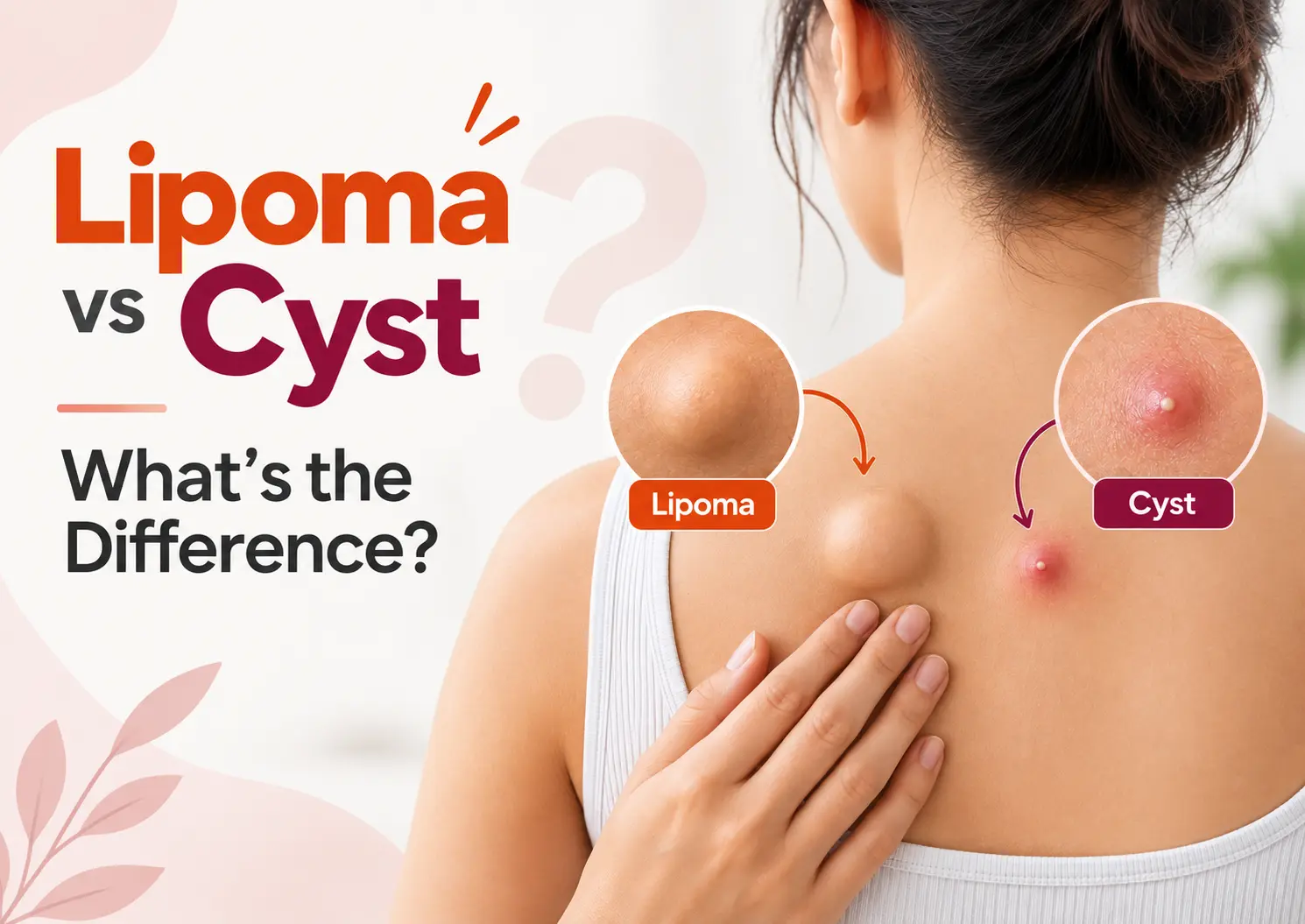
Lipoma vs Cyst: What’s the Difference?


- What is a Lipoma?
- What is a Cyst?
- Lipoma vs Cyst: Key Difference
- Can a Lipoma or Cyst Be Cancerous?
- How are Lipomas and Cysts Diagnosed?
- How is a Lipoma Treated?
- How is a Cyst Treated?
- When Should You See a Doctor?
- Concerned About a Lump Under Your Skin? Get it Checked
- Advanced Care for Lipomas & Cysts in Gurgaon
- Get Your Lump Evaluated by a Specialist
Summary
Not every lump under the skin is a cause for concern, but knowing what you’re dealing with can make all the difference. A small bump on your neck, back, shoulder, arm, thigh, or another part of the body may leave you wondering, “Is it a lipoma, a cyst, or something else?”
Lipomas and cysts are among the common causes of lumps, but they can look and feel surprisingly similar. This often makes it difficult to tell them apart without a proper medical evaluation.
So, how do you know whether a lump is a lipoma or a cyst? When should you see a doctor? And does every lump require treatment?
In this blog, we will explore the key differences between lipomas and cysts, warning signs to watch for, how doctors diagnose them, and when treatment may be needed.
What is a Lipoma?
A lipoma is a benign growth made up of mature fat cells. It develops underneath the skin and is usually slow-growing.
Lipomas can occur almost anywhere on the body where fat tissue is present. They are commonly found on the:
-
Neck
-
Shoulders
-
Back
-
Arms
-
Thighs
-
Torso
A typical lipoma feels soft, smooth, and somewhat rubbery. It may also move slightly when you press it with your fingers.
Dr. Anubhav Sangwan, Gurgaon's leading General Surgeon at Miracles Healthcare, explains, “A lipoma typically feels soft and mobile under the skin and grows slowly. However, any new or changing lump should be examined by a doctor rather than self-diagnosed.”
Most lipomas are painless and grow slowly over months or even years. Some remain very small, while others can become several centimetres in size.
Common Characteristics of a Lipoma
A lipoma may:
-
Feel soft or rubbery
-
Move slightly under the skin when pressed
-
Grow slowly
-
Be painless
-
Have normal-looking skin over it
-
Occur as a single lump or, in some people, multiple lumps
Most lipomas do not require treatment if they are small, stable, and not causing symptoms.
Dr. Anubhav adds, “Treatment is usually considered when a lipoma causes pain, discomfort, functional problems, or significant cosmetic concern. A growing or unusual lump may require further evaluation before treatment is planned.”
If you have noticed a lump or unusual change in your breast, learn more about the possible causes, symptoms, and treatment options in our detailed guide on Breast Lumps: Causes, Symptoms, Treatment & Prevention.
What is a Cyst?
A cyst is a sac-like structure that can develop in or under the skin. Depending on the type of cyst, it may contain fluid, keratin, pus, or other material.
One common type is an epidermoid cyst, which develops from cells that normally form the outer layer of the skin. These cysts are often found on the face, neck, trunk, or other parts of the body.
Unlike lipomas, cysts can sometimes become inflamed or infected.
An infected cyst may become:
-
Red
-
Warm
-
Swollen
-
Tender or painful
-
Filled with pus
Some cysts may also have a small opening or visible pore on the skin.
Common characteristics of a cyst
A cyst may:
-
Feel smooth or firm
-
Be located just beneath the skin
-
Remain stable or gradually increase in size
-
Become painful if inflamed or infected
-
Become red or warm
-
Sometimes release thick or foul-smelling material
Not every cyst becomes infected, and many cysts cause no symptoms at all.
Lipoma vs Cyst: Key Difference
Although both conditions can appear as lumps under the skin, there are several important differences.
Dr. Anubhav says, “Lipomas and cysts may look similar from the outside, but their structure, consistency, and symptoms can differ. A proper clinical examination helps determine what type of lump you are dealing with and whether any further evaluation is needed.”
|
Feature |
Lipoma |
Cyst |
|
What it is |
Growth of fat cells |
Sac containing fluid, keratin, pus, or other material |
|
Feel |
Usually soft or rubbery |
Can feel smooth, firm, or fluctuant |
|
Movement |
Often moves slightly under the skin |
May feel more fixed to the surrounding skin |
|
Growth |
Usually slow |
Can remain stable or grow |
|
Pain |
Usually painless |
Usually painless unless inflamed or infected |
|
Skin changes |
Usually normal skin |
May become red or swollen if inflamed |
|
Infection |
Not typical |
Can become infected |
|
Discharge |
Usually no discharge |
May release material if it opens |
|
Treatment |
Often observation; removal if needed |
Observation, drainage, or removal depending on the cyst |
Can a Lipoma or Cyst Be Cancerous?
This is one of the most common concerns when someone discovers a lump. Most lipomas and common skin cysts are benign. However, not every lump under the skin is necessarily a lipoma or cyst. This is why you should not try to diagnose a new lump solely based on its appearance or how it feels.
A doctor may recommend further evaluation if a lump:
-
Is growing rapidly
-
Is unusually large
-
Is painful without an obvious reason
-
Feels very hard
-
Appears fixed or does not move
-
Is located deep beneath the tissue
-
Causes changes in the surrounding skin
-
Keeps returning after treatment
-
Is associated with unexplained symptoms
A rare cancerous tumour involving fat tissue is called a liposarcoma. It is different from an ordinary lipoma. Fast growth, deep location, firmness, or other unusual features may prompt a doctor to investigate a lump further.
Dr. Anubhav Sangwan explains, “Most lipomas and cysts are benign, but a rapidly growing, hard, fixed, or unusual lump should always be evaluated by a specialist.”
Remember: a concerning lump does not automatically mean cancer, but it should be properly evaluated
How are Lipomas and Cysts Diagnosed?
Diagnosing a lipoma or cyst usually begins with a physical examination. Your doctor will assess the lump and look for features that can help determine its likely cause.
During the examination, the doctor may check:
-
Size and location of the lump
-
Whether it feels soft or firm
-
Whether it moves under the skin
-
Whether it is painful or tender
-
Changes in the skin over the lump
-
Signs of inflammation or infection
-
How quickly the lump has changed
Dr. Anubhav explains, “A careful clinical examination is often the first step in evaluating a lump. If its features are unusual or the diagnosis is unclear, imaging or other tests may be recommended.”
-
Ultrasound: An ultrasound can help assess the lump’s location, size, and internal characteristics and may help distinguish a cyst from a fatty or other soft-tissue mass.
-
MRI: An MRI may be recommended for larger, deeper, or unusual lumps that require a more detailed assessment of the surrounding soft tissues.
-
Biopsy: If the diagnosis remains uncertain or the lump has concerning features, a biopsy may be advised. A tissue sample is examined under a microscope to help determine the nature of the lump.
The choice of diagnostic test depends on the type, size, location, and characteristics of the lump and the doctor’s clinical assessment.
How is a Lipoma Treated?
Most lipomas do not require treatment if they are small, stable, painless, and not causing any problems. A doctor may recommend treatment if the lipoma:
-
Causes pain or discomfort
-
Is growing or changing
-
Interferes with movement
-
Puts pressure on nearby structures
-
Causes cosmetic concerns
-
Has unusual or uncertain characteristics
Surgical Removal
When treatment is needed, surgical excision is the most common approach. The surgeon removes the lipoma through a procedure planned according to its size and location. If clinically required, the removed tissue may be sent for laboratory examination to confirm the diagnosis.
According to Dr. Anubhav, “Most lipomas can simply be monitored, but removal may be considered when a lipoma causes symptoms, grows, or has features that require further evaluation.”
How is a Cyst Treated?
Treatment for a cyst depends on its type, size, symptoms, and whether it is inflamed or infected. A small cyst that is not causing problems may sometimes be observed without immediate treatment. If it becomes inflamed or infected, the initial treatment may focus on controlling the inflammation or infection.
-
Drainage: In some cases, the contents of a cyst may be drained to relieve pain, pressure, or swelling. However, drainage alone may not remove the entire cyst wall, so the cyst can recur.
-
Complete Removal: If a cyst is recurrent, painful, bothersome, or suitable for removal, a doctor may recommend complete surgical excision. Removing the cyst along with its wall can help reduce the risk of recurrence.
Dr. Anubhav adds, “A cyst should not be squeezed or punctured at home. Proper evaluation helps determine whether observation, drainage, or complete removal is the most appropriate treatment.”
Do not attempt to squeeze, puncture, or pop a cyst yourself, as this can increase the risk of infection, inflammation, scarring, and other complications.
When Should You See a Doctor?
Most lipomas and cysts are benign, but a new or changing lump should be evaluated rather than self-diagnosed. Whether it is a lipoma or cyst, consult a general surgeon near you if you notice:
-
The lump is growing rapidly
-
It becomes painful or tender
-
There is redness, warmth, or swelling
-
The lump feels unusually hard or fixed
-
There is pus or other discharge
-
The lump is deep or unusually large
-
The skin over the lump changes
-
A cyst keeps becoming inflamed or infected
-
A lump returns after treatment or removal
-
You develop other unexplained symptoms
Do not wait for a lump to become painful before getting it checked. A doctor can examine the lump and recommend further tests if needed.
Concerned About a Lump Under Your Skin? Get it Checked
A lipoma and cyst may look similar, but the right diagnosis helps determine the appropriate care. Most are benign, but a lump that is growing, painful, hard, fixed, or changing should be evaluated by a doctor.
If you have a new or changing lump, book a consultation with a general surgeon near you at Miracles Healthcare for expert evaluation and personalized care.
Advanced Care for Lipomas & Cysts in Gurgaon
If you have noticed a new, growing, painful, or unusual lump under your skin, timely evaluation can help determine whether it is a lipoma, cyst, or another condition. At Miracles Healthcare, experienced general surgeons assess lumps and soft-tissue concerns and recommend appropriate treatment based on the diagnosis.
-
As an NABH-accredited general surgery hospital in Gurgaon, Miracles Healthcare has been providing quality care since 2002. Our experienced surgical team offers comprehensive evaluation and treatment for lipomas, cysts, and other soft-tissue conditions, with access to advanced diagnostic facilities when further assessment is required.
-
Patients with other health conditions can also benefit from access to specialists across multiple medical disciplines when required.
-
Backed by a legacy of 26,000+ surgeries with a near-zero infection rate, the hospital combines extensive surgical experience with a strong focus on patient safety and quality care.
-
To make expert care more accessible, Currently serves patients through multiple centres across Gurgaon in Sector 14, Sector 56, and Sector 82, making it easier for individuals and their families to receive trusted healthcare closer to where they live.
Get Your Lump Evaluated by a Specialist
Don't try to identify a lump based on its appearance or feel alone. If you have noticed a lump that is growing, painful, hard, fixed, or changing, consult a specialist for proper evaluation.
Book a consultation with a General Surgery Specialist at Miracles Healthcare, Gurgaon, for expert assessment and an appropriate treatment plan.
Written and Verified by:

Dr. Anubhav Sangwan Exp: 10+
MBBS, MS(Surgery), FIAGES
Frequently Asked Questions
A lipoma is usually soft, movable, and slow-growing, while a cyst may feel firm and can become red, swollen, or painful. A doctor’s examination is the best way to confirm the diagnosis.
A typical lipoma is benign and does not usually turn into cancer. However, a rapidly growing or unusual lump should be evaluated to rule out other conditions.
Dr. Anubhav explains, “Lipomas are usually removed through surgical excision, while cysts may be drained or completely removed depending on their type, size, and symptoms.”
Lipomas generally do not disappear on their own. Some cysts may remain stable or occasionally resolve, but persistent or recurrent cysts may require treatment.
Cyst removal is often a minor procedure, depending on the cyst’s size, location, and complexity. Your doctor can recommend the safest approach after evaluation.






Was the information useful?
0 0